Which Countries Are Most Impacted By Rising Food Prices?

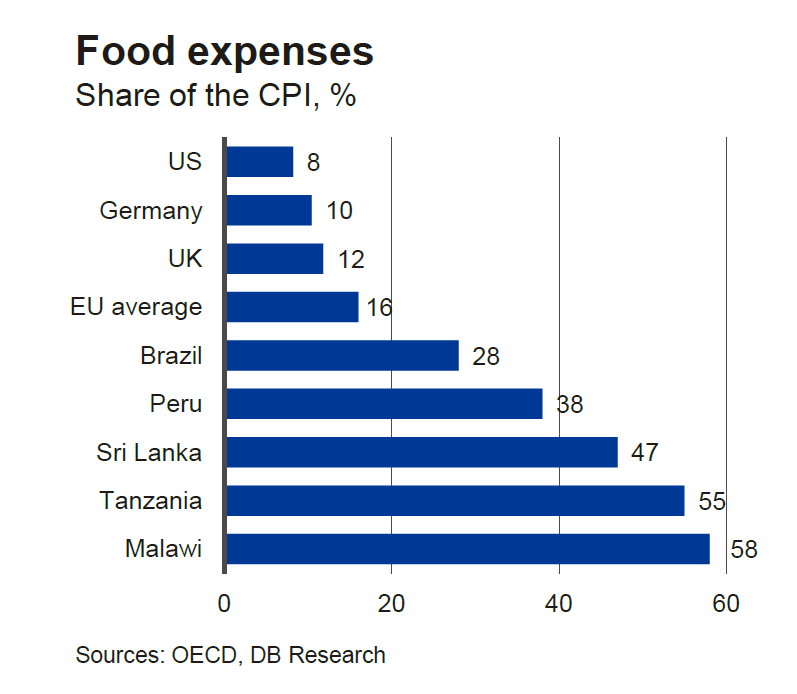
Rising food prices heavily affects low-income countries than developed markets. The following chart shows the food expenses share of the Consumer Price Index (CPI) for a few countries:

Click to enlarge
food-expenses-cpi.png

Source: Rising food prices – Short-term drivers, trends, implications, Deutsche Bank Research

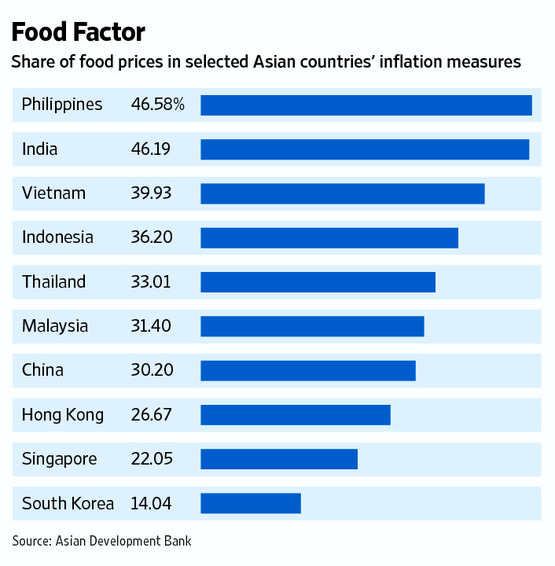
From an article titled Asia Price Rises Imperil Growth in The Wall Street Journal:

Unchecked increases in oil and food prices could shave growth across Asia over the next two years, according to a report by the Asian Development Bank, imperiling economic gains among the poor in the globe’s fastest expanding region.
food-prices-cpi.jpg

The ADB report warned Tuesday that if fuel and food prices continue to rise at their current pace, inflation could shave between 0.4 and 1.5 percentage points off gross domestic product in each of Asia’s largest developing economies this year and next, including in China and India. Barring such price rises, the intergovernmental bank expects growth in the region overall to be 7.8% this year. Inflation has become the dominant economic challenge in the region, prompting widespread monetary tightening and other measures, such as price caps, fuel subsidies and tariff reductions. Several countries, including China, Indonesia and South Korea have allowed their currencies to strengthen recently, making imported goods, especially commodities, more affordable.

Inflation continues to accelerate despite these measures. This week, Vietnam announced its April inflation rate hit 17.5% compared with a year earlier, the fastest rate in over two years, as increased supplies and attempts by the government to cool lending failed to halt the rise in food and fuel prices.

Food prices, which account for 40% of Vietnam’s inflation measure, rose 4.5% in April alone.

The takeaway for investors is that governments in emerging markets will try to rein in on inflation by raising interest rates which will adversely affect equity markets
11 Canadian Non-Financial Dividend Aristocrats To Consider

I have written about investment opportunities in Canada many times before.Many others have written on the same topic as well. More recently Seeking Alpha published an excellent piece by Joseph L. Shaefer of Stanford Wealth Management, LLC.

In this post let me list some of the top dividend stocks of Canada. These stocks are part of the S&P/TSX Canadian Dividend Aristocrats Index. Components of the index must satisfy the following criteria:

1.The company’s security is a common stock or income trust listed  on the Toronto Stock Exchange and a constituent of the S&P Canada  Broad Market Index (BMI).
2.The security has increased ordinary cash dividends every year for at least five consecutive years.
3.The float-adjusted market capitalization of the security, at the time of the review, must be at least C$ 300 million.

Some of the Canadian dividend aristocrats trading on the organized U.S. exchanges are listed below with their current dividend yields:

1.Company: TransCanada Corp (TRP)
Current Dividend Yield: 4.06%
Sector:Natural Gas Utilities

2.Company: TELUS Corp (TU)
Current Dividend Yield: 4.33%
Sector: Telecom

3.Company: Shaw Communications Inc (SJR)
Current Dividend Yield: 4.59%
Sector:Broadcasting & Cable TV

4.Company: Enbridge Inc (ENB)
Current Dividend Yield: 3.08%
Sector: Oil Well Services & Equipment

5.Company: Thomson Reuters Corp (TRI)
Current Dividend Yield: 3.09%
Sector:Printing & Publishing

6.Company: Canadian National Railway Co (CNI)
Current Dividend Yield: 1.78%
Sector: Railroads

7.Company: Tim Hortons Inc (THI)
Current Dividend Yield: 1.44
Sector:Restaurants

8.Company: Canadian Pacific Railway Ltd (CP)
Current Dividend Yield: 1.67%
Sector: Railroads

9.Company: Talisman Energy Inc (TLM)
Current Dividend Yield: 1.04%
Sector:Oil & Gas Operations

10.Company: Cameco Corp(CCJ)
Current Dividend Yield:1.39%
Sector:Metal Mining

11.Company: Canadian Natural Resources Ltd (CNQ)
Current Dividend Yield: 0.80%
Sector:Oil & Gas Operations

Note: Yields noted are as of April 28, 2011

Disclosure: Long CNI

The Five Best and Worst Performing Foreign Bank Stocks YTD

The five best performing foreign bank stocks trading as sponsored ADRs in the organized exchanges and OTC markets are listed below together with their current dividend yields:

1.Bank: Swedbank (SWDBY)
YTD Change: 37.98%
Current Dividend Yield: 1.73%
Country: Sweden

2.Bank: ING Grope (ING)
YTD Change: 33.81%
Current Dividend Yield: N/A
Country: The Netherlands

3.Bank:Banco Bilbao Vizcaya Argentaria, S.A. (BBVA)
YTD Change: 24.48%
Current Dividend Yield: 6.76%
Country:Spain

4.Bank:Intesa Sanpaolo SpA (ISNPY)
YTD Change: 22.69%
Current Dividend Yield: 3.35%
Country: Italy

5.Bank:BNP Paribas (BNPQY)
YTD Change: 21.78%
Current Dividend Yield: 2.36%
Country: France

The five worst performing foreign bank stocks are:

1.Bank: Banco Macro S.A. (BMA)
YTD Change: -27.09%
Current Dividend Yield: 2.43%
Country: Argentina

2.Bank: Creditcop (BAP)
YTD Change: -25.54%
Current Dividend Yield: 2.20%
Country: Peru

3.Bank: Commerzbank AG (CRZBY)
YTD Change: -14.40%
Current Dividend Yield: N/A
Country: Germany

4.Bank:Banco Santander (Brasil) S.A. (BSBR)
YTD Change: -11.40%
Current Dividend Yield: 3.34%
Country: Brazil

5.Bank:BBVA Banco Frances S.A. (BFR)
YTD Change: -11.38%
Current Dividend Yield: 10.81%
Country: Argentina

Note: Data noted above are as of market close April 27, 2011

Disclosure: Long ING, BMA, CRZBY, BBVA, SWDBY

Who Pays More Taxes in the U.S.- Corporations or Individuals?

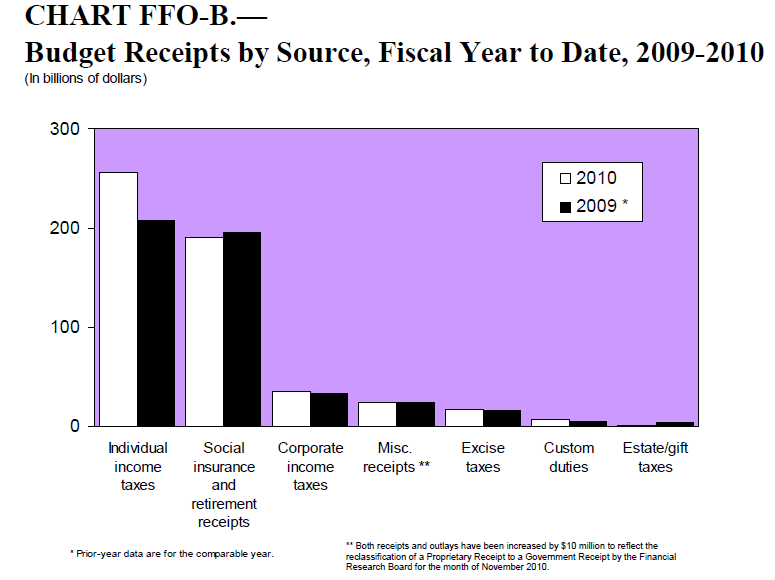
The chart below answers the question in the title of this post:

us-corporate-personal-taxes.png

Source: Treasury Bulletin March 2011. U.S. Department of the Treasury

From the report:

Individual income tax receipts, net of refunds, were $256.0 billion for the first quarter of fiscal year 2011. This is an increase of $48.3 billion over the comparable prior year quarter.

Net corporate income tax receipts were $35.9 billion for the first quarter of fiscal year 2011. This is an increase of $2.0 billion compared to the prior year first quarter.

Over the past few decades corporations have paid lower and lower taxes each year while individual income taxes have accounted for a larger portion of the Federal receipts.

Investing in Emerging Markets is a Must

Emerging markets have not performed well in recent months compared to many developed markets. Investors are concerned about investing in emerging markets due to inflation, political risks and other factors. However according to a report by Josephine Shea of Hartford Investment Management the best days of emerging markets(EM) are in fact ahead of us. He offers the following reasons on why investing in emerging markets is a must:

  • The future growth of U.S. multinationals is in emerging markets and not in the domestic market.
  • Global GDP is expected to grow 4.4% this year with roughly two-thirds driven by EM.
  • According to the IMF, the growth rate for China and U.S. are estimated to be 4.4% and 11.7% per year for 2011-2015.
  • Emerging and developing economies already produce 36.5% of global GDP.In ten years that could be 50% and by 2030, as high as 60%.
  • Foreign Direct Investment (FDI) flows into emerging markets have rebounded since the financial crisis according to a United Nations Conference on Trade and Development (UNCTAD).
  • In just five years, the market capitalization of the Hang Seng Index grew 48%, the Bombay 200 Index 55%, the Shanghai Composite Index 123%, the Brazil Bovespa Index 77% and lastly Russia’s RTS Index 38%, while the market capitalization of the S&P 500 Index has gone up only 2.5%.
  • Large EM corporates have stronger credit rating than their U.S. peers.

Source: Emerging Markets No Longer a Choice; A Must – Hartford Investment Management

Some of the large-cap emerging market giants are Petrochina Co Ltd of China (PTR), Vale SA (VALE) of Brazil, HDFC Bank Ltd (HDB) of India and Gazprom OAO (OGZPY) of Russia. While investing in EM companies directly is one way to profit from their growth another option is to simply invest in U.S. and European multinationals who have a strong presence in developing countries. Examples of such western multinationals include Nestle (NSRGY), Caterpillar Inc(CAT), Unilever (UN, UL), Coca Cola (KO), etc. A list of the top 25 U.S. and European multinationals with high exposure to emerging markets can be found here and here.

Disclosure: No positions