Should Investors Replace Bonds With Dividend-Paying Stocks?

When bond yields are lower than dividend yields of stocks some investors may be tempted to replace their fixed-income bonds with high-yielding dividend-paying stocks. But this is not a prudent strategy for the reasons discussed below.

The current yields on the 5-year, 10-year and 30-year U.S. Treasury bonds are 0.63%, 1.64% and 2.81%. respectively. Many stocks have higher dividend yields than these bond yields. Similarly yields on corporate bonds have declined with stocks having higher dividend yields than bonds. Here is a chart showing this phenomenon from an article in The Wall Street Journal last week:

Click to enlarge

Source:  Danger Lurks Inside the Bond Boom, The Wall Street Journal

Despite the higher yields of dividend-paying stocks it is not a good idea to replace bonds with dividend stocks.

The following chart shows the cumulative performance of dividend-paying stocks against broadly classified fixed income:

Source: Total-return investing: An enduring solution for low yields, Vanguard

The above chart shows that dividend stocks do not perform like bonds but rather like non-dividend paying stocks. Or to put it another way, dividend-paying stocks are still stocks and they perform like stocks. In addition, just like stocks they also carry high risks of volatility and the potential for significant loss.

Investors buy bonds for income and diversification. Dividend stocks clearly failed to provide diversification benefits in the period shown since they performed like other stocks and were volatile as well.

Generally the reasons for investing in bonds and stocks vary widely.For example, at a high level bonds offer safety of principal, periodic interest payments and return of principal at maturity. This is true for high-quality bonds although there are exceptions to the rule since corporate  bonds are also not risk-free investments as any company can fail. Investments in stocks have higher risks relative to bonds with the potential for price appreciation and earning dividends. However the  probability of substantial or even a total loss is high as well. Stocks and bonds also perform differently under various market conditions. In the event of a company going bankrupt, share holders have the lowest priority on claims relative to bond holders. As stocks and bonds have different characteristics and each has its pros and cons, investors are better off to keep their bond and stock investments separate. Income-focused investors should never replace all or some of their bonds for dividend-paying stocks.

In order to test the theory confirmed by the Vanguard study above, I reviewed the performance of a select few dividend-paying S&P 500 stocks during the global financial crisis, the performance of dividend ETFs against the S&P 500 and the performance of a bond ETF against a dividend ETF.

The following table shows the performance of ten randomly-selected stocks in each of the sectors in the S&P 500 index:

S.No.CompanySectorTickerMarch 2009 lowPre-Crisis PeakChange from Peak to trough
1Chevron CorpEnergyCVX$56.12$104.63-46%
2AlcoaMaterialsAA$4.97$44.77-89%
33M CoIndustrialsMMM$40.87$97.00-58%
4Carnival CorpConsumer DiscretionaryCCL$16.80$52.10-68%
5Procter & GambleConsumer StaplesPG$43.93$75.18-42%
6Johnson & JohnsonHealthcareJNJ$46.25$72.76-36%
7M&T BancorpFinancialsMTB$29.11$108.53-73%
8Intl Business Machines CorpInfo TechnologyIBM$83.02$130.93-37%
9AT&T IncTelecom ServicesT$21.44$42.79-50%
10CenterPoint EnergyUtilitiesCNP$8.66$18.63-54%


The S&P 500 fell over 50% back in 2008-2009. The above table shows that dividend stocks did not stay strong but rather followed the S&P 500 to the abyss with double digit losses. So dividend-stocks are not bonds and they will perform like stocks. An investor in high-quality corporate bonds or treasury bonds enjoyed stability during the crisis unlike holders of dividend-paying stocks who had to endure stomach-churning volatility and even suspension or reduction in dividend payments.

The chart below shows the 5-year performance of S&P 500 and four dividend ETFs:

The dividend ETFs also followed the course of the S&P 500 for the most part.

The 5-year performance of a corporate bond ETF vs. a dividend ETF:

The iShares corporate bond ETF(LQD) offered the much-needed stability during the financial crisis and recovered quickly compared to the dividend ETF.

In summary, regardless of market conditions and yield differences investors should not replace their bonds with dividend-paying stocks. It is always advisable to have a disciplined and defined allocation for equities and fixed income in a portfolio.

Related ETFs:

iShares iBoxx $ Investment Grade Corporate Bond Fund (LQD)
Vanguard Dividend Appreciation ETF (VIG)
SPDR S&P Dividend ETF (SDY)
iShares Dow Jones U.S. Select Dividend ETF (DVY)
PowerShares Dividend Achievers ETF (PFM)

Disclosure: No Positions

Welcome to The Asian Century

The 20th century is widely called as the “American Century” in honor of the role the U.S. played in world politics. The Wikipedia definition of the term:

American Century[1][2] is a characterization of the 20th century as being largely dominated by the United States in political, economic and cultural terms. The United States’ influence grew throughout the 20th century, but became especially dominant after the end of World War II, when only two superpowers remained, the United States and the Soviet Union. After the dissolution of the Soviet Union in 1991, the United States remained the world’s only superpower,[3] and became the hegemon, or what some have termed a hyperpower.[4]

According to a white paper by the Australian Government, the 21st century is the Asian Century. From the report:

Within only a few years, Asia will not only be the world’s largest producer of goods and services, it will also be the world’s largest consumer of them. It is already the most populous region in the world. In the future, it will also be home to the majority of the world’s middle class.

In this post let us review a few charts from this report.

1) Asia’s Share of World Output

Click to enlarge


In the last 20 years, one-third of Asia’s population has re-engaged the world. Standard of living for billions of people has improved. According to one study, between 2000 and 2006, one million people were lifted out of poverty every week in East Asia alone. It took the UK over 50 years to double its income per person during the industrial revolution. In contrast, China and India recently doubled their income per person within a decade.

2) Growth of Manufacturing Industry in Asia

Asia is the manufacturing engine for the world. Initially Japan led Asia in manufacturing. Then production when costs rose, low-cost manufacturing moved to Singapore, Taiwan, Hong Kong and South Korea and the highly skilled production remained in Japan. Later as production costs rose in those countries, businesses moved their production facilities to ASEAN countries and then to China. Today China has become the factory floor for the world not only in producing cheap low-cost goods but also high-cost electronic products. Other Asian countries such as India are also catching up with manufacturing but at a slower pace than China.

3) Asia’s Share of World Output Projection

By 2025, four of the 10 largest economies will be in Asia – China, India, Indonesia and Japan. Asia is projected to account for half of the world’s output with China alone accounting for half of that.

4) Asia’s GDP per capita Projection

The world total population is 7.0 billion and the U.S. population is 314.0 million. Asia has more than half of the world’s population at about 3.8 billion. As the income per person grows in Asian countries the middle class population is bound to expand further.

Source: Australia in the Asian Century, Australian Government

Related ETFs:

  •  iShares MSCI Pacific ex-Japan Index Fund (EPP)
  • iShares S&P Asia 50 Index Fund (AIA)
  • SPDR S&P Emerging Asia Pacific ETF (GMF)
  • iShares MSCI All Country Asia ex Japan Index Fund (AAXJ)

Disclosure: No Positions

Invest in Latin America For Superior Returns

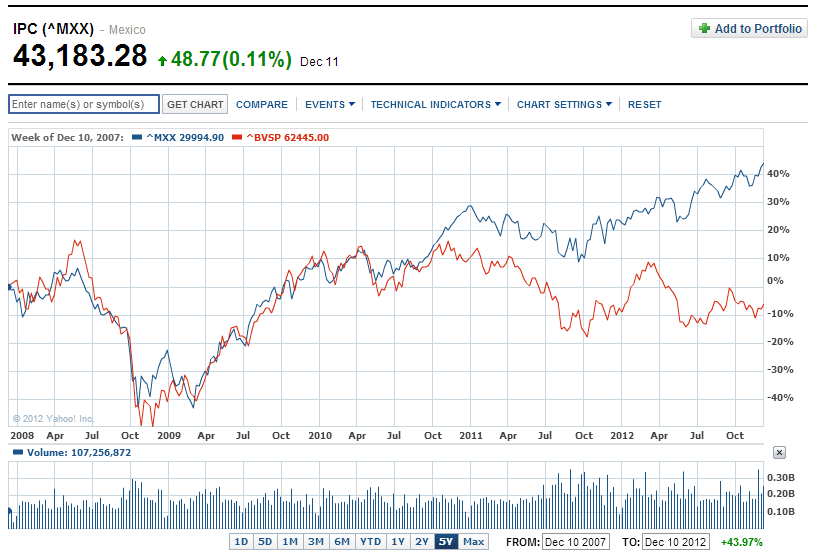
The S&P 500 is up 12.8% year-to-date(YTD). Compared to the performance of the US equity market, Latin America markets have been mixed so far this year. For example, Brazil’s Bovespa is up 3.1%, Chile’s Santiago IPSA is off 14.5% and Mexico’s IPC All-Share is up 15.4%.

Traditionally the U.S. has long considered Latin America as its own “backyard”. For more than a decade most of the Latin American nations have aligned themselves politically with the U.S. The U.S. intervened and installed friendly regimes in some countries when they tried to resist free-market principles.

From a recent article in The Wall Street Journal:

Latin America is becoming a tale of two economies, with nations like Peru, Colombia, Mexico and Chile growing faster than the global average and nations like Argentina and Brazil struggling with crippling slowdowns.

Brazil, for much of the past decade a growth powerhouse in the region, reported on Friday that its economy grew at an annual clip of just 2.4% in the third quarter from the previous quarter, far less than expected and dashing hopes of a bounce-back fueled by hefty interest-rate cuts and tax breaks.

The result suggests Brazil’s growth for the full year is likely to be 1%, according to São Paulo-based Tendencias consulting group—a far cry from the government’s expectations of 4.5% this year.

Overall, resource-rich Latin America has done very well in the past decade, mostly thanks to China’s ravenous appetite for raw materials to fuel its rise, which drove up prices for everything from oil to soybeans.

But the global slowdown of the past two years has created a divide in the region between countries that pushed a more aggressive free-market agenda and kept a tighter grip on the public purse and those that used the swell in coffers from rising commodity prices to embrace a bigger role for government in the economy.

U.S. investors should consider investing in Latin American stocks to generate better returns.

We all know the ubiquitous disclaimers found on fund documents that state “Past Performance is not an Indicator of Future Results”. While this is true, past performance is still an important measure and an indicator of future results at the country level since countries that performed well in the past generally perform well in the future and vice versa. Countries do not change dramatically overnight except in very rare circumstances such as the changes experienced by East European nations following the fall of the Berlin Wall. Myanmar is another example when it went from a military dictatorship  with a closed economy to a democracy with a free-market economy almost overnight recently.

Though the U.S. is performing better this year relative to Latin American countries, in the long-run the performance of US stocks have lagged. The MSCI returns in US dollar terms for the U.S. and the five Latin American emerging economies is shown below:

Click to enlarge

Source: MSCI

Mexico had higher returns than the U.S. in all the periods shown. Colombia was the best performer easily beating the U.S by a wide margin especially in the 10-year period. The slowdown in commodity markets has hurt Brazil’s returns in the 1-year, 3-year and 5-year returns.

From a dividend yield perspective, the S&P 500’s dividend yield is currently at 2.6%. It has stayed at this level for many years now despite strong growth in corporate profits. Brazil,Chile, Colombia, Mexico and Peru on the other hand have yields of 3.8%, 3.1%, 2.4%,  1.9% and 5.1% respectively according to Financial Times market data.

Hence U.S. investors looking to diversify internationally can add equities from Latin American countries discussed above especially those from Brazil, Peru, Colombia, Mexico and Chile.

Related ETFs:

iShares MSCI Brazil Index (EWZ)

iShares MSCI All Peru Capped Index Fund (EPU)

iShares MSCI Chile Index Fund (ECH)

Global X FTSE Colombia 20 ETF (GXG)

iShares MSCI Mexico Investable Market Index (EWW)

SPDR S&P 500 ETF (SPY)

Disclosure: No Positions

Knowledge is Power: Tesco’s Exit, Onions, Humanity Edition

‘Limits to Growth’ Author Dennis Meadows’ –  Humanity Is Still on the Way to Destroying Itself’ (Der Spiegel)

2012 Top 250 Global Energy Company Rankings (Platts)

Knowing your onions in New York (The Hindu)

Top Russian companies (RT)

ALEX BRUMMER: Tesco’s foolish retreat from the US marketplace (This is Money)

Why Argentina is now paying for its dangerously successful economic story (The Guardian)

Scotia’s international bank a shelter in hard times (Financial Post)

This is like Shenzen in 1979 (MoneyWeek)

Investing internationally? Look beyond a country’s growth (The Globe and Mail)

Coombs: The only way is up in 2013 (Trustnet)

Click to enlarge

The National Library of Belarus, Minsk

Photo Credit: English Russia

Infographic: Who Spends the Most at McDonald’s?

I came across this interesting graphic about U.S. fast-food giant McDonald’s:

Click to enlarge


Source: McDonald’s: Dominant the World Over, Yet No Two Markets Alike,  EuroMonitor International

Related ETFs:

SPDR Consumer Discretionary ETF (XLY)

SPDR Dow Jones Industrial Average (DIA)

Vanguard Dividend Appreciation ETF (VIG)

Disclosure: No Positions