Stock Buybacks Continue to Soar

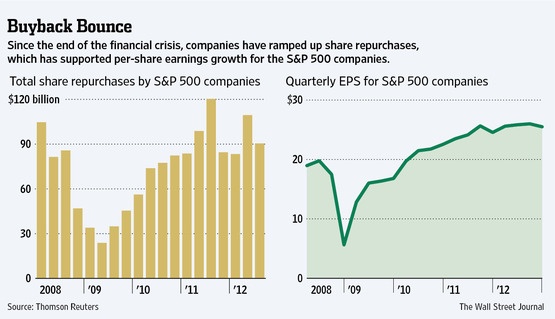
Many U.S. companies are increasing share buybacks to goose up earnings. Buybacks of own shares is the preferred method for some companies to put unused cash to work. While theoretically  buying back shares should reduce the number of outstanding shares and increase earnings per share it is not happening in the real world, according to an article the Journal. This is because, according to the article, companies issues new shares to employees thereby increasing the share count and effectively canceling the benefit of share buybacks. Buybacks is the worst form of strategy any company can follow. Some of the reasons for this conclusion include:

  • Share buybacks is unproductive use of cash
  • Buybacks are mainly financial engineering to raise share prices
  • Companies tend to buy their shares when prices are high or at peaks
  • Unlike paying back earnings to investors in the form of dividends, buybacks is not beneficial to outside shareholders. However it benefits insiders to manipulate stock prices to cash in on their options.
  • Buying back own stock does not require any intelligent corporate strategy and gives an “easy way” out for overpaid executives to waste shareholders’ equity.
  • Buyback is a short-term strategy that hurts long-term investors more and rewards insiders and traders who can take advantage of rise in share prices.

From “Investors See a Way Forward: Buybacks“:

In the 18 months between April 2011 and October 2012, the most recent period for which data is available, companies in the S&P 500 retired a net eight billion shares through buybacks, according to FactSet. At the end of the third quarter last year, about 300 billion shares were outstanding for S&P 500 companies, the lowest quarter-end total since the middle of 2009.

Many investors expect buybacks to continue in 2013, with companies finding fewer productive uses for their excess cash.

Click to enlarge
Buybacks-Bounce

Source: Investors See a Way Forward: Buybacks, The Wall Street Journal

In recent years, US firms have spent more on share buybacks than they paid out in dividends to shareholders. Investors may want to avoid firms that tend be big proponents of this strategy. Some of the companies mentioned in the article that are big spenders on share buybacks are Assurant(AIZ), bottler Coca-Cola Enterprises(CCE) and hotel operator Wyndham Worldwide(WYN).

Disclosure: No Positions
The Ten Most Widely Held ADRs 2013

The Ten Most Widely Held ADR stocks as of  Jan 23, 2013 are listed below:

S.No.ADR NameTickerTotal Number of Shares HeldOwnership Value ($)
1Daimler AGDDAIF419.7M22.9B
2Baidu IncBIDU223.9M22.5B
3UBS AGUBS1.2B19.2B
4Taiwan Semiconductor Manufacturing Co LtdTSM1.1B18.5B
5Royal Dutch Shell PLCRDS.A266.5M18.4B
6Vodafone Group PLCVOD665.5M16.8B
7Teva Pharamceuticals Industries LtdTEVA443.3M16.6B
8BP PLCBP386.6M16.1B
9Novartis AGNVS245.7M15.6B
10America Movil SAB de CVAMX670.6M15.0B


Source: ADR.com

UBS and Taiwan Semi are the top two widely held ADRs with each topping over 1 billion shares.

Disclosure: No Positions

How to Invest in Bank Stocks via ETFs?

Two banks only have failed so far this year compared with many failures in 2012 and the years before. The number of bank failures has declined since the peak attained during the global financial crisis. In addition, many of the struggling banks have cleaned up their balanced sheets and raised capital in the years since. Hence their capital ratios are higher now and some are increasing lending sharply according to a recent Wall Street Journal article.

Since hundreds of banks trade on the US markets investors have to be extremely selective with picking individual banks. In order to avoid the pitfalls of stock selections, investors looking to gain exposure to this sector can go with some of the ETFs available for this sector. Investing via ETFs is a cheaper option and removes the risk of investing in banks that turn out to be bad. Some of the bank ETFs are listed below for further research:

1. SPDR S&P Bank ETF (KBE)
Current Dividend Yield: 1.96%
Total Assets: $2.0 B
This ETF includes the super banks such as Citigroup and Bank of America (BAC).

2. PowerShares KBW Regional Banking ETF (KBWR)
Current Dividend Yield: 2.82%
Total Assets: $21.0 M
This ETF focuses on the regional banks but the total assets in the fund is small.

3.SPDR S&P Regional Banking (KRE)
Current Dividend Yield: 1.91%
Total Assets:$1.0 B

4. PowerShares KBW Bank Portfolio ETF (KBWB)
Current Dividend Yield: 1.22%
Total Assets: $79.0 M

5. iShares Dow Jones U.S. Regional Banks Index Fund (IAT)
Current Dividend Yield: 1.82%
Total Assets: $174.0 M

6.First Trust NASDAQ ABA Community Bank Index Fund (QABA)
Current Dividend Yield: 3.77%
Total Assets: $9.0 M

Disclosure: No Positions

The Importance of Manufacturing Sector To a Country’s Economy

The services sector accounts for a major portion of the economy in most developed countries. On the other hand, emerging market economies s are characterized by a mixture of natural resources, services and manufacturing with individual countries having varying portions of each. For example, the U.S. is world’s largest economy at about $15.0 Trillion. But much of the economy is based on the services sector. According to the CIA’s World Factbook site, the services sector accounts for about 79.6% of the economy with agriculture and industry accounting for 1.2% and 19.2% respectively. China’s economy is majority based on manufacturing and less on resource extraction. The Russian economy is heavily dependent on natural resources such as crude oil, natural gas, minerals, etc. and less on services and manufacturing.

In general, the manufacturing sector is very important for a country’s economy. This especially to emerging markets since the sector provides not only stable and well-paying jobs but also helps a country build the necessary infrastructure to help advance to the next level.  For developed economies also the manufacturing sector is important. However since most of the developed countries have switched to service-based economies,  their importance has diminished. Countries such as Germany with strong manufacturing industries have better economies than developed countries with higher reliance on the services sector. In the U.S. the service sector dominates the economy and up until a few years ago the FIRE (Finance, Insurance and Real Estate) sector accounted for a significant part of the economy. The reliance on the services sector leads the U.S. through the boom and bust cycles and generally makes the economy more volatile as we have seen in the past few years.

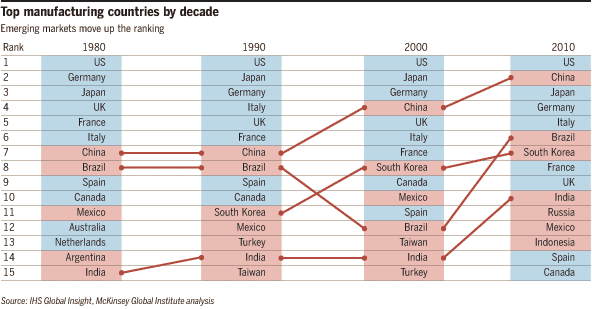
The following chart shows the world’s top manufacturing economies by decade:

Click to enlarge

Top-manufacturing-countries-by-decade

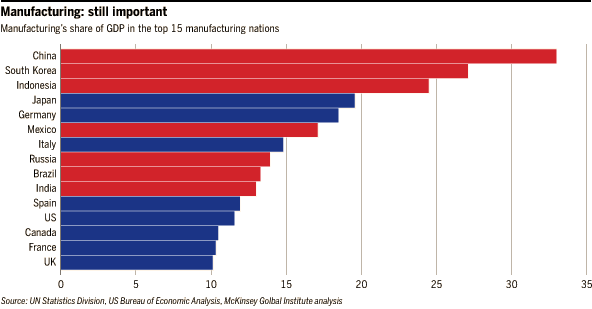
The rise of emerging countries such as Brazil and China, India as top manufacturing economies since the 1980s is commendable. Though the UK is in this list, manufacturing accounts for just 10% of the British economy compared to over 33% for the Chinese economy. Similarly manufacturing’s share of the U.S. economy  is just 12% as shown in the chart below:

manufacturing-is-important

Source:  Chart of the week: how important is manufacturing to emerging markets?, beyondbrics blog, FT

Emerging countries are more dependent on manufacturing than developed countries with China topping the list among emerging markets. As I noted above, manufacturing is a large component of the German economy. It is interesting to note that all the other European countries (except the UK ) with lower manufacturing experienced severe fiscal issues during the European debt crisis.