Why Invest in Railroad Stocks

The U.S. railroad industry is one of the key pillars of the economy. Railroads are highly efficient and help move goods from one point to another cheaply and efficiently.

1869-Golden_Spike

 Joining tracks of Central Pacific Railroad and Union Pacific Railroad to complete the transcontinental railroad at Promontory, Utah May 10, 1869

Some of the reasons to invest in railroad stocks are listed below:

  • The railroad industry is a oligopoly as shown in the chart here.
  • Railroads are the best form of transportation to transport natural resources such as coal, minerals, timber, etc.
  • Other goods such as autos and petroleum products are also moved by rail in increasing quantities.
  • Railroads have pricing power since in many places only one railroad serves the area. For example, a former in Iowa may not have options to move his produce other than one single railroad serving his rural community.
  • Automation and continued investments in technology and innovation makes the industry highly efficient.
  • Railroads move goods economically across the vast distances of the country.
  • The majority of the U.S. railroads are involved in freight transportation and not on passenger traffic.

Five railroad stocks are listed below with their current yields:

1.Company: CSX Corp (CSX)
Current Dividend Yield: 2.59%

2.Company: Kansas City Southern (KSU)
Current Dividend Yield: 0.92%

3.Company: Norfolk Southern Corp (NSC)
Current Dividend Yield: 2.91%

4.Company: Union Pacific Corp (UNP)
Current Dividend Yield: 2.09%

5.Company: Providence and Worcester Railroad Co (PWX)
Current Dividend Yield: 0.99%

Note: Dividend yields noted are as of Feb 5, 2013

Disclosure: Long NSC and CSX
Will BRICs Outperform U.S. Markets In This Decade?

Economist Jim O’Neill of Goldman Sachs coined the term “BRICs” in November 2001 to identify the core set of emerging markets at that time. These countries – Brazil, Russia, India and China – did not have many things in common other than all being emerging countries. For example, in terms of political systems Brazil and India follow democracy, China follows communism with a capitalist economic system and Russia is not yet democratic though it claims to be a democracy. Similarly Brazil and Russia are rich in many natural resources while China and India have limited natural resources and import most of the commodities needed for growth. Population wise, China and India have two of the world’s largest populations while Brazil and Russia’s population is relatively small.

Despite all the differences between these countries, the BRIC markets took off from 2001. From an article in the FT beyondbrics blog:

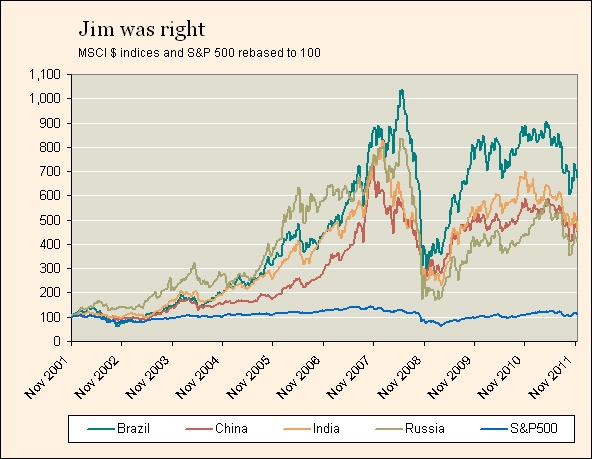
In investment terms, it paid off spectacularly. In the ten years since O’Neill launched the Brics in November 2001, the MSCI indices for the four Brics all comfortably outperformed the S&P 500. An investment of $100 in each of the four Brics,would have been worth $674 in Brazil, $451 in China, $459 in India and $414 in Russia. An investment in the S&P500 over the same years would have made just $112. See chart below.

Click to enlarge

MSCI_Bric_SP_from-2001

Source: Goodbye Mr Bric, FT beyondbrcis

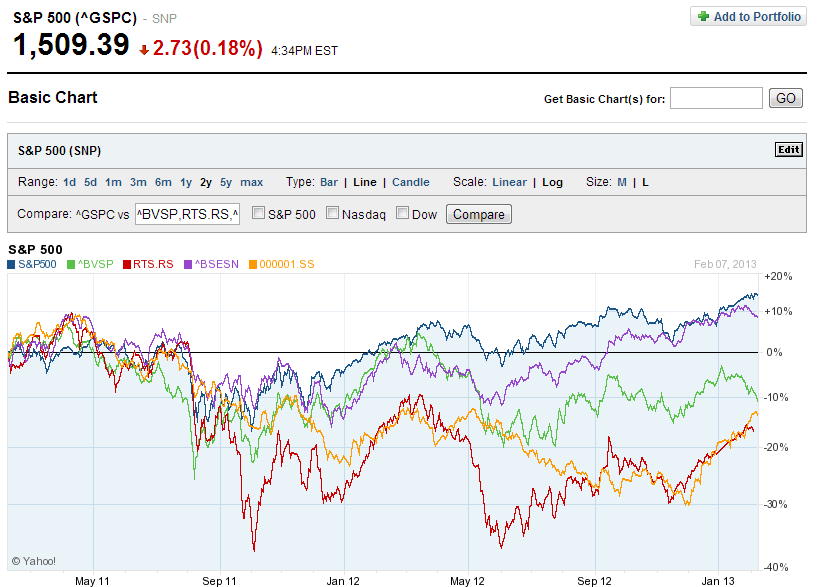
However the BRICs have lagged the S&P 500 in recent years as shown in the chart below:

SP500-vs-Bric-Indices-Best

Source: Yahoo Finance

Brazil’s Bovespa index is in the negative territory so far this year compared to the other BRIC benchmark indices and the S&P 500. It remains to be seen if the BRICs will outperform the S&P 500 this decade. Global investors will be eagerly watching the performance of the BRICs as their economies continue to expand although at a slower pace than before.

Related ETFs:

iShares MSCI Brazil Index (EWZ)
Market Vectors Russia ETF (RSX)
iShares FTSE/Xinhua China 25 Index Fund (FXI)
PowerShares India (PIN)
iShares S&P India Nifty 50 (INDY)

Disclosure: No Positions

Download: The Complete List of Foreign Stocks Trading on the NYSE


NYSE

A total of 525 foreign stocks traded on the New York Stock Exchange at the end of 2012. The complete list of these companies by country, ticker, listed date, etc. are shown in the PDF below:

Download: The Complete List of Foreign Stocks Trading on the NYSE (pdf)

Update #1: Current List of Foreign Stocks on NYSE as of  Jan 31, 2013 (pdf)

Data Source: NYSE

Why Invest in Investment Management Firms

DollarInvestment management firms manager assets for individuals, institutions, charities, pension funds and others. These firms provide a full range of services from asset management to wealth advisory to everything in between. Investment managers have strong business models and investment in their stocks are worth considering for the following reasons:

  • Investment management firms have for the most predictable earnings.
  • They earn a substantial portion of earnings from fees which remains stable regardless of market conditions.
  • They are established firms with billions under management.
  • They have the capacity to increase revenue by raising fees and charging for additional services to investors.
  • Their revenue streams are diversified.
  • Though competition is huge in the industry, large firms tend to have long-term contracts to manage funds of big companies and use economies of scale to reduce expenses.
  • Unlike banks they are not susceptible to loan losses from mortgages, commercial loans and other types of loans.

Some of the investment managers’ stocks are listed below for consideration with their current dividend yields:

1.Company: Franklin Resources Inc (BEN)
Current Dividend Yield: 0.84%

2.Company: BlackRock Inc (BK)
Current Dividend Yield: 2.87%

3.Company: Morgan Stanley (MS)
Current Dividend Yield: 0.87%

4.Company: T. Rowe Price Group Inc (TROW)
Current Dividend Yield: 1.90%

5.Company: Alliancebernstein Holding LP (AB)
Current Dividend Yield: 4.72%

Note: Dividend yields noted are as of Feb 5, 2013

Disclosure: No Positions

Why Invest in Electric Utility Stocks

Electricity-BallA well diversified portfolio should include some portion of the assets in utilities. Companies operating in this sector include electric utilities, gas utilities, power distributors, producers and multi-utilities.

There are many reasons to invest in electric utilities. In this post let me list a few of them:

  • They offer slow and steady growth over time.
  • They help reduce volatility in a portfolio.
  • They cushion the portfolio when the market tanks.
  • Electric utilities offer excellent dividends and dividend growth.
  • Most of them operate as a monopoly in markets they operate in.
  • They are good for income investors and cab be held for the long-term.
  • Electricity demand should increase with the explosive growth in smartphones, tablets and other devices.
  • Some producers are closing down expensive nuclear power stations and switching to natural gas powered stations since natural gas is becoming cheaper. This should help drive down costs of power production.

Five randomly-selected electric utilities are listed below for further research:

1.Company: Consolidated Edison Inc (ED)
Current Dividend Yield: 4.31%

2.Company: PPL Corp (PPL)
Current Dividend Yield: 4.74%

3.Company: Public Service Enterprise Group Inc (PEG)
Current Dividend Yield: 4.56%

4.Company: NextEra Energy Inc (NEE)
Current Dividend Yield: 3.32%

5.Company: Southern Co (SO)
Current Dividend Yield: 4.45%

Note: Dividend yields noted are as of Feb 4, 2013

Disclosure: Long NEE