Is a Crisis The Best Time to Invest ?

“The time to buy is when there’s blood in the streets.” – Baron Rothschild

I came across a Bloomberg BusinessWeek article from June, 2012 discussing about finding hidden opportunities in Greece. Since the Greek equity market was decimated during the previous few years as a result of the Greek crisis and the ensuing recession, George Elliott of hedge fund Naftilia Asset Management seemed to believe that investing in Greek stocks was a wonderful investment opportunity. In fact, he raised $63 million from investors for his Greek Opportunity Fund which planned to invest in nothing but Greek stocks.

One of the best times to invest in stocks is at the depth of a crisis when investors’ fear is at the highest peak. The following chart shows the performance of three benchmark indices from the lowest point attained during a crisis:

Click to enlarge
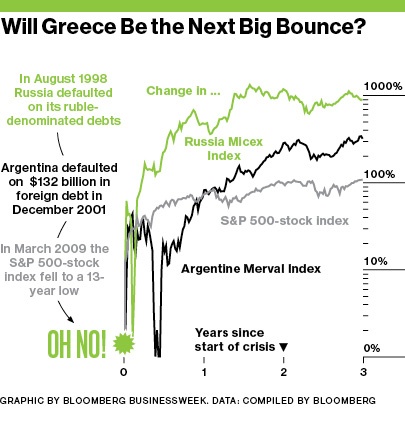
Crisis-best-time-to-invest-chart

Source: A Hedge Fund Hunts for Greece’s Hidden Gems, Bloomberg BusinessWeek, June 21, 2012

The returns for the indices shown above are indeed great. For example, the S&P 500 more than doubled from the March 2009 lows.

The strategy suggested by George Elliot is an excellent idea. However for most retail investors it does not mean that one should jump into equities with both feet during a crisis. Many stocks that plunged during the crisis are still down by more than 50% or more and may never recover to pre-crisis levels in one’s lifetime. But adding even small amounts of stocks or funds at the depth of crisis can enhance a portfolio’s overall return substantially.

For example, U.S. bank stocks suffered badly as a result of the recent global financial crisis. While most have recovered strongly since then many are nowhere where they were before the crisis hit. Here is chart showing the 5-year performance of KBW Bank index which is a benchmark index for regional banks:
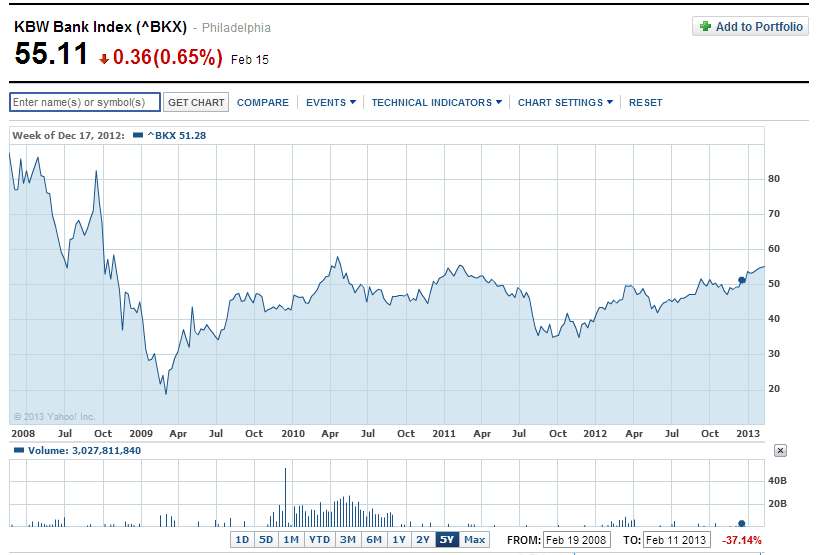
KBW-Index-5-Years

Source: Yahoo Finance

Another factor to consider is that investing during a crisis may not be the best idea for all countries. This is especially true for emerging or frontier markets where political risks are huge. So the chances of an investor losing everything is high.According to a research report by Dr. Bryan Taylor, President of Global Financial Data, Inc. for decades Latin American countries yielded inferior or mediocre returns. In the case of Peru, the stock market declined by 99%  in real terms between the 1940s and 1980s and finally investors were wiped out due to outright confiscation by the state. So this example shows that a crisis may last for decades and investing in crisis-ridden countries may not be the greatest strategy.

Related ETFs:

SPDR S&P Bank ETF (KBE)
SPDR S&P Regional Banking (KRE)
PowerShares KBW Regional Banking ETF (KBWR)
PowerShares KBW Bank Portfolio ETF (KBWB)
iShares Dow Jones U.S. Regional Banks Index Fund (IAT)
iShares MSCI All Peru Capped Index Fund (EPU)

Disclosure: No Positions
How to Invest in Oil Equipment & Service Companies via ETFs

One of the ways to invest in and profit from the oil industry is to invest in companies that supply the equipment and services to the major producers. I wrote an article on this strategy before. In this post let me discuss the simplest and easiest way to gain exposure to this sector via ETFs. Investing with ETFs is especially preferable for retail investors since the transaction cost is very low and the risk of selecting individual stocks is vastly reduced.

1. iShares Dow Jones US Oil Equipment Index Fund (IEZ)

This sector-specific ETF tries to replicate the performance of Dow Jones U.S. Select Oil Equipment & Services Index.The fund has assets of about $370 million and the annual dividend yield is 0.54%.

The top 10 holdings in the portfolio the top names in the industry such as Ensco, FMC Technologies, Halliburton, Schlumberger NV, etc. In terms of performance, the fund is up about 13% YTD this year and in the last five years it was down about 7% and 1% in 2012 and 2011 respectively.

2.  SPDR S&P Oil & Gas Equipment & Services ETF (XES)

Similar to the iShares ETF, this ETF has about $308 million assets and tries to replicate the return of S&P Oil & Gas Equipment & Services Select Industry Index.

The fund is up about 11% YTD. In the past five years, the ETF was down only in 1011 by about 5%. The top 10 holdings are similar to the iShares ETF with slight differences.

3. PowerShares Dynamic Oil & Gas Services Portfolio (PXJ)

This ETF is about half the size of the other two ETFs noted above in terms of assets held.  The fund tries to mimic the performance of the Dynamic Oil Services IntellidexSM Index.

The fund is up about 11% this year YTD and the top holdings are similar to the other two ETFs.

The five year return of the three ETFs is shown below:

Click to enlarge

xxxx

Source: Yahoo Finance

Two of the three ETFs have nicely recovered from the March 2009 lows and have even exceeded the pre-crisis levels. The other ETF is almost close to reaching the pre-crisis level.

For a listing of companies in this sector click here

Note: Dividend yields noted are as of Feb 15, 2013

Disclosure: No Positions

The Top Eight Publicly-Listed Food Producers

Heinz, one of the top food producers in the U.S. was sold to Warren Buffet and Brazilian private equity firm 3 G Capital for $23.2 billion this week. Heinz was sold at $72.50 per share representing a 19% premium to its all high. Heinz equity investors were lucky to receive such a nice premium in this buyout.

The food sector is always a favorable sector to invest in for investors looking to earn decent total returns in the long-term. Food companies generally tend to pay above average dividends and have consistent earnings regardless of the state of the economy. They are also highly innovative relative to other industries. For example, cereal makers come up with new varieties of cereals every year and the possibilities for innovation are endless.

For investors looking to invest in this sector, a good place to start would be the top companies. So the top eight food producers based on revenue in the latest quarter are listed below with their current dividend yields:

1.Company: Kellogg Co (K)
Current Dividend Yield: 2.95%

2.Company: General Mills Inc (GIS)
Current Dividend Yield: 2.98%

3.Company: Mondelez International Inc (MDLZ)
Current Dividend Yield: 1.96%

4.Company: Campbell Soup Co (CPB)
Current Dividend Yield: 3.00%

5.Company: ConAgra Foods Inc (CAG)
Current Dividend Yield: 2.96%

6.Company: Kraft Foods Group Inc (KRFT)
Current Dividend Yield: 4.24%

7.Company: Hillshire Brands Co 
– Acquired by Tyson Foods

8.Company: The Hershey Company (HSY)
Current Dividend Yield: 2.08%

I have left out Heinz since it has been bought out and will cease to trade.

Source: Heinz Sold as Deals Take Off (The Wall Street Journal)

Note: Dividend yields noted are as of Feb 15, 2013

Disclosure: Long GIS

Top Drug Companies’ Market Share in Home Region

The pharmaceutical in industry is a multi-billion dollar industry especially in developed countries where drug prices are very high and consumers are able to afford them. For drug companies, the actual manufacturing of the drugs is just one portion of the overall costs of sale prices of the drugs. Marketing plays a huge role accounting for as much as 20% in some countries. For example, drug companies spend heavily on advertising in the US market where they are allowed to market directly to consumers via TV, radio, magazines, etc. So even though the majority consumers have no knowledge about the product being marketed to them the industry’s logic is here that they will ask their doctors to prescribe the particular drug. However in many countries direct marketing to consumers is illegal. These countries believe that most consumers are not medical experts and a drug is not a cheap consumer product such as a 99 cents burger that everyone can buy. In addition, direct advertising to consumers may induce them to buy them even though they may not need it medically.

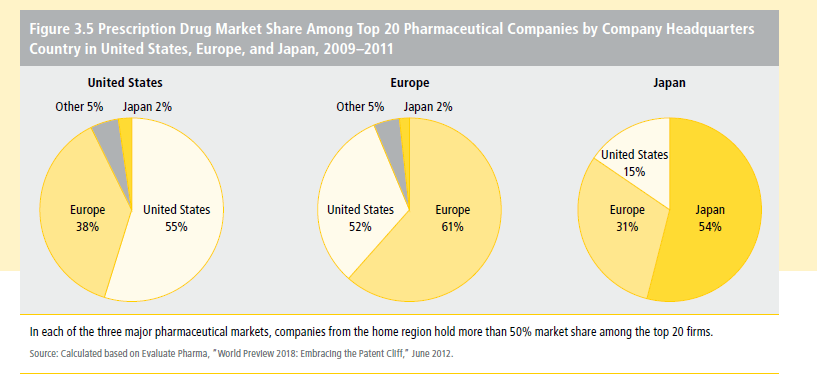
Here is an interesting chart I came across recently on the market share of top drug companies:

Click to enlarge

Pharma-Market-Share-by-Home-Country

Source: DHL Global Connectedness Index (GCI), DHL

Via FT beyondbrics blog

Companies from the home region generate more than 50% of their sales from home regions. So for example, U.S. firms such as Pfizer Inc. (PFE), Merck & Co. Inc. (MRK) and Eli Lilly and Company (LLY)  depend on the domestic market for more than half of the annual sales. It is interesting to note that though many of the top pharma companies are multi-nationals their home market is still their key market.

You may also want to check out the Top 25 pharma companies here.

Disclosure: No Positions

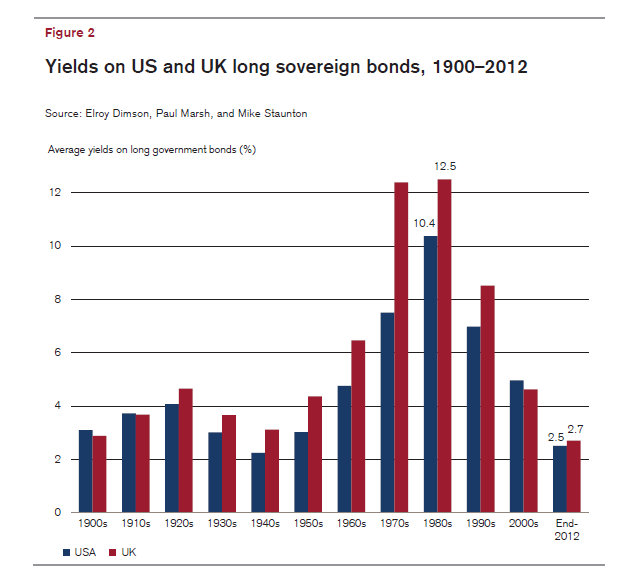
US and UK Long Sovereign Bond Yields 1900-2012

Here is an interesting chart showing the yield on long government bonds of US and UK. In the 1970s and 80s, British bonds yielded over 12% while US bonds over 7% and 10% respectively. Since then the yields have fallen dramatically for both country bonds. At the end of last year 20 year government bonds yields stood at 2.5% for the USA, 2.7% for the UK, 2.0% for Germany, and 1.0% for Switzerland.

Click to enlarge

US-UK-Long-Bond-Yields-1900-2012


Related ETFs:

iShares Lehman 7-10 Year Treasury Bond Fund (IEF)
iShares Lehman 10-20 Year Treasury Bond Fund (TLH)
SPDR Lehman Long Term Treasury ETF (TLO)
SPDR Lehman Intermediate Term Treasury ETF (ITE)
iShares Lehman TIPS Bond Fund (TIP)
Vanguard Long-Term Government Bond Index Fund (VGLT)

Source: Credit Suisse Global Investment Yearbook 2013, Credit Suisse