Ten Foreign Stocks To Consider For Potential Investment

Thousands of foreign stocks trade on the U.S. market. According to the depository BNY Mellon, currently 386 foreign companies trade on the organized exchanges and 2,388 trade on the OTC markets. With such a wide universe, US investors can cast a wide net to identify potential investment opportunities. Many high-quality large cap multinationals such as Total. Unilever, Nestle, Novartis, etc.  are part of this ADR universe.

Ten foreign stocks from the emerging and developed markets are listed below for further research:

1.Company: Ultrapar Participacoes SA (UGP)
Current Dividend Yield: 2.39%
Sector: Oil, Gas & Consumable Fuels
Country: Brazil

2..Company: Banco Santander-Chile (BSAC)
Current Dividend Yield: 3.06%
Sector: Banking
Country: Chile

3.Company: Nordea Bank AB (NRBAY)
Current Dividend Yield: 4.04%
Sector: Banking
Country: Sweden

4.Company: DBS Group Holdings Ltd(DBSDY)
Current Dividend Yield: 3.41%
Sector: Banking
Country: Singapore

5.Company: Novo Nordisk A/S (NVO)
Current Dividend Yield: 1.96%
Sector: Pharmaceuticals
Country: Denmark

6.Company:BASF SE (BASFY)
Current Dividend Yield: 2.36%
Sector: Chemicals
Country: Germany

7.Company:Air Liquide (AIQUY)
Current Dividend Yield: 2.23%
Sector: Chemicals
Country: France

8.Company: Telstra Corp Ltd (TLSYY)
Current Dividend Yield: 5.32%
Sector:Telecom
Country:  Australia

9.Company: National Grid PLC (NGG)
Current Dividend Yield: 4.62%
Sector:Multi-Utilities
Country: UK

10.Company: Autoliv Inc (ALV)
Current Dividend Yield: 2.04%
Sector: Auto Parts
Country: Sweden

Note: Dividend yields noted above are as of May 29, 2014. Data is known to be accurate from sources used. Please use your own due diligence before making any investment decisions.

Disclosure:  Long BSAC
Dividends Boost Stock Returns In The Long Run

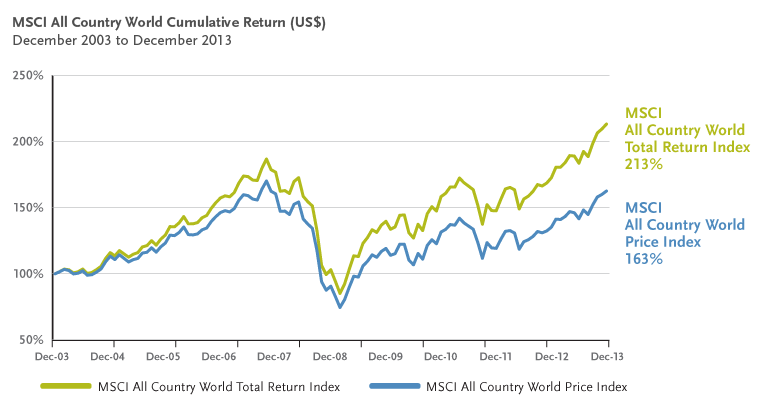
Dividend-paying stocks can implify returns in the long run due to the effect  of compounding. The total return is boosted by reinvesting dividends in addition to any returns due to price aprpeciation. Generally the longer the longer the holding period the higher the return. Stocks that grow dividends yield even higher returns due to the above process.  So investors are better off investing in high-quality dividend payers and growers than simply investing for price appreciation.

The chart below shows the total return and price return of  MSCI All Country World Index over the past 25 years:

Click to enlarge

MSCI All Country-Total vs Price Returns

Source: AGF Global Dividend FundAGF Management Limited

The Top 10 stocks from the MSCI World High Dividend Yield Index are listed below for further research and potential investment:

1.Company: Nestle SA (NSRGY)
Current Dividend Yield: 3.08%
Sector: Food Products
Country: Switzerland

2.Company: Novartis AG (NVS)
Current Dividend Yield: 3.06%
Sector: Pharmaceuticals
Country: Switzerland

3.Company: Roche Holding AG (RHHBY)
Current Dividend Yield: 3.01%
Sector: Pharmaceuticals
Country: Switzerland

4.Company: Total SA (TOT)
Current Dividend Yield: 4.68%
Sector: Oil, Gas & Consumable Fuels
Country: France

5.Company: Johnson & Johnson (JNJ)
Current Dividend Yield: 2.76%
Sector: Pharmaceuticals
Country: USA

6.Company: Chevron Corp (CVX)
Current Dividend Yield: 3.49%
Sector: Oil, Gas & Consumable Fuels
Country: USA

7.Company: Pfizer Inc (PFE)
Current Dividend Yield: 3.51%
Sector: Pharmaceuticals
Country: USA

8.Company: AT&T Inc (T)
Current Dividend Yield: 5.19%
Sector: Telecom
Country: USA

9.Company: Merck & Co Inc (MRK)
Current Dividend Yield: 3.04%
Sector: Pharmaceuticals
Country: USA

10.Company: Royal Dutch Shell PLC (RDS.A)
Current Dividend Yield: 4.78%
Sector: Oil, Gas & Consumable Fuels
Country: UK

Note: Dividend yields noted above are as of May 29, 2014. Data is known to be accurate from sources used. Please use your own due diligence before making any investment decisions.

Disclosure: No Positions

Ten European Consumer Staples Stocks To Consider

Stocks in the consumer staples sector offer stability and steady growth. They are especially attractive during turbulent market conditions. As the name implies companies in this sector produce goods that consumers buy regardless of the economic conditions. Household products like toothpaste, food items, cleaning products, hygiene items, shampoo and even beer are good examples of consumer staples. While products such as beer may seem like they are discretionary items, in reality they are consumer staples since people buy beer to enjoy during periods of economic expansions and also buy during recessions to drown their sorrow.

Large-cap European consumer staples companies offer exposure to not only the European market but also to the fast growing emerging markets. Hence investors looking to gain from the emerging market consumption growth can invest in these companies.

In order to identify some consumer staples stocks from Europe I referred to the STOXX® Europe 600 Optimised Consumer Staples index.

The STOXX Europe 600 Optimised Market Quartile indices provide investors with access to companies classified under one of the four peer groups: Consumer Discretionary, Consumer Staples, Cyclicals and Defensives. Based on the STOXX Europe 600 index, companies are evaluated by fundamental factors and allocated to one of four clusters. The index covers companies across 16 European countries: Austria, Belgium, Denmark, Finland, France, Germany, Ireland, Italy, Luxembourg, the Netherlands, Norway, Portugal, Spain, Sweden, Switzerland and the United Kingdom.

Source: STOXX

Ten stocks from  the STOXX® Europe 600 Optimised Consumer Staples index trading on the US markets are listed below for consideration:

1.Company: Unilever PLC (UL)
Current Dividend Yield: 3.29%
Sector: Food Products
Country: UK

2.Company: British American Tobacco PLC (BTI)
Current Dividend Yield: 3.92%
Sector:Tobacco
Country: UK

3.Company: Henkel AG & Co KGaA (HENKY)
Current Dividend Yield: 1.63%
Sector: Household Products
Country: Germany

4.Company: Heineken NV (HEINY)
Current Dividend Yield: 2.07%
Sector:Beverages
Country: The Netherlands

5.Company:SABMiller PLC (SBMRY)
Current Dividend Yield: 2.81%
Sector:Beverages
Country: UK

6.Company: Nestle SA (NSRGY)
Current Dividend Yield: 3.08%
Sector: Food Products
Country: Switzerland

7.Company: Unilever NV (UN)
Current Dividend Yield: 2.91%
Sector: Food Products
Country: UK

8.Company: Reckitt Benckiser Group plc (RBGLY)
Current Dividend Yield: 2.61%
Sector: Household goods
Country: UK

9.Company: Anheuser-Busch InBev SA/NV (BUD)
Current Dividend Yield: 1.92%
Sector:Beverages
Country: Belgium

10.Company: Diageo PLC (DEO)
Current Dividend Yield: 2.50%
Sector: Beverages
Country: UK

Note: Dividend yields noted above are as of May 29, 2014. Data is known to be accurate from sources used. Please use your own due diligence before making any investment decisions.

Disclosure: Long HENKY, RBGLY

Knowledge is Power: Portugal, Emerging Europe, Tulips and Stocks Edition

Lazard’s Ryan: Why I’m maxing out my emerging market exposure (FE Trustnet)

Don’t ‘set and forget’: Proper asset allocation is key to investment returns (Financial Post)

Tulips and stocks: Don’t succumb to their charms  (The Globe and Mail)

Portugal: Out of the bailout, out of the woods? (Deutsche Welle)

The Japanese Economy: Will It Revive If the Bank of Japan Acts? (Charles Schwab)

America dumbs down (MaClean’s) **

 (beyondbrics)

DC-Zoo Panda


Investors Should Not Panic In A Global Crisis

Investors should not panic and sell their holdings during times of extreme volatility in equity markets especially due to a global crisis. I wrote an article earlier this year discussing why panic selling is not good. During times of times of a crisis it is best to stay clam and not do anything. I wrote a couple of articles related to this topic which can be found here and here.

From an article in  The Wall Street Journal earlier this month discussing this topic:

The best course of action during a crisis: Remain calm and don’t sell. If you are bold, you could even use it as a buying opportunity.

Consider a study of 51 notable crises since 1900 conducted by Ned Davis Research, a quantitative-research firm in Venice, Fla. While any exercise of this type involves making many judgment calls, the list does include all the major suspects—from the outbreak of major conflicts (including Pearl Harbor and the Korean War), to serious threats of war (such as the Cuban missile crisis and the Sept. 11, 2001, terrorist attacks), to the 1987 stock-market crash.

Not surprisingly, the Dow Jones Industrial Average immediately fell during the 51 events, losing an average of 6.7%. The market’s low in the immediate wake of those crises more often than not marked the extent of the decline, however. Six months later, the Dow on average was higher than where it stood before the outbreak of those crises.

Source:  Why It Pays to Keep Calm in an International Crisis, The Wall Street Journal, May 2-3, 2014

The article noted that after Iraq invaded Kuwait in August 1990, the Dow Jones fell 13.3% the day after. However six months later it was up by 16.3%. Similarly the index fell immediately after other geo-political events such as JFK assassination, invasion of Afghanistan by USSR, Suez Canal crisis, etc.

Hence based on historical data, if Russia gets involved militarily in the current crisis in Ukraine global equity markets will fall immediately due to investors’s knee-jerk reaction but after the dust settles a weeks later markets will recover.

Related ETFs:

  • iShares MSCI Emerging Markets Index ETF (EEM)
  • Vanguard Emerging Markets ETF (VWO)
  • SPDR S&P 500 ETF (SPY)
  • SPDR STOXX Europe 50 ETF (FEU)
  • SPDR DJ Euro STOXX 50 ETF (FEZ)

Disclosure: No Positions