How Big Are the Economies of Individual States in the U.S.?

The U.S. is the world’s largest economy with a GDP of $16.72 in 2013 based on purchasing power parity according to the the CIA World Factbook. The next largest economies are the EU, China, India and Japan in that order based on 2013 estimates. Compared to the U.S. economy, many of the developed world’s economies are small. For example, the German economy is just $3.2 Trillion in size compared to the $16.0 Trillion U.S. economy.

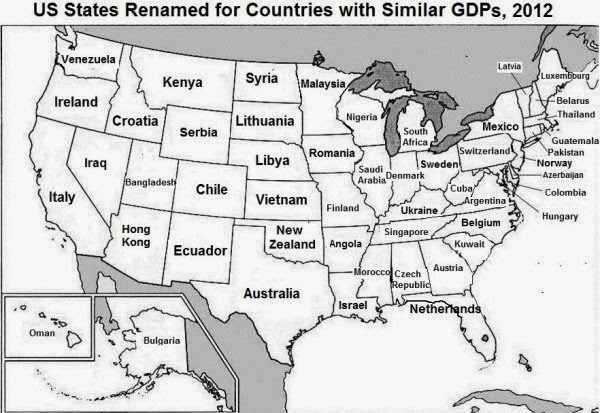
Since the U.S. economy is so huge, the economies of each of the individual states in the country are also big. In fact, their sizes are comparable to the economies of many countries. Other countries have a lot to catch up in terms of productivity and economic growth.

Click to enlarge

US Map:
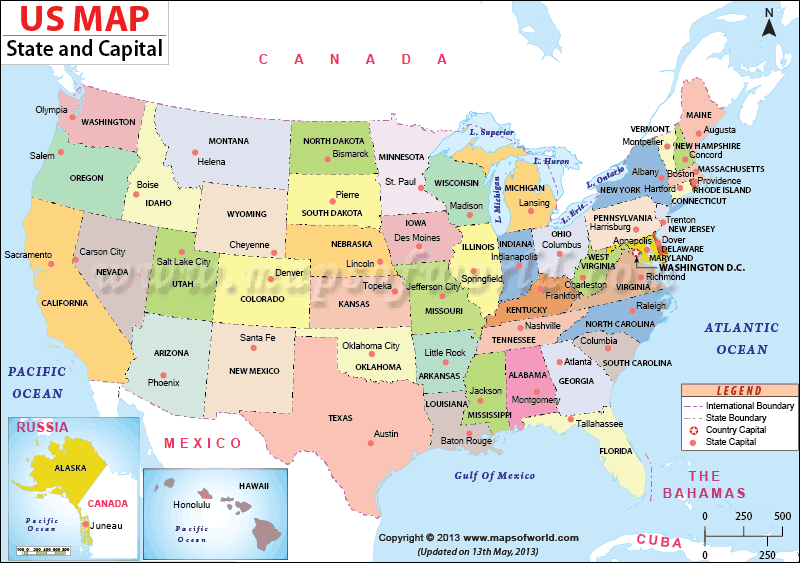
us-map

Source: MapsofWorld.com

The following map puts the sizes of the economies of individual US states in perspective.  The whole Australian economy is just about the size of the Texas economy.
usmap4-600x413

Source: Unknown

On The Dividend Payout Ratio of Japanese Stocks

In an article in September I wrote that the payout ratio of U.S. is on a long-term decline and is now less than 40%. The payout ratio for European companies is on an uptrend and has reached about 50%.

Compared to U.S. and European companies, Japanese companies are very stingy when it comes to rewarding their shareholders in the form of dividends. In fact, income investors generally do not consider Japanese stocks when evaluating the equity universe in the  the developed world for dividend stocks. As of Nov 13, the dividend yield for U.S. stocks is 1.9% while the yields on the France, Germany, Spain and UK stocks are 3.1%, 2.8%, 4.4% and  3.8% respectively according to FT Market Data. The dividend yield for Japan stocks is lower than that of the U.S. stocks at just 1.7%.

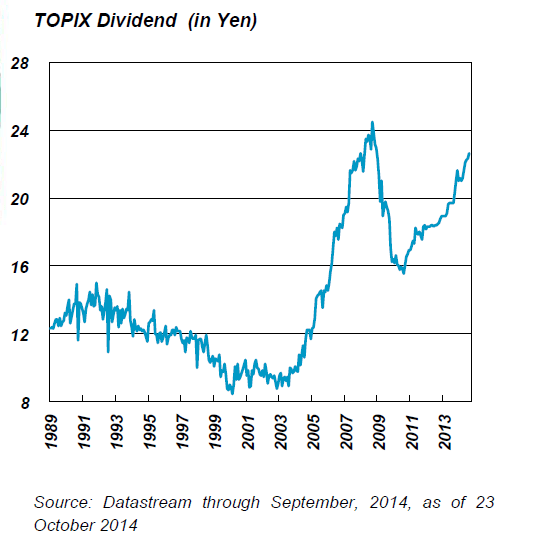
The dividends paid by companies in the TOPIX index is rising as shown in the chart below:

Click to enlarge

TOPIX Dividend

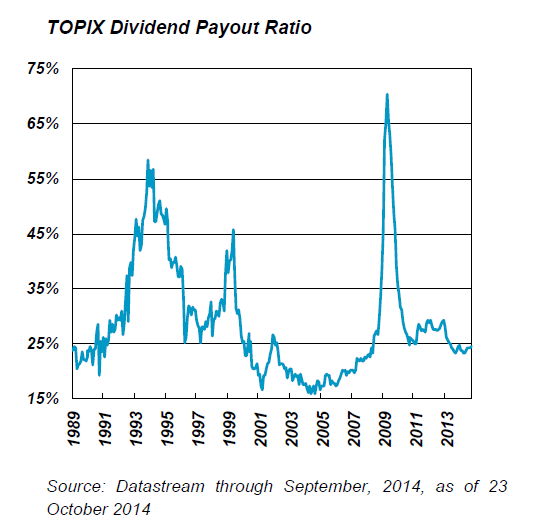
However the dividend payout ratio has been stagnant and has stayed below 25% in the past few years:

TOPIX Dividend Payout Ratio


Source: Evolving Markets, Oct 2014, Nikko Asset Management Asia Limited

Though Japanese companies are generating higher earnings they are not increasing the payouts to shareholders.According to a report by Nikko AM, the current Abe administration may start emphasizing the importance of dividend payouts congratulating companies that increase their payouts.

Since the current payout ratio in Japan is much lower than in the U.S. and Europe, Japanese companies should increase their payouts considerably in order catch up with other markets in the developed economies. Higher dividend payouts would also attract more domestic and foreign investors to invest in Japanese stocks.

Related ETF:

  • iShares MSCI Japan Index (EWJ)

Disclosure: No Positions

Knowledge is Power: Malaysian Market, World’s Safest Banks 2014, Global OTC Stocks Edition

Year-end to-do list (Fidelity)

Global Equities: a long-term investment strategy (Invesco Perpetual)

Going Global: Trading Foreign Stocks OTC (Charles Schwab)

The Nuances Of The Malaysian Market (Malaysia Finance)

 (beyondbrics)

The 10 most influential business books of the past decade (Financial Post)

China is old news – here’s where we should be investing (MoneyWeek)

WORLD’S SAFEST BANKS 2014 (Global Finance)

National Mall, Washington DC

The National Mall, Washington DC

Keep Calm and Stay Long With German Stocks

Germany’s benchmark equity index DAX plunged last month over fears of slow economic growth. From 9,454 the index fell to as low as 8,354 for a fall over 11%. However it recovered strongly from the depth of the lows and closed at 9,326 in October.As of Nov 10th, the DAX is down by 2.1%  year-to-date while the S&P 500 is up by 10.3%.

Investors in German equities panicked in October based on some published economic data including surveys.Generally survey data are not reliable and investors should not react information based on surveys. This is because surveys are fatally flawed in many ways. For example, surveys can generate very different answers from participants based on how a question is posed to them.

Here are a few summary points from an article titled “Why You Should Avoid German Equities” by Andrew Sachais, posted on Oct 15th in Seeking Alpha:

German economic sentiment reached multi-year lows in October.
Sentiment in the region has deteriorated alongside industrial production and inflation measures.
Continued economic weakness signals that investors should flee German equities.

One of the charts the author used to in the article support his theory is the German ZEW index which is created based on a survey. As I noted above one should not make the decision to buy or sell stocks based on surveys. One of the commentators to the article correctly noted that the ZEW is a”nonsense indicator”.

Another article titled “Germany’s Dark Future” by Frances Coppola painted a scary future for the German economy.

Natixis released a special report on Oct 13th, with the aptly named title “Germany: Don’t panic!”. The following is the summary of the report:

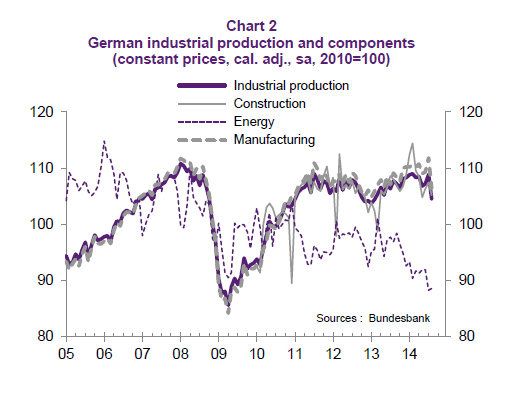
The recent disappointing industry data has increased the worries over the German economy heading into a technical recession in the third quarter, after a mild contraction of -0.2% QoQ in Q2. While August’s weak hard data and falling sentiment confirmed that the German economy is losing some steam, we do not expect the German economy to fall back into recession. Due to technical factors, industry data for September should rebound. Overall, given that Germany’s domestic economy is fundamentally strong, we think that fears over a hard landing for Germany are overstated.

Natixis noted that Germany’s disappointing industry data in August is likely exacerbated by shifts in holidays.

Click to expand

Germany Economy-1

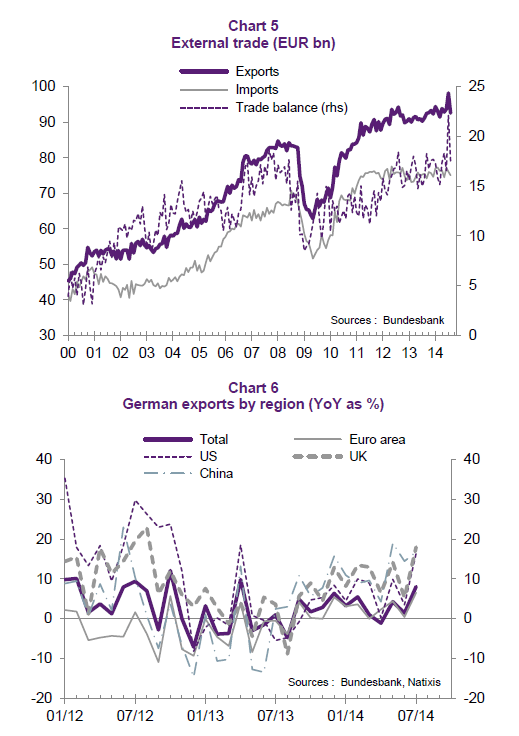
Since the Germany is an export-based economy it is important to focus on export data. The report had a positive take on exports:

German Exports

German exports slumped -5.8% in August, adding to the disastrous picture of Germany’s gloomy industry data seen in the last week (chart 5). However, again, adverse effects from late school holidays should have played a non-negligible role in the sharp decline in German exports in August. In fact, exports were strong in the previous month, showing a monthly gain of +4.8%. This, together with a favourable carry-over growth, took exports +2.0% above the Q2 average up to now. At the same time, the outlook for Germany’s exports is encouraging. So far, Germany’s exports to major trading partners outside the euro area held up well (chart 6) and a lower euro should act as a boost to German exports, although a lower exchange rate will need some time to feed through.

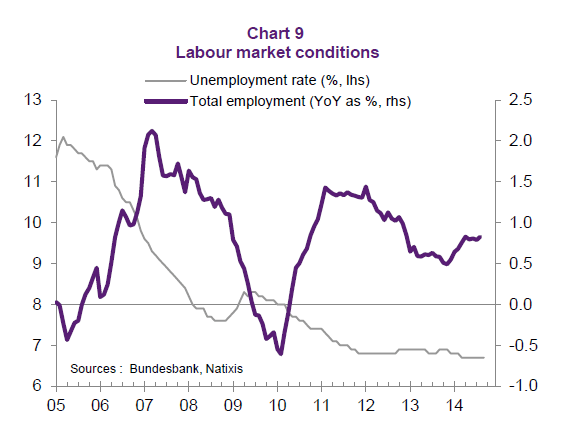
The German domestic economy is fundamentally strong as workers enjoy rising income, low inflation and low unemployment rate.The unemployment rate stood at just 5.0% in September. The following chart shows the strong labor market:

German labor market

Source: Germany: Don’t Panic, Special Report, Natixis, Oct 13, 2014

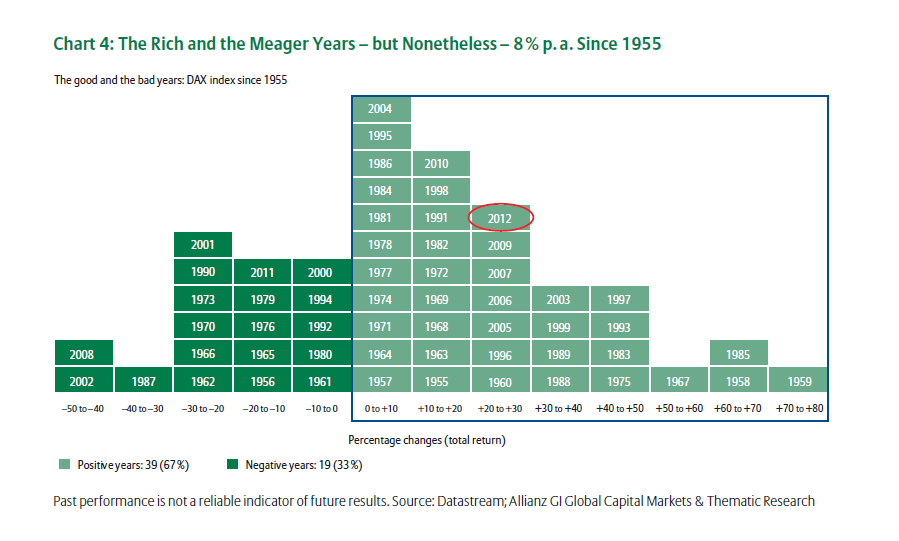
Despite the short-term economic fluctuations investors in should stay clam and hold German stocks for the long-term.Instead of panicking investors are better of taking advantage of lower stock prices by adding high-quality stocks to their portfolios in phases. The long-term performance of German stocks has been excellent in the past as evidenced by the chart below:

Click to enlarge

DAX-Index-Return-by-year 1955 to 2012

Source: 25 Years of the DAX:Wealth for Everyone, Allianz Global Investors

From an article I wrote back in in January “Since 1955 the returns have been mostly positive in the vast majority of the years. In 39 years the returns were positive compared to 19 years in which returns were negative.”.

Related ETFs:

  • iShares MSCI Germany (EWG)

Disclosure: No Positions

Knowledge is Power: Good Companies, Japan Stocks, Europe Outlook Edition

Retiring: Finding, and Battling, Hidden Costs of 401(k) Plans (NY Times)

Invest in good companies, don’t pay too much for them, and then do nothing: Why Fundsmith boss takes the slow road (This is Money)

The economist who beat Thomas Piketty ( Live Mint)

Don’t forfeit 50% of inherited Roth IRA to the IRS (MarketWatch)

27 stocks that could benefit from lower oil prices (Financial Post)

The remarkably cheap market Ben Willis couldn’t ignore (Trustnet)

Germany’s east still lags behind (Deutsche Welle)

Japanese Stock Market Could Get a Boost from Pension Investments (Charles Schwab)

A positive outlook for Europe (Invesco Perpetual, UK)

Does Stock Picking Still Work in Emerging Markets? (Alliance Bernstein)

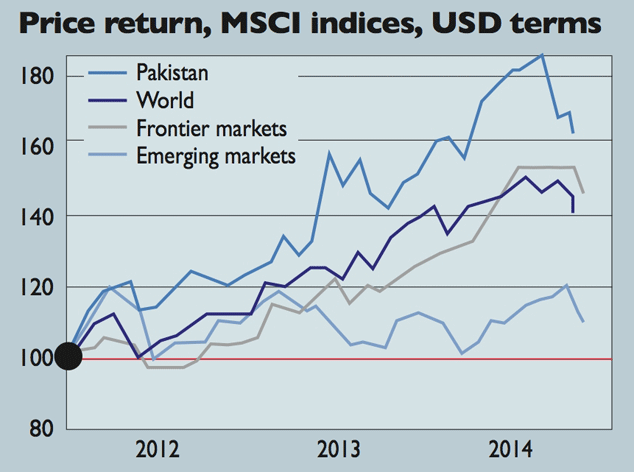
Pakistan Stock market

Source: Chart of the week: Pakistan’s surprisingly resilient stocks (MoneyWeek)

Halloween 2014 PumpkinHalloween 2014 – Pumpkins