US Stocks Have Performed Better Under A Democrat President Than Republican President

The U.S. election drama is in full swing. Generally US elections tend have lots of lights, fury and shows just like Hollywood movies and very little substance. One party’s billionaire candidate promises to “Make America Great Again” without explaining what that actually means. He also says that he will bring the jobs back from foreign countries ass if a president has any power to do that. Regardless this candidate is pull record crowds. A candidate from the other party goes to the other extreme promising to do many things which are practically impossible to happen in this country. One such thing he promises is free college education. Another candidate from the same party hopes to win the presidency claiming she is best suited to run this country not only because of having well-heeled international experience but also being simply a female. Apparently having the first female president seem to mean something to many people similar to having the first black president for some others.

Anyway how do US stocks perform under a democrat president vs a republican president?

According to an research report by Fidelity portfolio managers Aditya Khowal and Nick Peters,  US stocks have outperformed under democrats than republicans.

From the report:

Stock markets under Democrat presidents have, on average, outperformed those under Republican presidents, with average returns of 10 per cent over a Democratic president’s term since 1928, against 1.8 per cent for a Republican president.

Out of the 22 terms of office since 1928, four terms under a Republican president ended with negative returns, which compares to just one negative return under a Democratic president, Roosevelt’s second term in office.

Click to enlarge


US Stock Returns-Under Democrat versus republican presidents

US stock returns under presidents


Source: Democrats versus republicans: who is best for the US stock market?, Money Observer

It is surprising to see that stocks perform under democrat presidents than republican presidents since republicans are traditionally big supporters of businesses.

The World’s Biggest Dividend Payers

The Henderson Global Dividend Index from Henderson Global Investors is a long-term study into global dividend trends. The report reviews the dividend payments by global companies with 2009 as the base year. Unlike other research studies, this study is interesting since it is at a global level and shows the trend of dividends paid out to investors.

This year Henderson projects global dividend payouts to exceed $1.17 Trillion.

The table below the top global dividend payers from 2009 to 2015:

Click to enlarge


Worlds Biggest Dividend Payers

Source:  The Henderson Global Dividend Index, Henderson Global Investors

Anglo-Dutch oil giant Royal Dutch Shell (RDS-A,RDS-B) topped the ranking followed by American oil major Exxon Mobil (XOM). In addition, Royal Dutch Shell is a consistent payer too with the company taking the top spot in five out of the past seven years.

Seven out of the top ten ranking were US firms as shown above. It is surprising that tech giants Apple(AAPL) and Microsoft (MSFT) appear in this list.

All the 20 companies listed above are large-cap established multi-national companies.

Disclosure: No Positions

The Platts Top 250 Global Energy Companies 2015

Every year Platts, a unit of McGraw Hill Financial published the world’s top 250 energy company rankings. This list can be important source for investors looking to invest in the energy space which includes oil, natural gas electric and gas utilities. With the current turmoil in the oil industry some investors may be interested in top oil companies in order to pick up stocks at the current lower prices.

The rankings are based on a “special Platts formula”. The Platts Top 250 Global Energy Companies list for 2015 are shown below:

Click to enlarge

Platts Top 250 Energy Companies for 2015-Page 1Platts Top 250 Energy Companies for 2015-Page 2

Platts Top 250 Energy Companies for 2015-Page 3Platts Top 250 Energy Companies for 2015-Page 4Platts Top 250 Energy Companies for 2015-Page 5

Source: Platts

A few observations:

  • Despite the fall in oil prices and the subsequent share prices of firms in the oil sector, major oil companies are some of the top dividend payers in the world. For example, Royal Dutch Shell (RDS-A, RDS-B) was the biggest dividend paying company in the world according to Henderson Global Dividend Index. The next payer in that list was Exxon Mobil (XOM). Billions of dollars of paid out in dividends oil firms each year and income investors are rewarded for their trust and loyalty. If a retired person owns 1000 shares of Exxon Mobil stock, they will receive a solid income each quarter.
  • Due to the regulatory mess and other issues investors can avoid European utilities except British utilities. For US investors looking to add utility stocks, plenty of options are available in the domestic utility industry.
  • Investors can stay away from pure players in the oil and gas industry. This will be companies that operate in one field such as oil pipelines, storage, refining, etc. Instead going with diversified players is a wise strategy.
  • It is important to avoid smaller companies and those that are highly leveraged. Unlike the big oil firms, small companies may not be withstand the current volatility and may go bankrupt wiping out common shareholders.

Download: The Platts Top 250 Global Energy Companies list for 2015 (in pdf)

Disclosure: No Positions

The Cost of Air Pollution is Enormous

Air pollution takes an enormous toll on countries across the world according to a report by the OECD. In terms of human cost, about 3 million people are killed globally due to air pollution!.

One of the main causes of air pollution is vehicles especially automobiles. Countries with high car ownership for transport tend to have high pollution and the misery that goes with it such as death, diseases, etc.

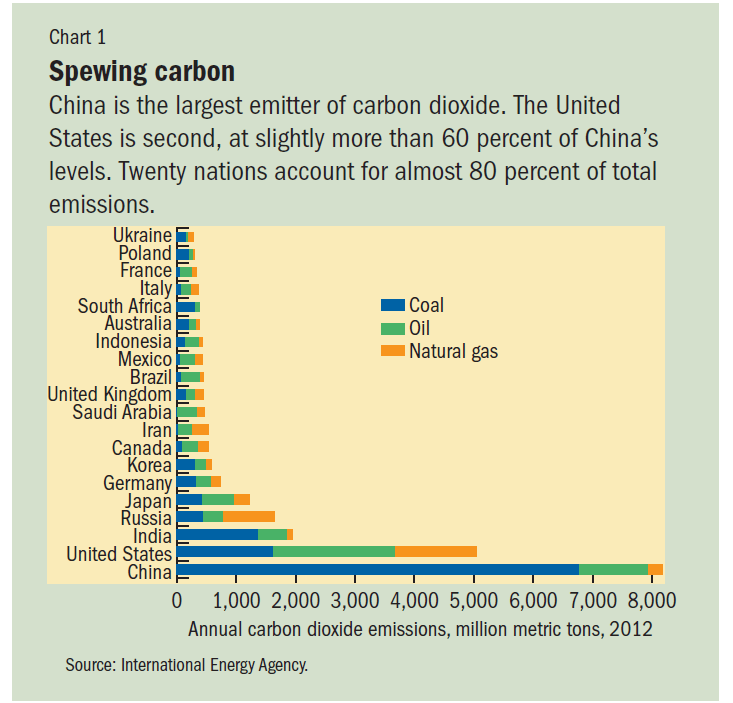
The following chart shows that the US ranks the top in air pollution among OECD nations. This is not surprising since the country is addicted to cars. Other than the major cities. the rest of the country has no meaningful public transportation forcing Americans to use cars as the main mode of transportation. Accordingly the society has accepted to pay a heavy price in terms of lives lost, human suffering, health care cost, etc.

Click to enlarge

Air Pollution in OECD Countries

Source: Flabber-gassed by our noxious air: can electric vehicles save us?, OECD

Here is an infographic on the health impacts of road transport:

Infographic Cost of air pollution

Globally China and India top the ranking in number of deaths. As these countries embrace automobiles for personal transportation, air pollution is bound to increase.

The research report noted “In most OECD countries, the death toll from heart and lung diseases caused by air pollution is much higher than the one from traffic accidents.”

Source: The Cost of Air Pollution, OECD

Why Invest In Foreign Small Cap Stocks

Many investors limit themselves to large cap companies when investing in foreign stocks. This is because large multinational companies are usually well-known and information about them are easier to access. In addition large-cap stocks are well followed by the investment community and are usually listed in major exchanges. Since putting one’s money in companies of faraway countries involves high risk, sticking with large companies seem to be the wise choice. However in order to gain higher returns from investing in international stocks, it is wiser to go with small cap stocks as opposed to sticking with only large caps.

Unlike large cap companies, small companies are most likely to benefit from the growth in domestic economies and small firms generally tend to depend on local markets for their earnings.

A recent article in the Journal discussed the advantages of investing in foreign small caps. From the article:

Small adventures

Such an unorthodox approach can make sense for several reasons.

• First, small-caps provide true portfolio diversification. Small companies, no matter their location, typically operate exclusively in their home market. Consequently, these stocks offer a pure play on an economy—an Italian supermarket chain relies on Italian shoppers, for instance.

By contrast, large companies tend to compete with rivals across borders. South Korean phone giant Samsung, for example, battles Apple for customers world-wide. In a portfolio, such similar holdings can overlap and limit the benefits of diversification.

• Second, international small-cap funds have outperformed larger-cap peers, gaining 7.85% on average in the 10 years through June 2015, for example, versus a 5.22% annualized return for larger-cap international funds, according to S&P Dow Jones Indices.

• Third, international small-cap is among the few stock-fund categories where fund managers have posed a stronger challenge to ETFs and other indexed offerings. That is in part because foreign small-caps aren’t as well covered by analysts as their larger cousins, giving astute stock pickers a fighting chance to outperform.

About 44% of international small-cap fund managers beat their benchmark index over the decade through June 2015, compared with 18% of actively run larger-cap international funds, S&P Dow Jones Indices reports.

Source: The Case for Buying Small-Cap Foreign Stocks, WSJ, Feb 7, 2016

Sometimes simply going with large caps won’t give exposure to the country’s growth. For instance, many of the FTSE 100 in the UK derive most of their revenue from overseas instead of the domestic market. So investing in these firms or the FTSE 100 index via an ETF does not give exposure to small and medium British firms which tend to follow the domestic economy. So companies in the FTSE 250 index are better ways to invest in the UK.

There are also many disadvantages of investing in foreign small caps. Some the cons include:

  • Information on many small cap overseas firms may be difficult to find online. Though they may have a website the information presented may not be thorough and detailed.
  • Small caps are inherently more risky than large caps. During economic downturn they will fall harder due to their smaller size.
  • Unlike large caps small caps may not pay a dividend or have a tiny payout as they are more focused on growth than rewarding shareholders.

Despite the problems with international small caps, they have many advantages and a small allocation to these stocks in a diversified portfolio can amplify returns in the long-return.

Four ETFs that give access to foreign small cap companies are listed below for consideration:

Vanguard FTSE All-World ex-US Small-Cap ETF (VSS)
SPDR S&P International Small Cap ETF (GWX)
iShares MSCI EAFE Small-Cap ETF (SCZ)
WisdomTree International Small Cap Dividend ETF (DLS)

Disclosure: No Positions