Which Countries Are Best For Life After Retirement?

Paris-based Natixis Global Asset Management recently published its 2016 Natixis Global Retirement Index report. This report contains the rankings for Global Retirement Index(GRI) based a study of 43 countries including the BRICS.

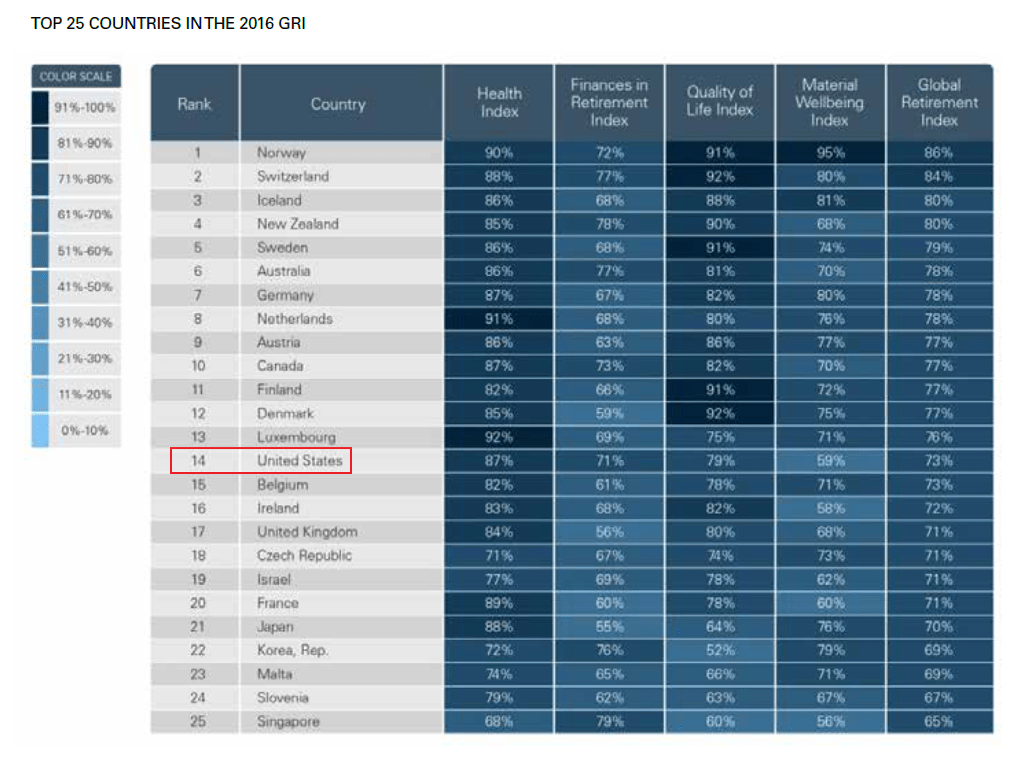
The Top 25 countries based on the GRI are shown below:

Click to enlarge
Top 25 Countries for Retirement

Source: 2016 Natixis Global Retirement Index, Natixis

Of the top 25 countries 17 are from Europe. This is not surprising as socialist European countries spend heavily on social welfare of the society.

The Top Three countries are Norway, Switzerland and Iceland. The US ranks 14th in this list. Some of the reasons for the low scores for the US include high levels of public debt, increasing tax burden , etc. The report also notes that though the country ranks 5th in per capita income globally, it ranks among the lowest in income equality (37th).

Download the full report:


Depressed Stocks May Not Recover For Years

Stocks that fall to depressed levels may take years to recover.Sometimes such companies may end up going bankrupt and equity becomes worthless. Though stocks may be depressed they may continue to trade and simply frustrate investors for years. Depressed levels can be considered as big declines of 50% or more.

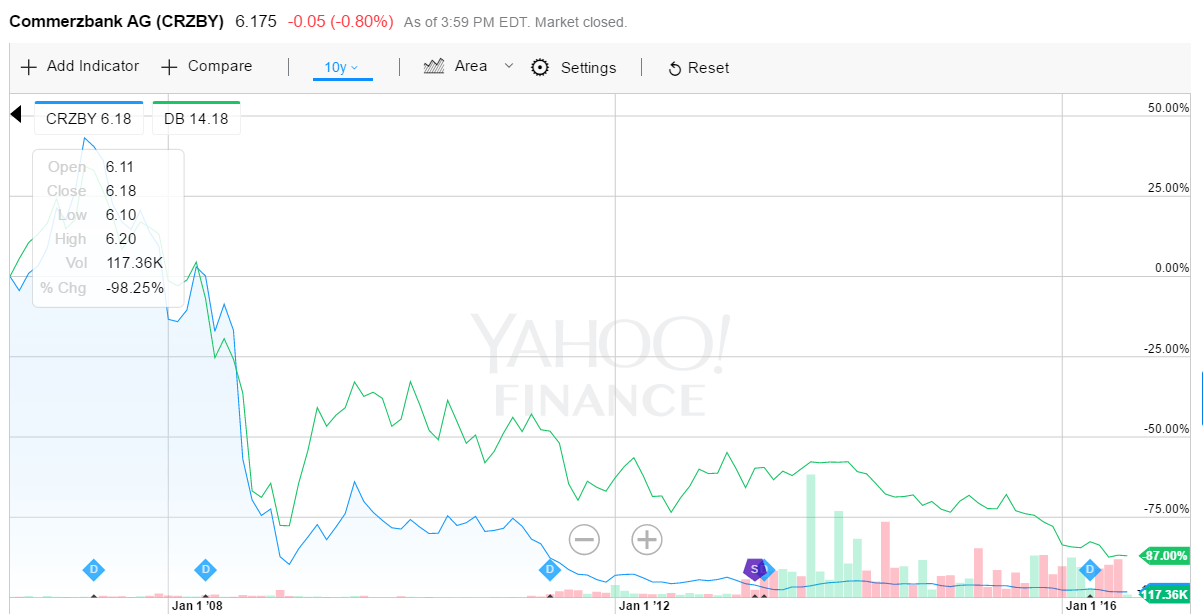
The example below shows the charts of two such depressed companies – Commerzbank(CRZBY) and Deutsche Bank(DB) of Germany. They have plunged over 98% and 87% respectively over the past 10 years. These are two of the largest German banks. With seemingly no end in sight to all the issues facing these lenders investors are treating them as rotten fish.

Another point to remember is that just because stocks fall to 75% or more does not mean they are cheap and investors should invest in them. Former giant Commerzbank even had a 1 for 10 reverse stock split in 2013 in a vain attempt to reverse the continued stock slide. Today it closed at $6 and change.

Click to enlarge

DB-CRZBY 10 Year Returns


Source: Yahoo Finance

Other depressed stocks include Avon Products Inc.(AVP) down over 86% in 10 years, PDL BioPharma, Inc. (PDLI) off by over 82% in the past decade, Groupon (GRPN) down 77% since its IPO, etc.

Disclosure: No Positions

The Fortune Global 500 of Year 2016

Fortune magazine recently published its famous Fortune Global 500 list. The top 10 companies from the ranking for 2016 are shown in the table below:

RankCompanyCountryRevenue in USD
1WalmartUnited States$482.1 billion
2State GridChina$329.6 billion
3China National PetroleumChina$299.3 billion
4SinopecChina$294.3 billion
5Royal Dutch ShellNetherlands & UK$272.2 billion
6Exxon MobilUnited States$246.2 billion
7VolkswagenGermany$236.6 billion
8Toyota MotorJapan$236.59 billion
9AppleUnited States$233.7 billion
10BPUnited Kingdom$225.98 billion

Source: Fortune

US retailer Walmart(WMT) is the world’s largest firm with a revenue of over $482 billion. The second spot went to Chinese utility State Grid. The importance of oil globally is shown by the presence of five petroleum firms in the top 10 above.

124 of the 500 firms are US-based firms.

The complete list of the Fortune Global 500 firms for 2016 can be found here.

Related:

Disclosure: No Positions

Knowledge is Power: Globalization, Facts about Kissing, Oil Stocks Edition

Digging up Mammoth Tusks in Sibera

Digging up Mammoth Tusks in Sibera

Photo Credit: Production of mammoth tusk in Siberia, English Russia

How Big is US Defense Spending ?

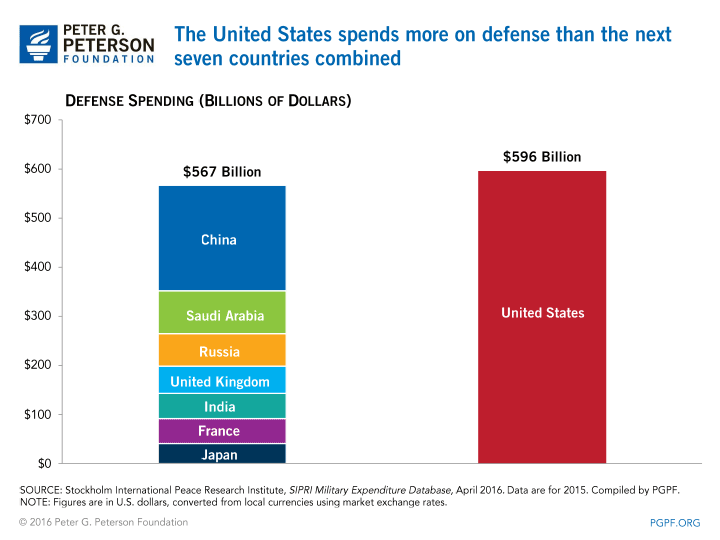
The U.S. easily beats other countries in defense spending. In fact, its defense expenditures accounted for 37% of the world’s military budgets in 2015.  Last year the total US spending on defense reached $596 billion. This figure is more than the defense spending by the next seven countries combined according to Peterson Foundation.

Click to enlarge

US Defense Spending vs Major Countries

Source: Peter G.Peterson Foundation

Military Expenditures in US Discretionary Spending:

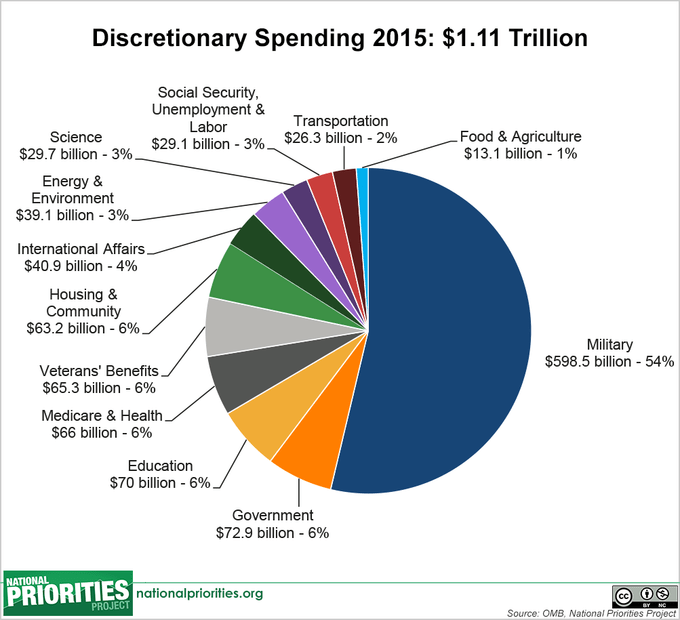
Military spending alone is projected to account for more than half (54%) of all US discretionary spending in fiscal year 2015.

US Defense Spending in Federal Budget

Source: National Priorities Project

Some thoughts on US defense spending:

US allies benefit from the high spending on defense by the US since they are protected by the US military and they are able to divert their resources to other expenses such as social spending.

High spending on military keeps a large part of the economy active and booming at all times. For instance, defense contractors employ thousands of workers producing all kinds of weapons for the military.

Though it may unnecessary to devote more than half the nation’s budget to defense, there are many benefits. For example, military spending many wonderful innovations such as the internet and not the over-hype up venture capital industry.

For millions of middle to poor Americans the US military is the only outlet for getting a job, education and career for a variety of reasons. Without high defense budgets most of these folks would join the ranks of the unemployed. So in a sense the military can be considered as “the employer of last resort”.

Since the world is constantly changing and threats are everywhere, having a powerful world-class military ensures enemies are kept at bay. During peace times, military is a great tool to offer humanitarian assistance to people in need. From Hurricane Katrina to Haiti Earthquakes and thousands of other natural and human disasters, US military personnel provided immeasurable aid and service to victims.