Are Investors Overestimating Europe’s Political Risks?

European equities continue to trade at a discount compared to their developed world peers. For many years, when Europe suffered from one crisis after another including the soverign debt crisis, may rounds of Greek debt crisis, etc. investors fled European equities fearing total meltdown of the political and economic order. More recently, last year the usually traditional and conservative British shook the continent and the world with their suprisee vote for Brexit. Fears of crash in the British equity amrket were proven wrong when stocks soared after the decision.

This year Europe is back in focus on investors’ minds as another set of elecctions are scheduled to take place in Germany, France, The Netherlands and Italy. With populist surge sweeping the US and UK, investorrs are rightfully worried about the outcome of eletions in these countries. As France and Germany are two of the major economies in Europe, any major shakeup in the political system there will have reverberations across the EU.

Though political risk is an important factor to consider when investing in foreign countries, it should be noted that Western European countries are highly devleoped with strong democratic instiutions and so political stability will prevail despite short-term uncertainity. The past European crisis have shown that fears of collpase of the Euro and the EU are overblown.

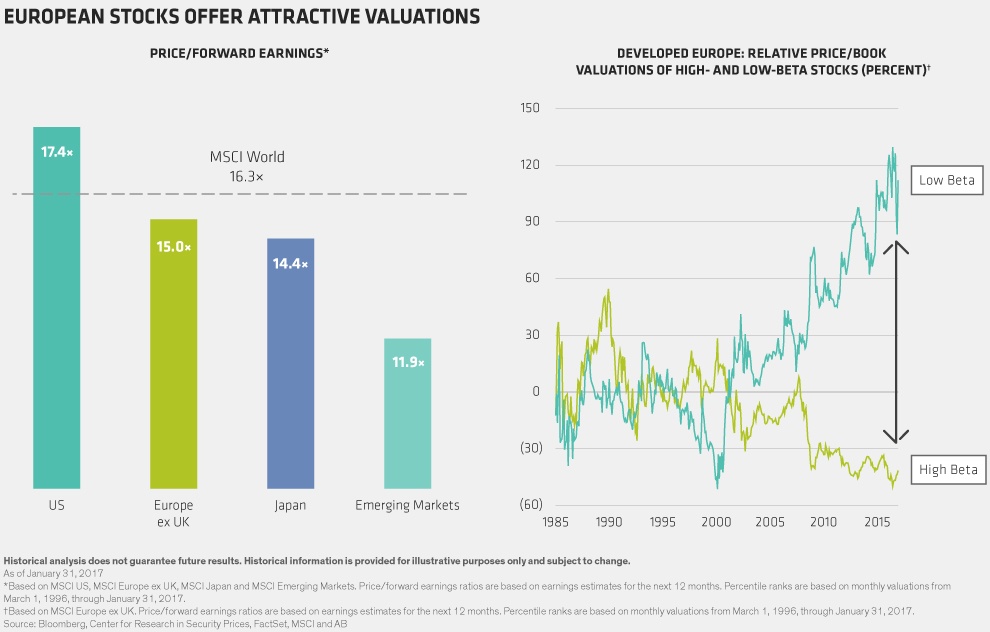
According to an article at Alliance Bernstein blog, European stocks valuations are attractive relative to other markets. And political risks need not justify high discounts compared to other developed markets. From the article:

Today, European stock markets offer abundant opportunities. European equities are attractively valued, in our view, at a price/forward earnings ratio of about 15x—an 8% discount to global developed stocks and a 17% discount to US stocks (Display, left). High-beta stocks, which are generally considered riskier, trade at very deep price/book discounts versus low-beta stocks. In other words, many investors are still overpaying for perceived safety, creating plentiful mispricing for stock pickers to exploit.
 

Source: Does Political Risk Matter for European Stocks?By Tawhid Ali, Andrew Birse, AB Blog

Many European economic indicators are showing signs of growth. For example,commercial lending is picking up compared to US.

Click to enlarge
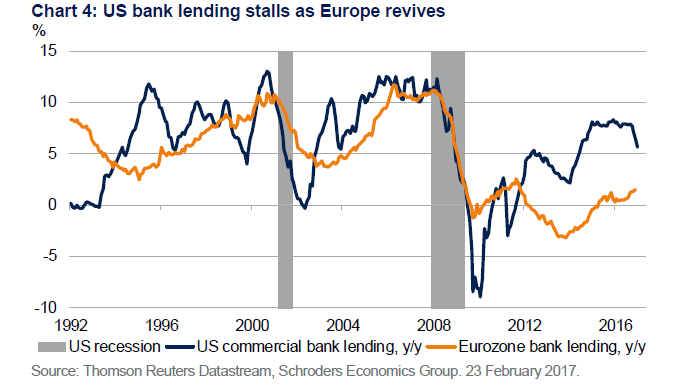
Source: Schroders Economic and Strategy Viewpoint, Schroders, March 2017

So investors with a long-term horizon of five years or more can consider European stocks. Though political risks have to be considered, one need not overweight them to the point of completely avoiding European companies.

Some of the European stocks that investors can consider for long-term investment include: Nestle SA (NSRGY), Reckitt Benckiser Group plc (RBGLY), Henkel AG & Co KGaA (HENKY), Diageo PLC (DEO), Syngenta AG (SYT), Total SA (TOT) and Autoliv Inc (ALV).

Disclosure: Long RBGLY and ALV

Also see: European shares are cheap: time to get greedy?, Money Observer, Feb 27. 2017
Should Fees “Health Warning” Be Made Mandatory In The U.S.?

Fees is an important factor that erode a fund investor’s return. In the long run such as 10 years or more, a fee of 1% or even 0.50% on a mutual fund can cut thousands of dollar from returns due to the effect of compounding. In general, the higher the fees (or expense ratio) the lower the return can be. So investors are better off avoid funds that charge high fees and embrace passively-managed funds with low or very low fees.

Vanguard UK recently called for a fees “health warning” on funds marketed in the UK. From the Vanguard article:

Warnings on fees should receive equal prominence to those on past performance

Vanguard’s research proves high-cost funds struggle to consistently deliver outperformance

Disclosure on fees and performance can, and should, be made radically simpler

Sean Hagerty, Head of Vanguard’s European business said:

“Performance is a potential. Costs are a certainty, hence why investors should focus as much, if not more, on costs. A “health warning” on the impact of costs would be a clear sign of intent from the industry that it’s putting the needs of the investor first.”

To say Sean’s statement is profound and so true is an understatment. One of the few things that we can control is fees. So we must first make use of that power. Performance is simply a projection. Portfolio managers and fund companies can make all kinds of performance projections, comparisions, analysis reports, etc. with cool charts and graphics. But all those mean zilch since performance is just a potential while fees is a certainity. Whether a funds grows by 10% or declines by 40%, fees will be deducted from an investor’s account. Just like death and taxes, fees are a one thing that an investor cannot escape as long as they stay invested with a fund.

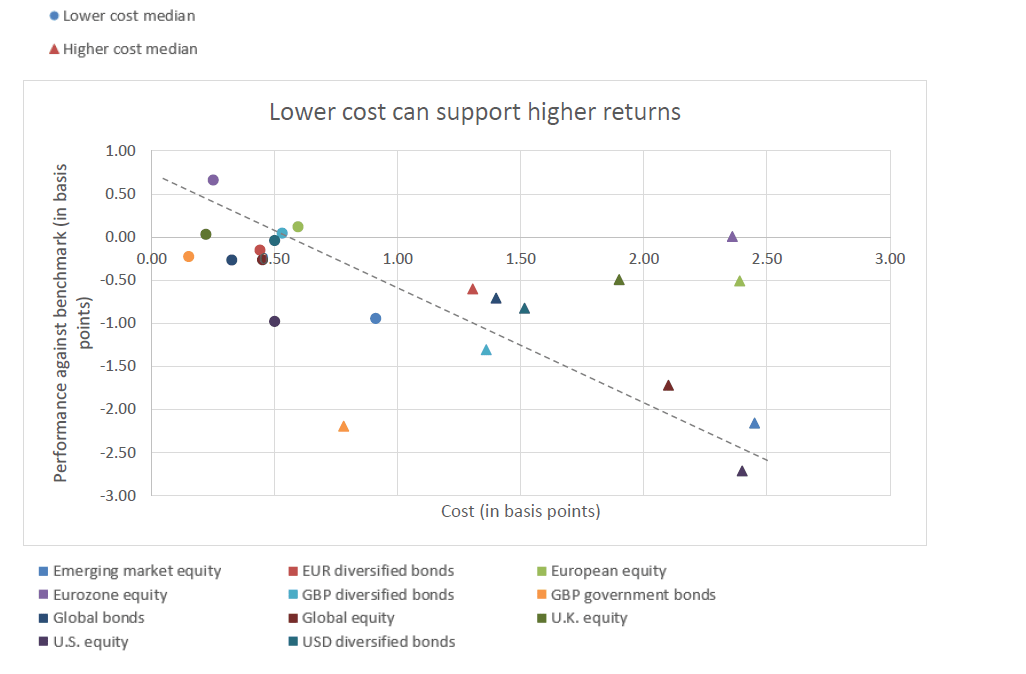
The following chart shows that low-cost funds are better than high-cost funds in terms of returns. From the report:

Vanguard examined the performance of a range of actively managed and index equity and fixed income mutual funds available to UK investors and found that, when funds are split into lower and higher cost-quartiles, the low-cost funds outperformed those with higher costs across all categories, over the past ten years (see figure below)1 .

Source: FCA ASSET MANAGEMENT REPORT: VANGUARD CALLS FOR FEES “HEALTH WARNING” ON FUNDS, Vanguard UK

The answe to my title question is an absolute yes. Many investors are woefully unaware of the adverse impact of high fees. As a result billions of dollars are lost to fees year after year. While good old warnings like “Past performance is not an indicator of future results” are helpful, the really important part is the negative effects of fees.Critical thinkers would agree that the current warning on something that is uncertain is meaningless than posting a warning that is certain.

Update:

An interesting article on fees by WSJ’s Jason Zweig today. From the article:

Daniel Goldstein and Jake Hofman are behavioral scientists at Microsoft Research, a unit of the computer giant. They have shown that numbers become much easier to grasp — and remember — when the words “to put this in perspective” are coupled with a familiar reference.

Today’s prospectuses show cumulative fees on a $10,000 investment over one, three, five and 10 years. Instead, an investor should be able to see those fee totals for any amount or time period she chooses.

If stocks gained an average of 6% annually over the next 30 years, someone who invested $25,000 and paid a 1% yearly fee would cumulatively forgo more than $35,500 in gains. “To put this in perspective,” the disclosure might say, “that difference is greater than the amount you started with.”

Source: It’s Time for a Revolution in Investor Disclosures, WSJ, Mar 10, 2017

Ken Fisher’s Six Ground Rules For Consuming Media For Investors

The media is a big industry in most developed countries with many companies competing against each other to inform and educate the public. In the financial world, the media plays a big part in acting as a middle man between investors , the state, regualtors and the publicly listed companies. For investors, the availability of a wide-ranging spectrum of news sources also becomes both pros and cons. While having as much information as possible can help an investor better investment decisions, too much information and consumption of media also turns into a disdvantage. In the past investors had to deal with financial websites, chat rooms, forums, mailing lists, investment newsletters, etc. today social media has added another dimension to the information explosion. From Twitter to Facebook and everything in betweeen help spread vast amount of information on a daily basis with investors feeling overwhelemed. Simply having access to all this information 24/7 does not always help investors. In fact, if investors consume all the news they can and take investment actions based on them, they can may hurt their returns. So in a world of high media overload with things push notifications constantly hitting our smartphones and all types of media pundits preaching on the TV, it is highly critical that we consume the media wisely.

Simply put, the media is a friend to a smart investor and an enemy to an ill-informed investor.

Ken Fisher, Chiarman of Fisher Investments. published an interesting article this weekend laying his ground rules for consuming media. Following these rules can help an investor make informed decisions. From the article:

Knowing how the media operates, you can glean something useful by following a few ground rules:

Media reports news

By definition, this is what has already happened. But stocks are forward-looking! If the media is reporting something, the time to react and trade on that particular news item has likely passed.

Stocks reflect all widely known information…

That doesn’t mean, in the near term, the stock market is always correct. It isn’t, because people aren’t always correct. Rather, the stock market reflects widely held views.

…as such, forecasting market direction is about measuring relative expectations

When forecasting stocks over the next 12 to 24 months, reality can matter less than what is expected to happen. Understand what people expect and what you think is likely to happen. It’s that gap between reality and expectations that will drive stocks.

Don’t be a contrarian

Just because the media says something, it doesn’t mean the opposite is true. It just might mean the expected impact is under- or over-stated. Just because they say something is so, doesn’t mean it is. Make that a mantra.

Always put data in proper context and ignore the author’s point of view

Journalists know telling the story straight may not always get eyeballs, so they may include an exciting narrative that obscures reality or use anecdotes which may not be statistically significant.

Ignore adjectives, adverbs and anecdotes unless they highlight something fundamental and isolate the facts. Then consider them in context. Scale the number. Ask: ‘What’s the global impact?’

Be politically agnostic

Many people have an ideology they view as correct, but ideology is another form of bias that can blind you. Vary what you read, and be an equal-opportunity sceptic.

Follow those ground rules and you’ll be a better, more informed consumer of media. Don’t ignore media – use it to your advantage.

Source: ‘I heard it in the news, so it must be so’: Fisher’s financial mythbusters, Money Observer, Feb 24, 2017

The key point to remember is that the media must be mostly used for entertainment purposes. Any information presented by the media must be questioned critically before making a conclusion. As Fisher notes above, journalists and others in the media world have an agenda which can be to garner more viewers, to earn more advertising revenues, promote a company’s product, etc. In order to support that narrative, they will usually have colorful graphics, charts and other third-parties corroborate that story with additional data.

Below are a few personal rules that I follow when consuming media:

  • Always look out for what is not mentioned or avoided.
  • Be wary of statistics as numbers can be massaged to fit a story.
  • Do not watch too much of business TV networks.
  • Whenever an “expert” makes a prediction use caution on both the expert and the prediction.
  • Do not trust any of the surveys put out by the media as survey responses can easily be manipulated by framing the questions in one way or using a small random to make big conclusions.

From Brexit in the UK to the outcome of the US elections the media has been miserably wrong in a million ways. So smart investors should consume media with a grain of salt in order to be successful in meeting their long-term goals.

Australia vs. Canada: Household Saving Ratio and Household Debt-to-Income Ratio

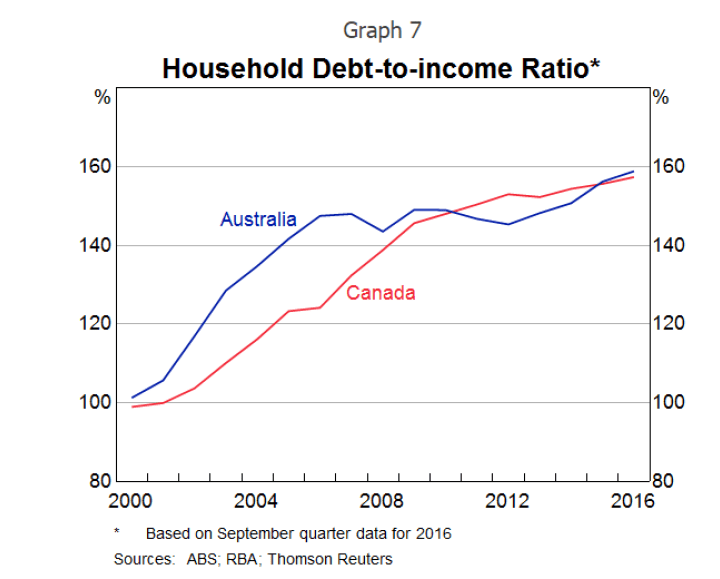
Households in Australia and Canada are carrying high-levels of debt in recent years. In both the countries mortgage is a major driver of household debt as prices of houses have skyrocketed. Overall the debt-to-income ratio for households has been rising in both the countries as shown in the chart below:

Click to enlarge

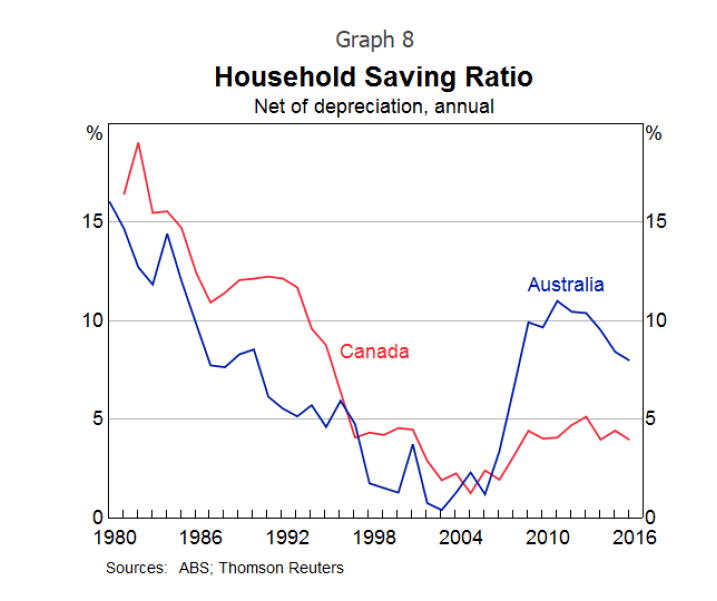
The household saving rate declined continousely since the 1980s until 2004. However they have reversed direction and has been on an upward trend in the past few years. The saving rate in Australia is much higher than in Canada

Source: Philip Lowe: Australia and Canada – shared experiences a speech by Mr Philip Lowe, Governor of the Reserve Bank of Australia, BIS

Hat Tip: Matthew C. Klein at Alphaville

Emerging vs. Devloped Markets 12-Month Foward EPS Growth: Chart

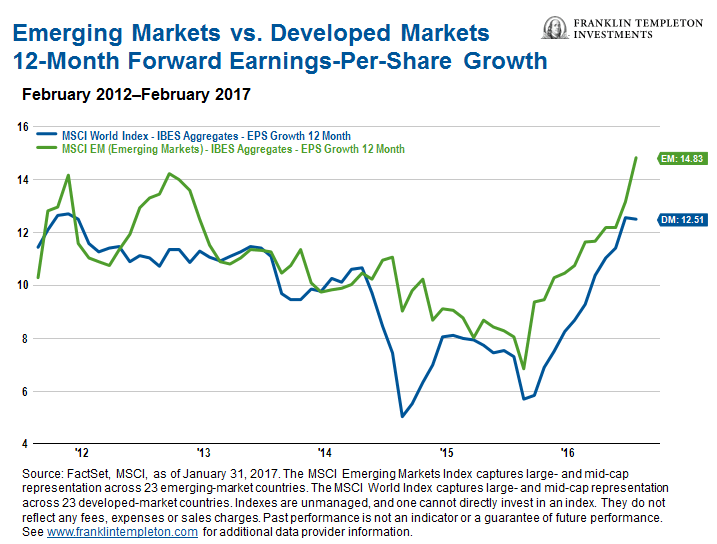
Emerging equity markets have performed well so far this year. After a few years of disappointing average to poor returns emerging stocks are projected to have good growth potential this year. For example, commodities such as copper prices are rising due to rising demand.

Some of the emerging markets’ year-to-date returns are listed below:

China’s Shanghai Composite: 4.8%
India’s Bombay Sensex: 8.0%
Brzail’s Sao Paulo Bovespa: 14.7%
Russia’s RTS Index: 0.8%
Chile’s Santiago IPSA: 5.0%
Mexico’s IPC All-Share: 4.3%

Source: WSJ

In an article published last week, Stephen H. Dover of Franklin Templeton Investments is also bullish on emerging equities. From the article:

Despite some uncertainties, we see opportunity in emerging markets in 2017 and are optimistic many investors will see value in making greater allocations to them. GDP growth is expected to outpace that of developed markets, with the International Monetary Fund projecting growth of 4.5% in emerging and developing economies versus 1.9% in developed markets this year.8 We see evidence that earnings growth in emerging markets could likely be higher than in developed markets, too. Emerging markets have been lagging in regard to earnings growth, but 2016 marked the first time in more than five years they outperformed developed markets. We think there’s still quite a bit of room for emerging markets to further catch-up.

8. Source: International Monetary Fund World Economic Outlook, January 2017 update. There is no assurance that any estimate, forecast or projection will be realized.

Source: An Emerging-Market Evolution, Franklin Templeton Investments

From an investment perspective, not all emerging markets are out of the woods yet. However many attractive opportunities can still be found in some markets such as Chile, Brazil, Mexico, etc.