Diversification is Key to Risk Management

One of the simple and easy ways to reduce risks with investing in equity markets is to diversify one’s assets across various asset types, countries, regions, etc. The following chart shows the unpredictability of market returns one year after another:

Click to enlarge
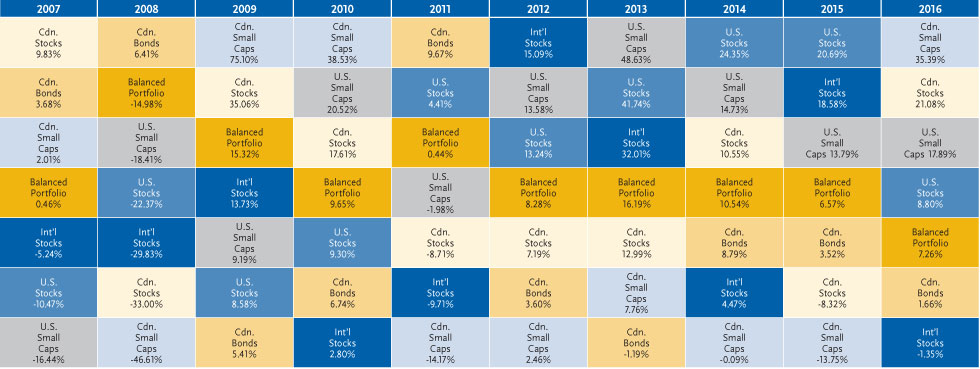
Source: AGF Investment Operations, December 31, 2016. Canadian Stocks represented by S&P/TSX Composite Total Return Index, U.S. Stocks  – S&P 500 Total Return Index (C$), International Stocks  – MSCI EAFE Index (C$), Canadian Bonds – FTSE TMX Canada Universe Bond Index, U.S. Small Caps – Russell 2000 Index (C$), Canadian Small Caps – BMO Nesbitt Burns Canadian Small Cap Index. Balanced Portfolio made up of 20% Cdn. Stocks / 20% International Stocks / 15% U.S. Stocks / 40% Cdn. Bonds / 2.5% U.S. Small Caps / 2.5% Cdn. Small Caps.
The information provided is for illustrative purposes only and is not meant to provide investment advice. You cannot invest directly in an index. Calendar years returns in Canadian dollars.

Source: AGF Management Limited
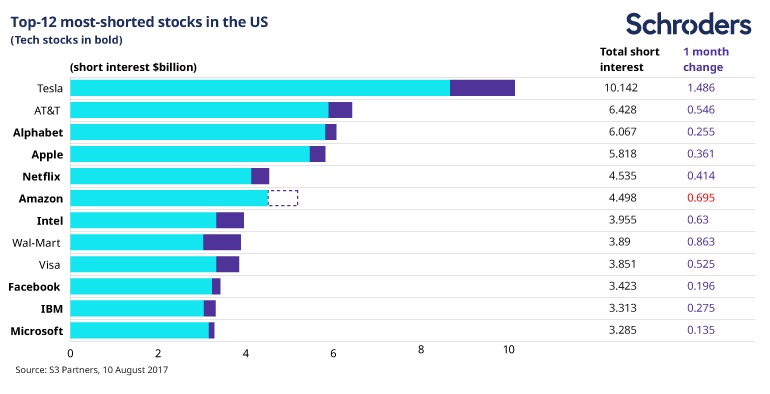
Nine out of the Top 12 Most-Shorted US Stocks Are Tech Stocks

The tech sector in the US equity market has soared to astronomical levels this year. In terms of equity returns, the sector as a whole has risen more than double that of the S&P 500 so far this year. Most investors seem to have forgotten about the dot com crash and are placing their hopes on the next tech boom with things like Artificial Intelligence(AI), Cloud, Internet 2.0, e-Commerce 2.0, Self-driving cards, Internet of Things, etc. Retail investors and institutions have been piling into tech stocks in fear of missing out the boom. Long dead tech stocks like those in the semiconductor space have also shot up catch the tech craze among investors. For example, chip maker NVIDIA Corporation (NVDA) is up nearly 60% year-to-date.

Though most investors are bullish on the sector, short-sellers are betting that these over-hyped stocks are due for a fall. According to an article at Schroders today, of the 12 most-shorted stocks in the US market, 9 stocks are from the tech sector. From the article:

Short-sellers get their teeth into FANGs

Eight out of the 12 most-shorted stocks in the US are from the tech sector, and the short interest is growing, according to latest data from S3 Partners.

If, as is frequently argued, Elon Musk’s Tesla is categorised as a tech stock rather than a car manufacturer, that figure rises to nine out of 12.

Investors “short” a stock when they expect the price to fall.

The tech sector, which includes the so-called “FANG” quartet of Facebook, Amazon, Netflix and Google (now Alphabet), has outperformed strongly in recent years. As a result, valuations have risen to levels that make some investors (including our Value team) nervous.

Year-to-date as at 29 August the S&P 500 North American Tech Sector index has risen 22.5%, compared to a return from the broad S&P 500 of 10.6%, according to Bloomberg. Over three years the respective numbers are 64% versus 36%.

Past performance is not a guide to future performance and may not be repeated.


SourceChart attack: Seven market snapshots from August, Schroders

The key takeaway for investors is that caution is warranted with investing in tech stocks at the current levels.

Disclosure: No Positions

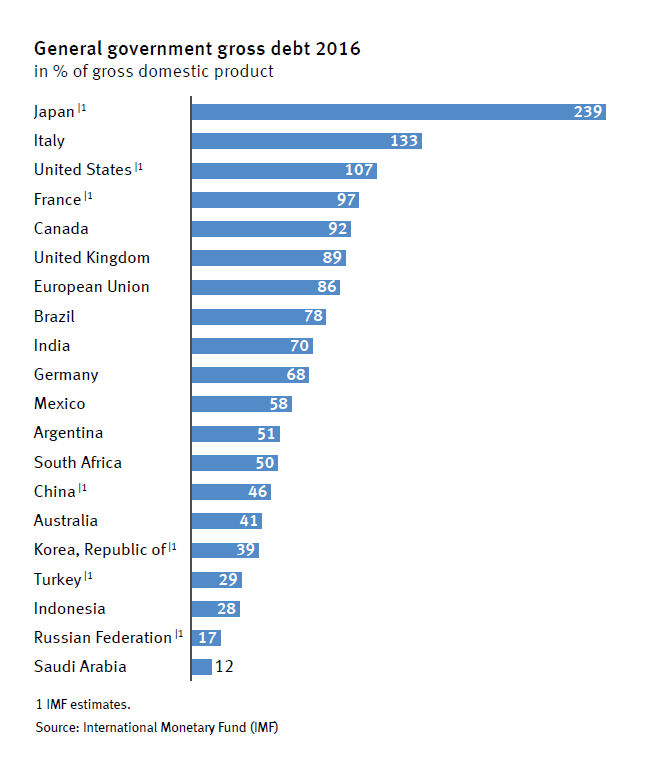
General Government Gross Debt as a Percentage of GDP by Country 2016

The majority of the G-20 countries recorded a deficit in 2016. Only South Korea and Germany had a budget surplus last year. In all the other countries government expenditures exceeded revenues.

The gross debt level also remains high in G-20 countries. The chart below shows that Japan had the highest debt levels that was over double of its GDP. The next high debt countries were Italy and USA whose debt was more than their respective GDPs.

Click to enlarge


Source: G20 in Figures – Summit of the G20 states in Hamburg 2017

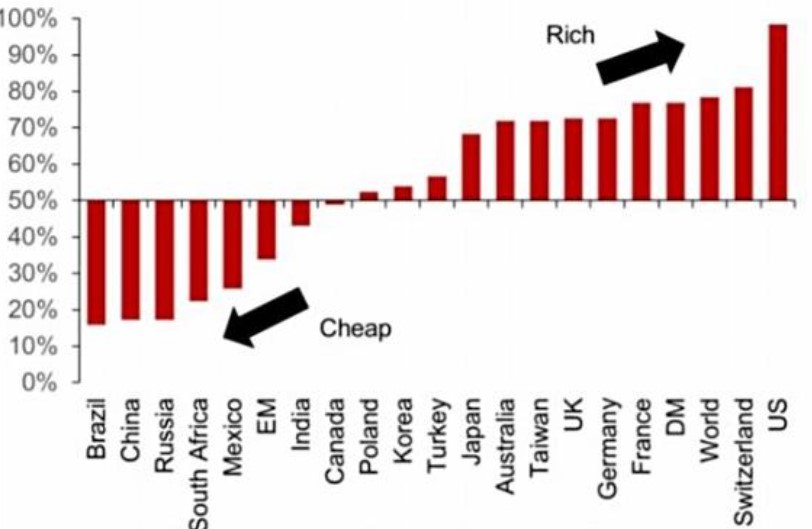
Global Equity Markets: Which Markets are Cheap and Which Markets are Expensive?

US Stocks have performed well so far this year with the S&P 500 up by over 10% based on price returns. However though US stocks can still go higher on a valuation basis, they are expensive relative to other major markets in the world including other developed markets. Though American stocks always commanded a premium over other markets, it does not mean they can continue to go higher and higher. Much of the post-election euphoria is over and tax reforms also seem to be headed for a failure. So investors need to be cautious with any new investments.

The following is an excerpt from an article by by Niels Clemen Jensen at Absolute Return partners:

The valuation argument first. Although it is very much a US-based argument, equity valuations are not outright cheap anywhere in the developed world (Exhibit 7), and we all know that, should US equities run into the proverbial wall, it will definitely have some negative impact on equity markets elsewhere.

Source: Two Sides of the Same Coin – September 2017, The Absolute Return Letter , Absolute Return Partners

Related ETF:

  • SPDR S&P 500 ETF (SPY)

Disclosure: No positions