How American Workers Suffer a Double Whammy of Higher Taxes and Lower Wages

The US unemplyment rate stood at 4.4% in August according to BLS data. Despite the steady decline in the rate since the Global Financial Crisis(GFC) wage growth contniues to be stagnant. In most industries wages have not kept up with inflation. However the economy as a whole is growing due to credit markets. Debts of all types are soaring as workers maintain their lifestyle with debt as opposed with income.

While there are a multitude of reasons for the lack of growth in wages, one of the primary factor for low-level workers is illegal immigration. Since supply of labor exceeds demand wages tend to be sticky. According to an article at FP, native-born citizens not only earn lower wages but also pay higher taxes when illegals get benefits. From the article:

A century and more ago when the captains of American industry imported European workers for their mines, mills and factories, labour wasn’t cheap — American workers then earned the highest wages in the world — and it wasn’t subsidized. America’s industrialists would finance their recruits’ voyage by sea, and also provide the necessities of life through what were known as company towns. Industry won, workers won, and society won through the largely free-market relationships that then ruled labour markets.

Today’s captains of industry, in contrast, profit at the expense of taxpayers, who foot much of the bill for the immigrants’ medical, schooling, housing, policing and welfare costs. The National Academies study pegs the annual cost to state and local governments at US$57 billion, or US$1,600 a year per new unskilled immigrant, and estimates that it will take 75 years before this immigrant stops being a net loss to society. The native-born American worker not only shoulders much of this cost through his taxes, he also suffers a wage hit. The $500 billion per year in lost wages, in effect, amounts to an immigration tax on the native-born worker estimated at 5.2 per cent.

Source: Why America’s elites like DACA, and so many American workers don’t, Financial Post

One way workers can protect themselves from the effects of legal and illegal immigration is to get a job in regulated industries mentioned in the article.

Also see:
Emerging Market Returns by Country From 2003 Thru First Half 2017

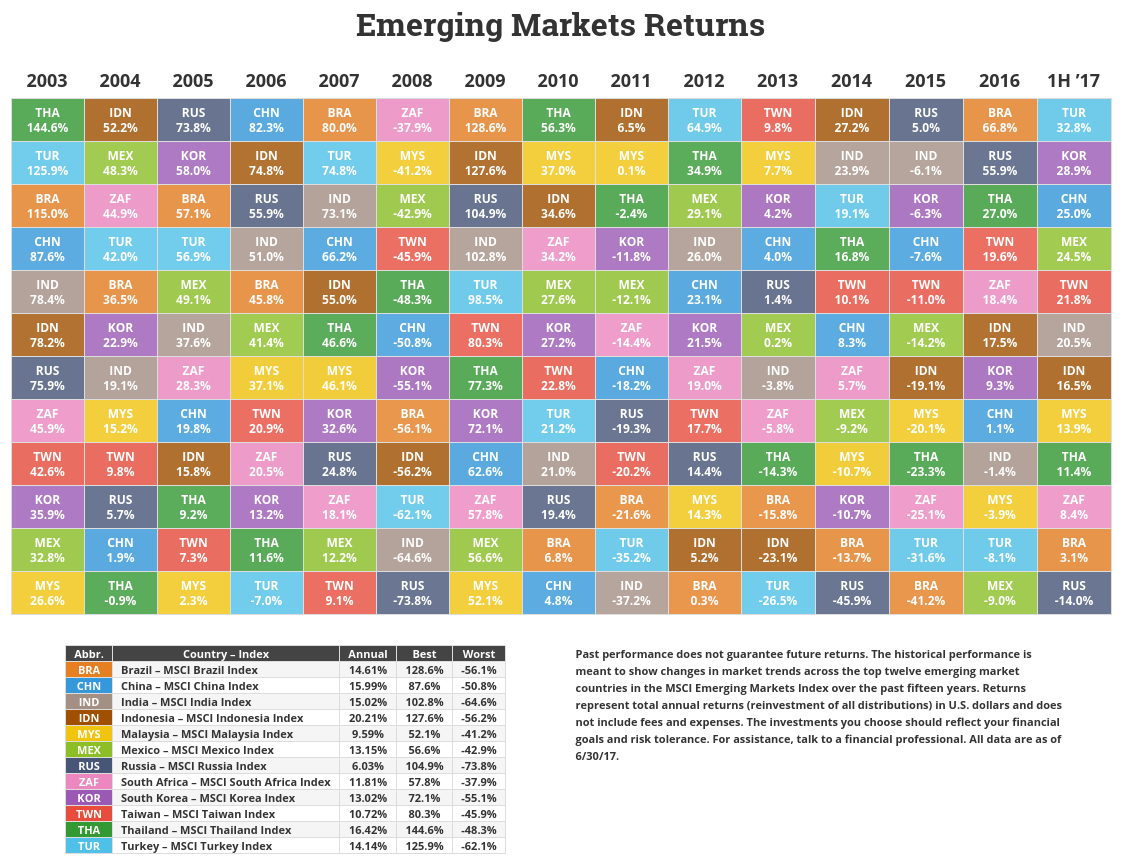
Emerging markets have performed well so far this year with countries like India, Brazil, Mexico, etc. up by double digit percentage points.

Unlike developed markets, emerging markets tend to me more volatile in terms of returns from year over year. The chart below shows the returns of emerging countries from 2003:

Click to enlarge


Note: The returns shown above are based on MSCI country index returns.

Source: Novel Investor

Related ETFs:

  • iShares MSCI Mexico Capped Investable Market (EWW)
  • iShares FTSE/Xinhua China 25 Index (FXI)
  • iShares MSCI Brazil Index (EWZ)

Disclosure: No Positions

Multiple Expansion or Dividend Growth: Which is the Main Driver of Long-Term Equity Returns ?

Generally most investors aim achieve their long-term goal with equity investing with capital appreciation of their holdings. Only some of the investors pay attention to dividend yield and dividend growth in the long-term. While there are many reasons for this situation, one of the main factor is that growth stocks tned to have solid and strong growth over many years and their yields tend to be low Similarly value stocks tend to have low growth.

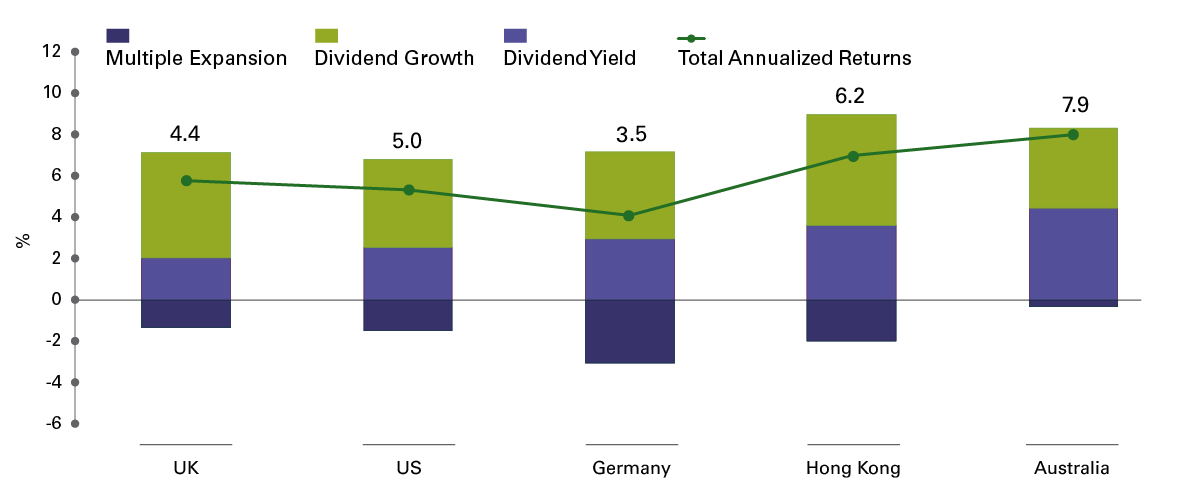
Contrary to populate belief, dividend yield and growth have played a major role in total annual returns over the past 15 years than price appreciation. In a recent article, Mark Whitehead at Legg Mason discussed the importance of dividends in total returns.

From the above article:

Equities are intimately associated with capital appreciation, but this overlooks the fact that income is the main driver of long-term returns. Indeed, as Chart 2 shows the multiple-expansion component has actually been a detractor of returns over the past 15 years, with the dividend yield and dividend growth doing all the pulling – an observation that applies across markets. Not to forget the fulcrum that is compounding. Dividends reinvested can materially boost returns over time, thanks to some very simple – but often ignored – arithmetic.

The risk in a yield-starved environment such as the current one is that investors start moving along the quality curve in a desperate hunt for income. Rarely is this wise. Higher-quality dividend payers can provide better risk-adjusted returns than both the broader equity market and bonds. A related observation is that dividend-paying stocks tend to be less volatile – typically with a lower maximum drawdown – than their non-paying counterparts, making the journey less nerve-wracking for shareholders worried about the gyrations of markets.

Click to enlarge


Source: THE CASE FOR GLOBAL EQUITY INCOME, Legg Mason

Dividend growth has contributed significantly to the overall total annual returns than tultiple expansion in all the five countries shown above. The contribution of dividends to total annual return was much higher in the UK than the US.

The key point to rememeber is that dividends play a major role in total returns and investors should not focus mostly on price gainss especially in the long run. Due to the effect of compouding and growth year after year, dividends can exceed price gains in some periods.


The US Consumer Debt Burden: Infographic

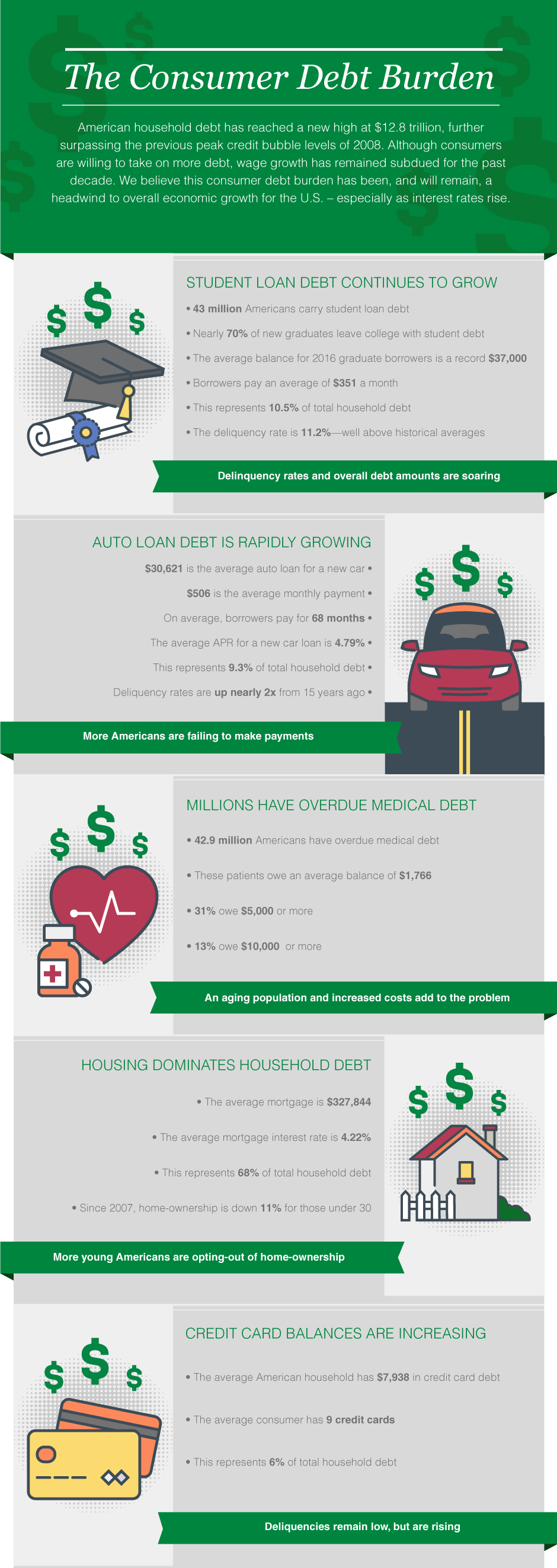
US household debt has reached a new high of $12.8 Trillion. This figure exceeds the debt levels reached in 2008 at the height of the Global Financial Crisis(GFC). A strong economy with low unemployment rates is allowing American consumers to take on more debt. As a results debts of all types from credit cards to auto loans have been increasing.

The following is an inforgraphic showing the various types of debts of American households:

Click to enlarge


Source:  The Consumer Debt Burden, Manning & Napier


Some CAC-40 Companies Have Low Exposure To France

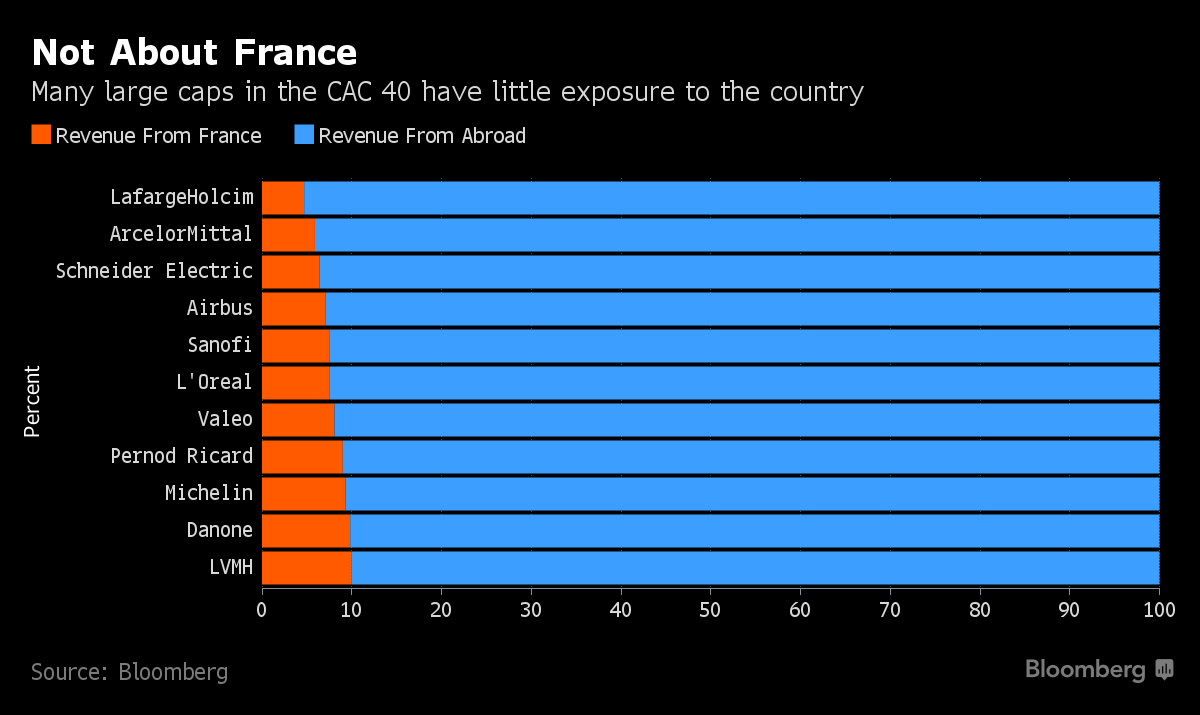
Some of the constiuents of the CAC-40 index have low exposure to the domestic market. Similar to major firms in the FTSE-100, some large French firms derive most of their revenues from markets outside of France. Hence stock performance of these firms is more dependent on overseas economies than France.

The following chart from a Bloomberg article earlier this year shows some of the CAC-40 exposure to the domestic and foreign markets:

Click to enlarge

Source: Déjà Vu as France’s CAC Harks Back to FTSE 100 Before Big Vote, Bloomberg

Disclosure: No positions