Performance of European Defensive vs. Economically Sensitive Stocks Since Global Financial Crisis

Defensive stocks perform well during periods of economic contractions and uncertainity. The sector comprising of stocks in the consumer staples and healthcare industries have outperformed sectors such as commodities that are sensitive to the economy since the global financial ciris of 2008-09 in the European context.

Click to enlarge
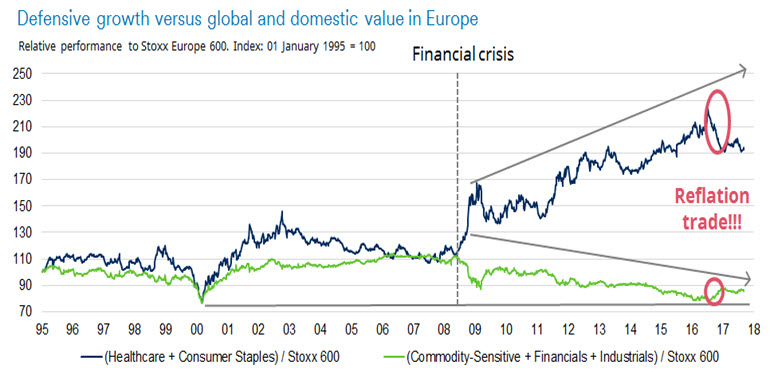
Source: Why high beer prices could give investors a hangover by James Sym, Schroders

The key point to remember is that consumer staples stocks are an important ingredient in a well-diversified portfolio and that during adverse market conditions they can offer protection and stable growth.
Unloved Food Stocks Deserve A Look

One of the sector that is currently unloved by the market is the food sector.Investors are avoiding food producers for a variety of reasons. Though many of the factors cited are understandable investors need not totally ignore stocks from the sector. As part of the consumer staple industry food companies deserve a look and are worth holding in a well-diversified portfolio as they can offer shelter during market downturns. Besides many of these firms offer stable and growing dividends. This makes them attractive for income seeking and long-term investors. The key point to remember is that even in recessions consumers have to eat food and these established companies are not just going to disappear anytime soon.

Some of the reasons for the current bearishness on the food sectors include:

  • Online retail goliath Amazon(AMZN)’s acqusition of Whole Foods. The argument is that Amazon would drive down food prices with its own brands and severely impact traditional food companies.
  • Consumers’ preference for healthy and non-sugary foods. Hence cereals like froasted flakes are out the window and the maker of such products will suffer.
  • Grocery chains and other retailers building out their universe of store brands that are priced much lower than name brand prducts. As more and more consumers move towards these cheaper brands the premium branded players will lose market share.
  • Fearing the collapse of the sector, some of the CEOs of a few large-cap food producers are fleeing the ship.
  • Pricing pressures and changes in consumer taste are also adversely affecting food makers.
  • In addition, millenials and other youngesters are avoiding traditional instant foods to healthier fare.

Despite all the negative reasons listed above investors can still consider food stocks especially at curent levels. Some of the major companies in the sector are listed below with their current dividend yields for consideration:

1.Company: Kellogg Co (K)
Current Dividend Yield: 3.46%

2.Company: General Mills Inc (GIS)
Current Dividend Yield: 3.77%

3.Company: Mondelez International Inc (MDLZ)
Current Dividend Yield: 2.15%

4.Company: Campbell Soup Co (CPB)
Current Dividend Yield: 3.01%

5.Company: ConAgra Foods Inc (CAG)
Current Dividend Yield: 2.50%

6.Company: Kraft Heinz Co (KHC)
Current Dividend Yield: 3.21%

7.Company: Danone SA (DANOY)
Current Dividend Yield: 2.37%

8.Company: The Hershey Company (HSY)
Current Dividend Yield: 2.42%

9.Company: Unilever NV (UN)
Current Dividend Yield: 2.53%

10.Company: Nestle SA (NSRGY)
Current Dividend Yield: 2.68%

Note: Dividend yields noted above are as of Oct 5, 2017. Data is known to be accurate from sources used.Please use your own due diligence before making any investment decisions.

Disclosure: Long GIS

Related:

Also see: Consumer Staples: Why a “Boring” Sector May Be Worth a Look, Schwab, Oct 10, 2017

Why Build A Diversified Portfolio

One of the very important factors for success with investing is the ability to build and own a diversified portfolio of various assets types. Simply owing only stocks for the long-run is highly risky. So it is better to own a combination of stocks, bonds, gold, real estate, etc. in a well-diversified portfolio.

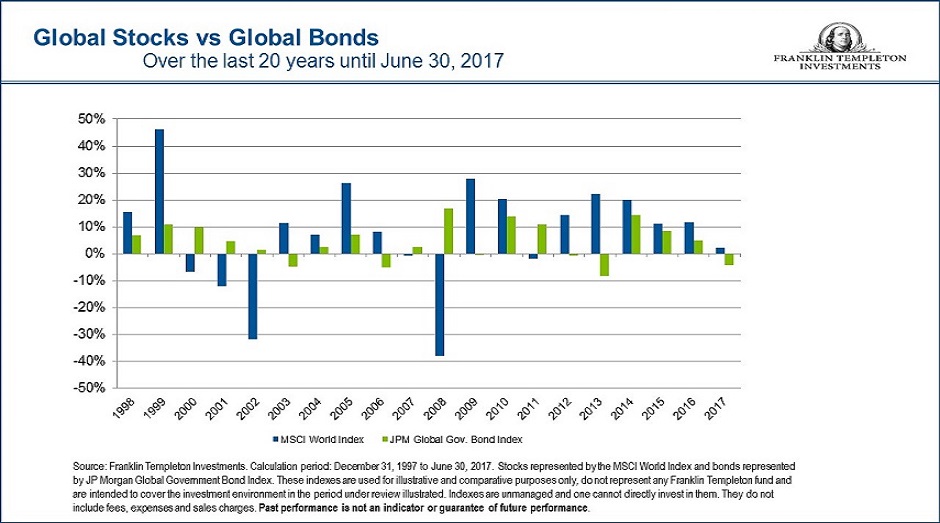
Stocks and bonds globally have moved in different directions over the past 20 years as shown in the chart below:

Click to enlarge

Source: Lessons Learned from the Global Financial Crisis, T. Anthony Coffey, CFA,  Franklin Templeton Investments

The above chart shows that holding both stocks and bonds can offer stability and higher long-term growth. For example, in 2008 when stocks fell nearly 40% global bonds were up by over 15%.

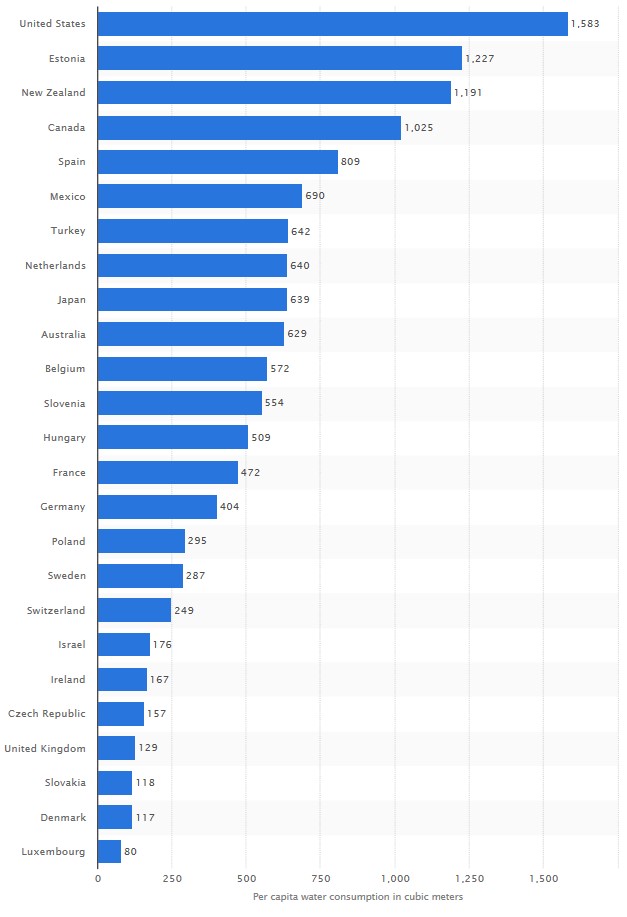
Water Consumption per capita for Select Countries

Water consumption per capita is high in the US relative to other countries. An average American consumes 1,583 cubic metres per year. Other developed countries like UK, Denmark, Ireland, etc. consumer much less. For example, an average British consumers only 129 cubic metres according to the chart below:

Click to enlarge


Source: Running Out of Freshwater, The Absolute Return Letter, Oct 2017, Absolute Return Partners

See also: