Cyclical Bull Market in US Stocks Since World War II

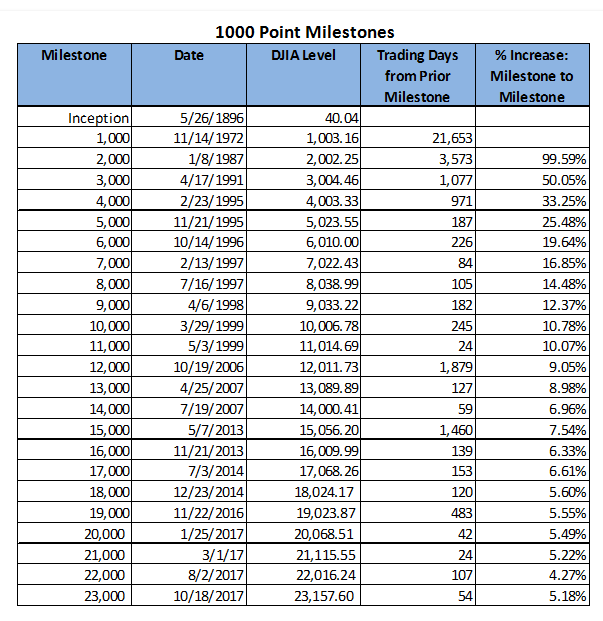
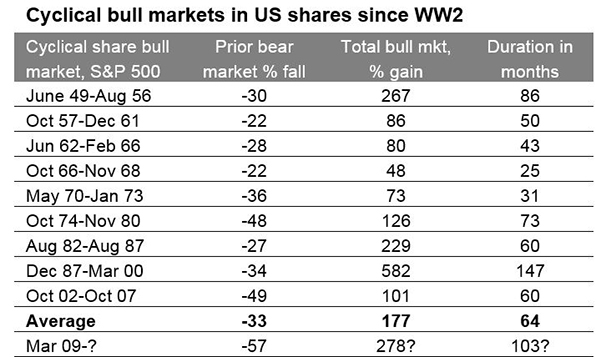
The Dow Jones crossed 23,000 for the first time today. The S&P 500 has also made record gains since the Global Financial Crisis(GFC) of 2008-09. In fact, the current cyclical bull market is the second strongest in terms of returns and is also the second longest since World War II according to an article by Shane Oliver at AMP Capital.

The following table shows the many cyclical bull markets in US stocks since World War II:

Click to enlarge

Source: Where are we in the global investment cycle and what’s the risk of a 1987 style crash? by Shane Oliver, AMP Capital

Shane used the definition that  “a cyclical bull market is a rising trend in shares that ends when shares have a 20% or more fall (ie, a cyclical bear market). Source: Bloomberg, AMP Capital.”

Euro Zone Stocks Have Still Reached Their Previous Peaks

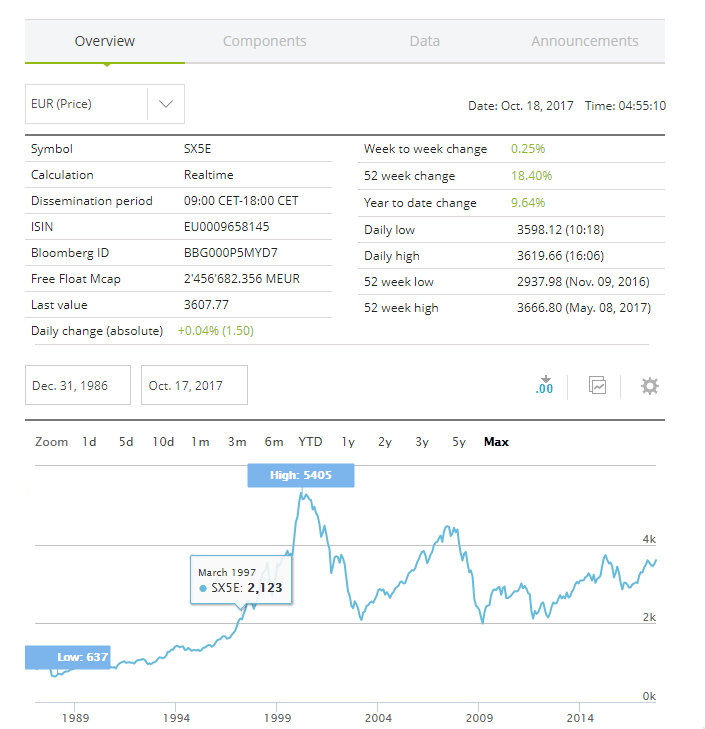
Stocks in the Euro Zone are still lagging behind in terms of recovering previous losses. For instance, the benchmark Euro Stoxx 50 index has still not reached the peak attained before the Global Financial Crisis of 2008-09 as shown in the chart below. In addition, the record high of 5,405 before the dot com bust still remains the highest peak.

Click to enlarge


Source: Stoxx

Related ETF:

  • The SPDR  EURO STOXX 50 ETF  (FEZ)

Disclosure: No Positions

Black Monday Was Just a Blip in the Long Run

On 19 October 1987 the Dow Jones fell an astonishing 22.6% making it the worst one day fall in its history. That day has gone into the history books as the “Black Monday”.

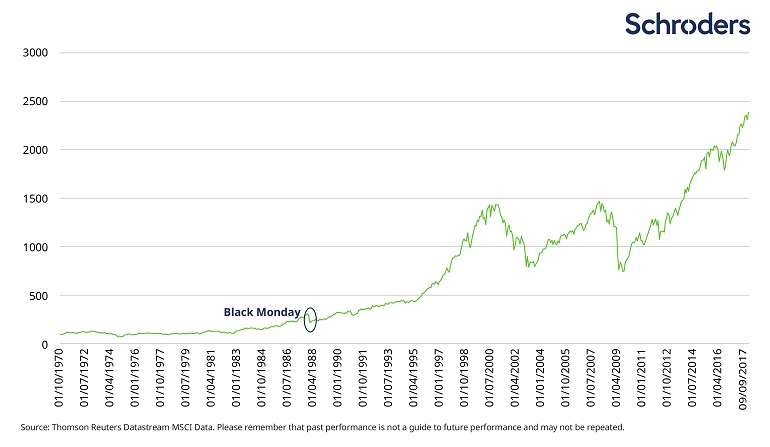
Though Black Monday was a terrible day for equity investors it was just a blip in the long term returns of the US equity market. The following chart shows the long-term returns of the MSCI USA Index from 1970 thru September 2017:

Click to enlarge

MSCI USA: 1970-2017 and the blip that was Black Monday

Source: Black Monday 30 years on: how it happened and what we can learn by David Brett, Schroders

From David’s above article:

The chart above (edited) reflects the fluctuations in the US stockmarket since 1970. It illustrates how Black Monday registered as barely a blip in the long term and how resilient stocks have been over the last 47 years.

Those who invested after Black Monday would have seen $100 turned into $1,135 without considering the dividend income paid out. That high return was achieved despite remaining invested through the dotcom crash of 2000-03 and the global financial crisis of 2007-09.

The takeway for investors is that in the long-run even scary one-day plunges in markets may become inconsequential in terms of returns. When markets take dramatic turns like that Monday 30 years ago investors need to remain calm and not sell out.  Instead of panicking investors have to focus on their long-term goal and simply ride out the storm. The above example shows how patient investors were rewarded after enduring the dot com and the global financial crisis of 2008-09.

Update:

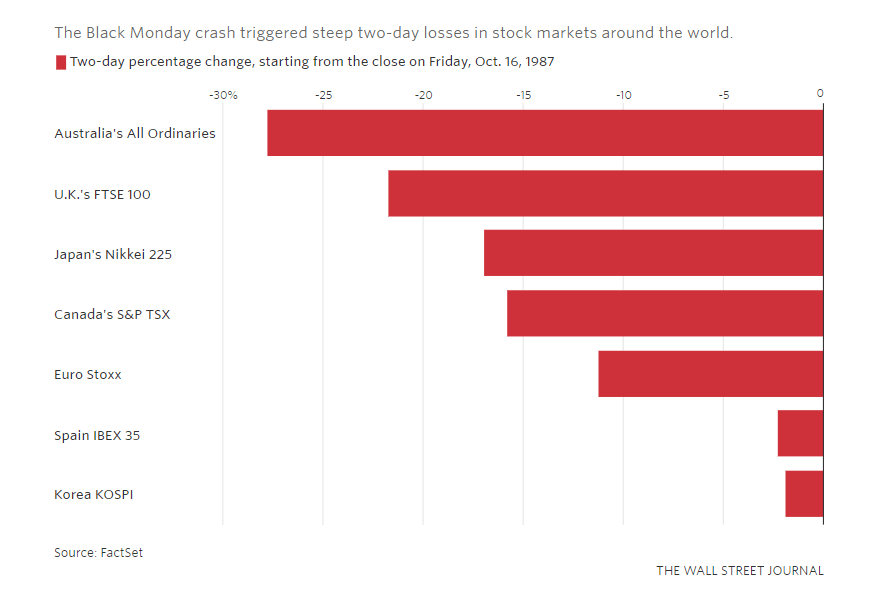
Global Markets following Black Monday, 1987:

Click to enlarge

Source: WSJ

US Retail is Oversatured Compared to Other Developed Countries

The US is the third largest country in the world based on land mass. With a population of around 323 million it is the third most populous country in thr world after China and India.

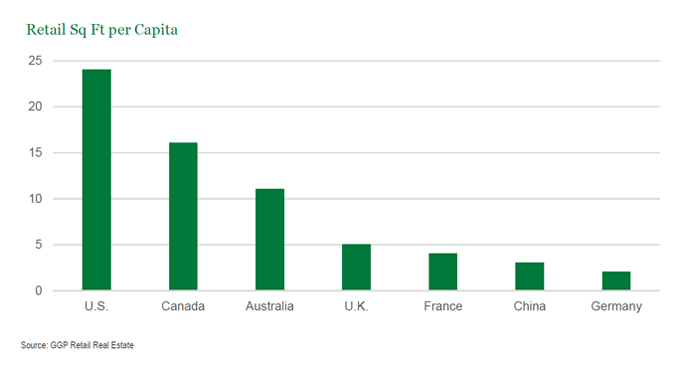
In terms of retail space the US has the highest amount of space per person than other major developed countries. With the explostion of online shopping many national chains are closing stores every year. According to a Credit Suisse report, about 8.640 stores are projected to be closed this year compared to 6.200 at the peak of the Global Financial Crisis(GFC).

The following chart shows the vast oversaturation in American retail:

Click to enlarge

Source:Retail Closures on Record Pace,  Manning & Napier

The difference in retail space per capita between Germany and USA is shocking. Years of overbuilding of stores and shopping malls in the US like there is no tomorrow has lead to the death of many of these cathedrals of capitalism in recent years. Abandoned malls dot the country from small towns to mid and large cities. Over the next decade or so many more thousands of stores and hundreds of malls will be shutdown and converted to space for some other useful purpose.