Honda vs. Tesla: A Brief Review

Electric automaker Tesla(TSLA) has become one of the most valuable auto companies the world. Investors are highly attracted to the company’s stock for its growth potential. In this post, let’s take a quick look at how Tesla compares with the Japanese auto giant Honda.

Equity investors in Tesla have enjoyed phenomenal gains. The firm’s stock is up 43% year-to-date compared with just 13% for Honda Motor Co. Ltd(HMC). In the past five years, TSLA has shot up an astonishing 873% while HMC is basically flat as shown in the chart below:

Click to enlarge
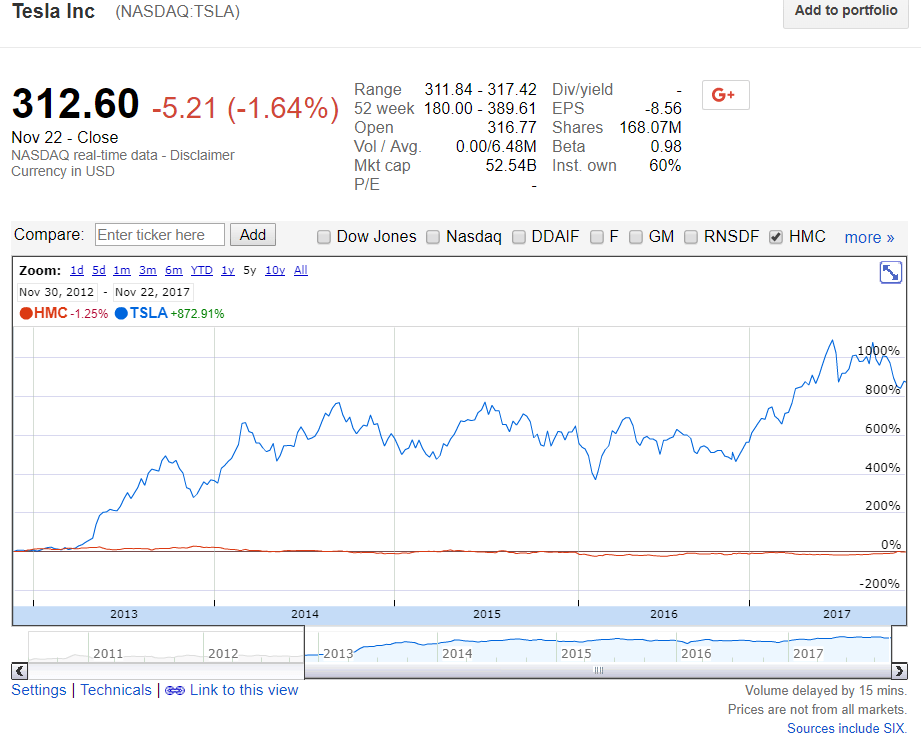
Source: Google Finance

In the past 10 years, TSLA has soared 1,528%. However it should be noted that Tesla is a highly volatile stock.Even a small negative news has a substantial adverse on the stock price.

Ben Preston of Allan Gray published an article titled “Finding value in an over-valued world”. From the piece:

Honda vs Tesla

Graph 1 compares the market capitalisation and revenue of Honda and Tesla. It is remarkable that investors have allowed themselves to be so convinced of Tesla’s future success that they are now saying Tesla is worth more than the whole of Honda, even though Honda has 10 times the revenue. Bear in mind that in a decade of existence, Tesla has never been profitable. And, in the last four decades, Honda has never been unprofitable.

It is important to acknowledge that Honda’s earnings have historically been cyclical. The company experienced a big decline in earnings from the mid-80s to the mid-90s, and again in the global financial crisis. But even during those periods, Honda’s shares have only rarely – and only very briefly – traded for less than tangible net asset value. On average, its shares have traded at a 50% premium to net asset value, but today investors can buy them at a 10% discount. In the context of a stock market that looks quite expensive overall, Orbis believes that Honda shares look like pretty good value.

Source:Finding value in an over-valued world, Allan Gray

Obviously Tesla is a high growth company and Honda is a stable well-established slow grower. Clearly investors are willing to pay a premium for fast growing firms even of they are not profitable.

Disclosure: No Positions
Five Stocks to Consider from Chile

The first round of Presidential election was held recently in Chile. The billionaire Conservative Sebastián Piñera won the first round and is due to face the Socialist candidate Alejandro Guillier in the second round on December 17. Mr.Sebastián is likely to win that round as well and become the President of Chile.

From an investment point of view, the fortunes of Chile is closely tied to Copper price since the country is the largest copper producer in the world. Copper prices have rebounded strongly in recent months and accordingly Chilean stocks have gone up nicely as well. The benchmark Santiago IPSA Index is up about 21% as of November 22. After the first round of elections, Chilean stocks sold off sharply. The long-term prospects are still good despite the political uncertainty. As one of the top emerging economies in Latin America Chile has many advantages for investors over other Latin American markets. For example, by law companies in Chile have to pay out a certain percentages of their profits as dividends to shareholders. So investors looking to gain exposure to Chile can consider the following five stocks for further research:

1.Company: Empresa Nacional de Electricidad SA (EOCC)
Current Dividend Yield:5.13%
Sector: Electric Utilities

2.Company: Banco Santander-Chile (BSAC)
Current Dividend Yield: 3.63%
Sector: Banking

3.Company: Banco de Chile (BCH)
Current Dividend Yield: 3.00%
Sector:Banking

4.Company:Vina Concha y Toro SA (VCO)
Current Dividend Yield: 2.64%
Sector:Beverages

5.Sociedad Quimica y Minera de Chile SA (SQM)
Current Dividend Yield: 3.20%
Sector:Chemicals

Note: Dividend yields noted above are as of Nov 22, 2016. Data is known to be accurate from sources used.Please use your own due diligence before making any investment decisions.

Disclosure: Long BCH

Why Investors Should Say No To The Narrative, But Not The Opportunity

Many retail investors tend to get caught up with the latest and greatest hypes. But investors are better off avoiding the prevailing narratives and instead focusing on the fundamentals of a company when identifying investment opportunities. For example, during the dot com era the narrative was that internet companies were the future and that nothing can wrong investing in any of the hundreds of dot coms that were being listed. One of the industries that was projected to crash and get wiped out was the auto dealerships all over this country since people were projected to simply go to some website and order cars. That was in fact a hype and not based on facts. After two decades, most of the dot coms are dead including the ones that tried to put dealerships out of business.

I recently came across an interesting article by Philip Worz at PSG Asset Management on the importance of analyzing the current narratives and identifying potential investment opportuntites for the long-term. From the article:

‘The death of PC’

Consider Microsoft – a company whose products many of us use daily. In 2012, Microsoft’s share price had effectively been flat for a decade, trading in a range of $20 to $30. Over that period, earnings per share had continued to compound by over 10%. The popular narrative back then was that technological advancements like mobile, cloud computing and the move away from upfront software licences would significantly impair Microsoft’s business model.

We deemed this view overly simplistic, given the company’s considerable moat in enterprise computing and the fact that its consumer segment was only a small part of the overall business. At the time, it had $50 billion in cash on its balance sheet and was generating roughly $24 billion of free cash flow. Given these strong fundamentals, we took the view that a wind down of the business was discounted in the share price, and that any outcome other than its collapse would be positive for investors. The strong negative narrative allowed us to invest in Microsoft at a price-earnings (P/E) ratio of under 10 times.

Fast forward five years: Microsoft has transitioned into the Cloud and subscription services, and doubts about its continued relevance are long forgotten. Now, at a share price of $76, it trades at a P/E ratio of well over 20 times. While Microsoft remains a great business, we believe that its valuation no longer provides a margin of safety. We sold out of the company in recent months as its share price approached our estimate of intrinsic value.

Source: THE PSG ANGLE: SAY NO TO THE NARRATIVE BUT NOT THE OPPORTUNITY by Philip Worz  PSG Asset Management

The complete article is worth a read.

One of the popular narrative that is currently in vogue is:

“Death by Amazon (AMZN)” – The story goes that Amazon will simply disrupt and destroy almost every industry you can think of. For instance, simply by buying a over-hyped and costly food retailer Whole Foods, the internet giant will kill the grocery industry as we know it today effectively wiping out Kroger(KR), Walmart(WMT), etc. Companies in other industries like shipping, drug retailing, healthcare, banking, clothing, etc. are also the targets of Amazon. Obviously it is foolish to think that a web retailer like Amazon is going to put companies like Walmart, Walgreens(WBA), FexEd, UPS(UPS), UnitedHealth(UNH),etc. are out of business.

Disclosure: No Positions

The Top 25 Non-Financial State-Owned Multi-National Companies 2017

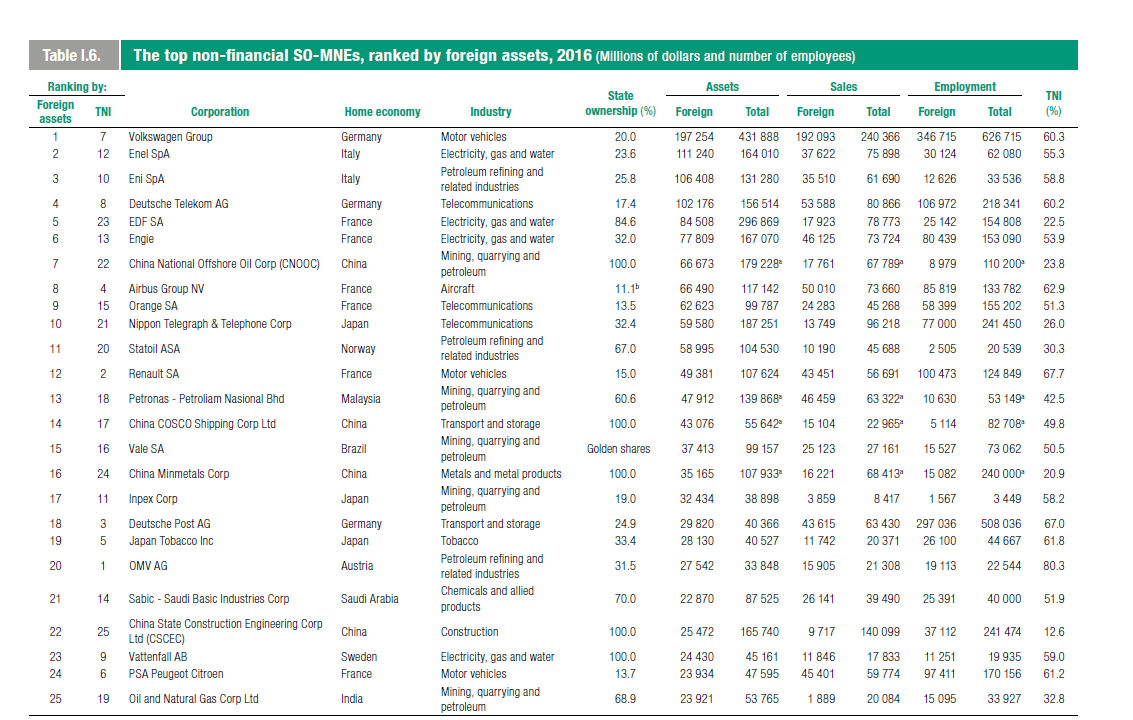
The Top 25 Non-Financial State-Owned Multinational Corporations (MNCs) ranked by Foreign Assets as of 2016 are listed in the table below:

Click to enlarge

Source: World Investment Report 2017, UNCTAD

In the developed world, some of the top multinational firms especially from Europe have substantial state ownership. For example, the Norwegian state owns 67% of oil major Statoil(STO). The government of France is a major shareholder in firms like utility providers EDF((ECIFY ), Engie(ENGIY), etc.

Related:

Disclosure: No Positions

Mobile Internet Usage Among G-20 Countries: Chart

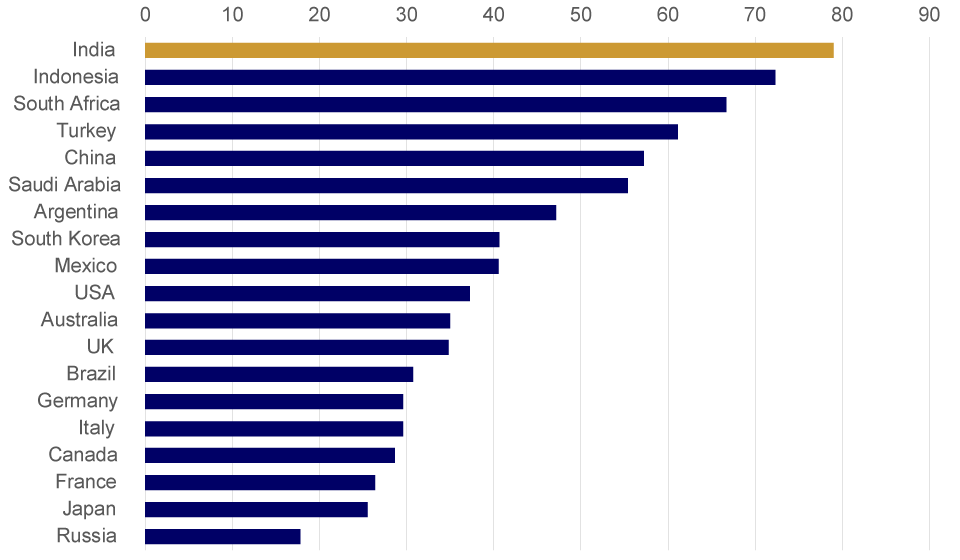
India leads the world in the number of users accessing the interest using their smartphones as shown in the chart below:

Click to enlarge


Note: The European Union is in the G20, but not all countries in the EU are in the chart.
Source: StatCounter GlobalStats, February 2017

Despite the lead, only 18% of the Indian population had a smartphone in 2016. Smartphones are still more common in the developed world than in the emerging world.

Source: A Megatrend is Underway, Thornburg Investment Management, Inc.