S&P 500 Index: Foreign vs. US Revenue Exposure

tLarge cap US firms have substantial exposure to foreign markets In fact, because many US multinationals derive a high proportion of their reviews from overseas markets some investors try to gain exposure to foreign markets by simply owning US stocks.

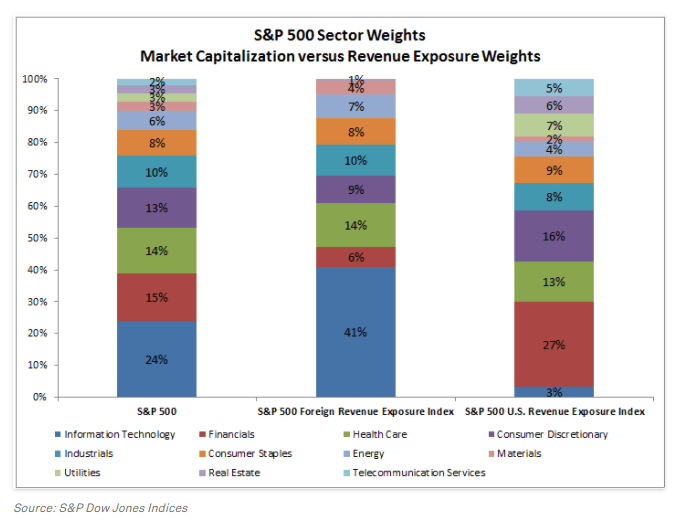
I have never seen a chart showing the US revenue of S&P 500 firms against their foreign revenues. But this week I came across a chart showing this comparison by sector sector .

Click to enlarge
Source:Capturing Global Market Gains Using U.S. Sectors, Indexology Blog

Of all the sectors in the S&P 500, The tech sector generates the most revenues from foreign markets. The sector accounts for only 24% of the index but earns 41% from overseas. Financials on the other hand derive more than one fourth of their revenues from the domestic market.


26 UK Dividend Heros

The UK equity market has one of the highest dividend yields in the world. Many of the large British firms pay a high proportion of their profits as dividends and some of them have increased payments over the years.

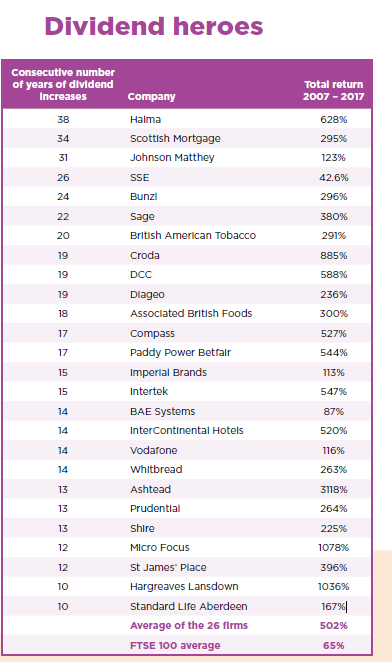
Among the FTSE 10o constituents, 26 members have increased their dividends for at least the past 10 years. These “Dividend Heros” are listed below:

Click to enlarge

Source: AJ Bell Dividend Dashboard, Q4,17

Investors looking to add UK dividend stocks can consider adding some of the stocks from the above list.

Some of these firms trading on the US include:

  • Vodafone Group PLC (VOD)
  • British American Tobacco PLC (BTI)
  • Imperial Tobacco PLC (ITYBY)
  • BAE Systems PLC (BAESY)
  • Diageo PLC (DEO)

Disclosure: No Positions

Five Foreign Auto-Parts Suppliers To Consider

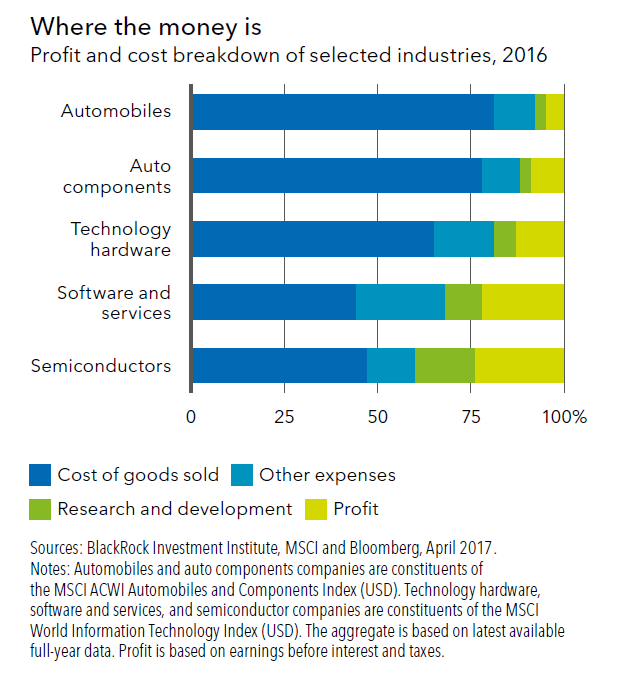
The auto industry is one of the most important industries in the world. In developed countries such as those in Western Europe and North America, the auto industry is considered as a systematically important industry that gets bailed out even if a company goes bankrupt. However for investors the way to benefit from the industry is not to invest in auto makers but to invest in the parts makers that supply the various auto companies. These auto components have a solid business model whereby they provide the auto makers with various parts needed to build a new vehicle and also sell after-market parts when those vehicles get older.

I reviewed a Blackrock report on the automobile industry and its future.One chart that caught my attention from the report is the following showing the many industries related to the auto industry and their profit margins:

Click to enlarge

Source: Future of the vehicleWinners and losers: from cars and cameras to chips, Blackrock

Five foreign auto parts suppliers to consider for further research are listed below with their current dividend yields:

1.Company: Valeo SA (VLEEY)
Current Dividend Yield: 1.74%
Country: France

2.Company: Magna International Inc (MGA)
Current Dividend Yield: 1.87%
Country:

3.Company: Denso (DNZOY)
Current Dividend Yield: 1.51%
Country: Japan

4.Company: Continental AG (CTTAY)
Current Dividend Yield: 1.52%
Country: Germany

5.Company: Autoliv Inc (ALV)
Current Dividend Yield: 1.75%
Country: Sweden

Note: Dividend yields noted above are as of Jan 26, 2018. Data is known to be accurate from sources used.Please use your own due diligence before making any investment decisions.

Some of the top US firms in the industry are: Lear Corporation(LEA), Delphi Technologies(DLPH),  BorgWarner Inc (BWA) and Visteon Corporation(VC).

Disclosure: Long ALV, CTTAY and MGA

US Firms’ Dividend Payouts Is A Warning Signal For Crash: Deutsche Bank

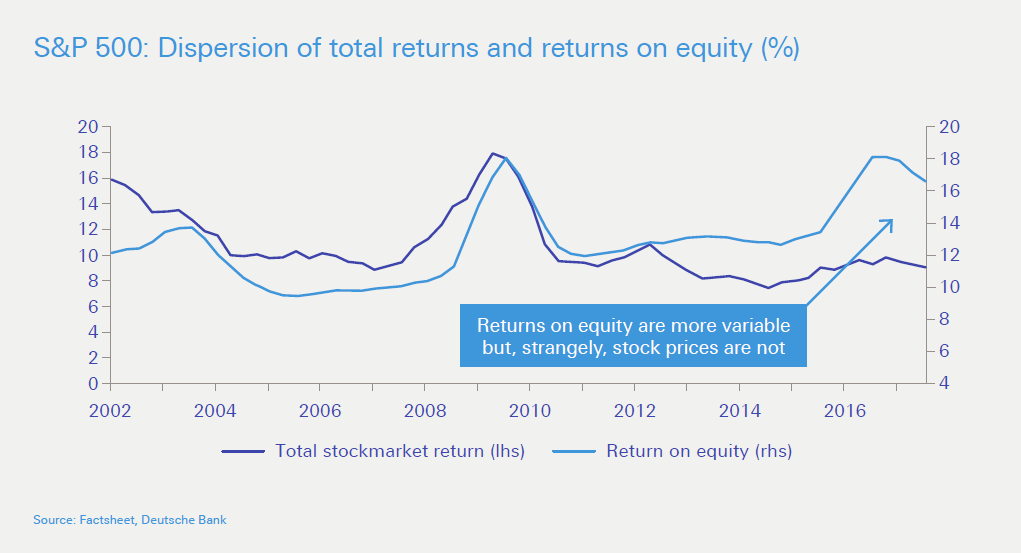
Investors in US equities are becoming increasingly worried about high valuations as the bull market continues to roar with nothing unable to stop it. From North Korean political tensions to US political drama such as the shutdown, the Russian investigation of manipulation of US elections, etc. stocks seem immune to fall. While investors have focused on traditional metrics such as the Shiller multiple to worry about extreme valuations, Deutsche Bank’s Luke Templeman says that the unsustainable dividend payouts of US firms is the metric that may finally tip US stocks from their relentless march upwards. In a nutshell, he states that American companies are borrowing heavily to finance their dividend payments though earnings have are not keeping up. Companies feel they have no choice other than to maintain dividend payouts in order to keep investors happy. It should be noted that unlike European firms which tend to vary dividends based on profits, US firms traditionally maintain and even increase dividends regardless of earnings.

From the article titled “US equities -the dividend shakeout” in DB’s Konzept report:

Dividends, though, do provide a warning signal. Indeed, the evidence shows that market gains in recent years have been propped up by unsustainable expectations of future dividends, and there are signs t hat 2018 could be the year.

the trend finally turns. The dividend aristocrats provide a useful illustration. These are a selection of about 50 stocks which have a strong history of paying increasing and reliable dividends. These stocks matter as they comprise about one-fifth of the total market value of the S&P 500 and their post-crisis bull run has been a significant contributor to the overall stockmarket’s return. Indeed, since the crisis, they have outperformed the S&P 500 by one-fifth.


More recently, though, the aristocrats’ performance has turned. Over the last 18 months, they have underperformed by about one-quarter. One reason for this is that investors have begun to realise they have reached capacity in the amount of debt they can take on to finance both outsized dividends and share buybacks. In the decade before the crisis, the net debt of these stocks was a steady one-third of ebitda. Since then, net debt has more than tripled as a proportion of earnings. This increase in leverage to fund capital returns can only happen once yet investors valued these stocks on the basis it could persist.

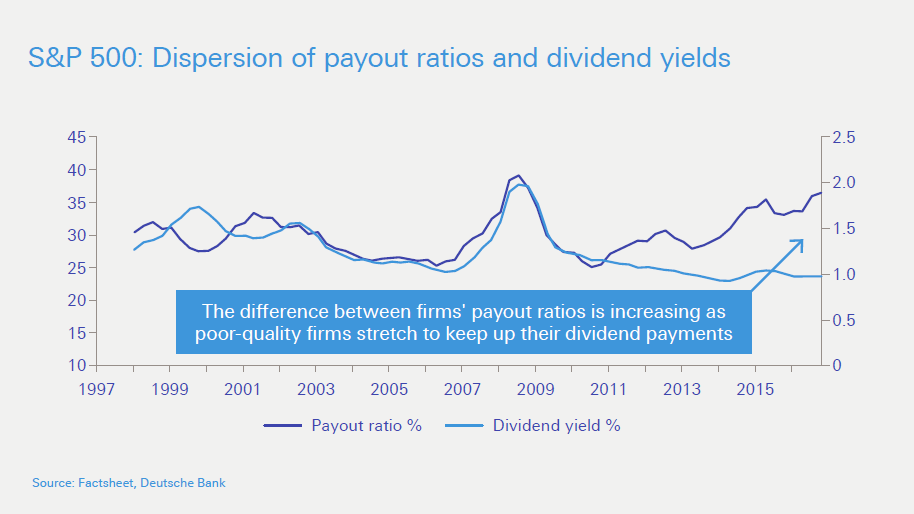
Another sign that investors have increasingly valued stocks based on their dividend can be found in the dividend yield of S&P 500 stocks which has been relatively constant since the financial crisis. More  importantly, the difference between the dividend yields of stocks, the dispersion, has been falling and now sits at its lowest level in at least two decades. This is down 15 per cent from precrisis levels. Said a different way, market prices have become increasingly sensitive to changes in dividend payouts. Unsurprisingly, managers have paid attention and boosted them. Just before the crisis, the average company paid out one-third of its earnings as a dividend. Now it pays out a half. Furthermore, the dispersion between dividend payments has stayed low, meaning companies have paid attention to their peers and increased their dividends in unison.

The entire piece is worth a read. Investors interesting on his arguments for a potential crash in US stocks may read the full article here.