India’s Sensex Reached A New Record High

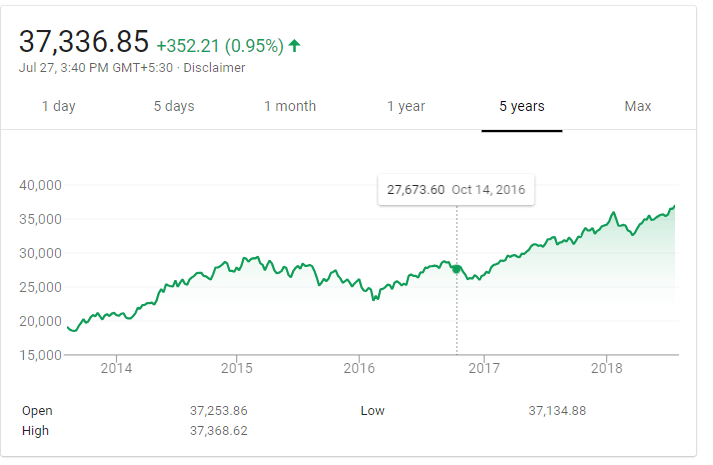
The Indian equity market is on fire with the benchmark BSE Sensex index reaching a new record high yesterday. The index rose 352 points or 0.95% to reach 37,336. Sustained capital inflows and India’s insulated economy from the impacts of Trump’s trade wars are fueling the surge in stocks. In dollar terms, the Sensex is up by 9.6% YTD.

The chart below shows the 5-year return of the Sensex:
The chart below shows the long-term return of the Sensex:
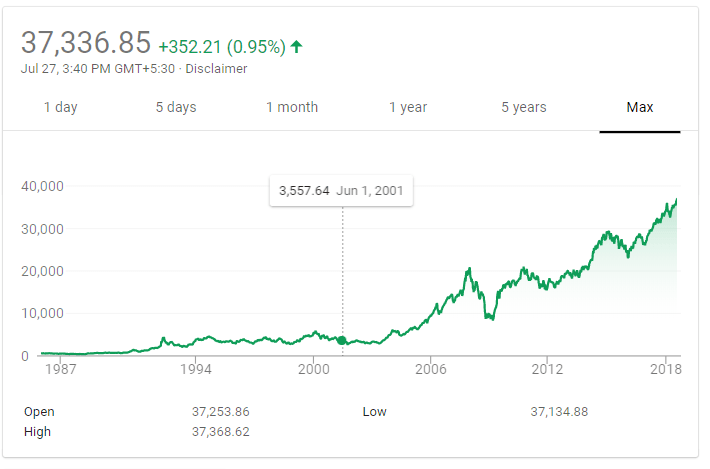
Source: Google Finance

From a recent journal article:

Analysts point to several reasons for the rally. For a start, India is booming, even as neighboring China shows signs of slowing, and was the fastest-growing big economy in the first three months of 2018. All else being equal, solid growth bodes well for corporate earnings, and tends to send shares higher.

In fact, per-share earnings for companies in MSCI’s India index should rise 28% in 2018, far outpacing the roughly 15% growth for emerging markets in Asia as a whole, said Ben Luk, a global macro strategist at State Street Global Markets. It helps that net profits last year were rather lackluster, especially for financial firms, he said.

In addition, millions of Indians are pouring money into shares for the first time. That has supported stock prices even as overseas buyers, who own roughly a quarter of the market, have grown more cautious. Locals added roughly $800 million in new positions this month, overwhelming the $44 million sold by foreigners.

Unlike rivals in Tokyo and Shanghai, for example, which experienced previous huge rallies, peaking in 1989 and 2007 respectively, it is also comparatively easy for this market to break new ground.

Moreover, India is comparatively less exposed to changes in U.S. trade policy. The U.S. -China spat has rippled through Asia, hurting companies that rely on cross-border trade.

Source:Indian Shares Set Records, WSJ

The soaring Sensex has been powered by a handful of stocks and some analysts are remain cautious. From an article at First Post:

The Sensex hit dizzying heights, reaching the 37,000-level for the first time on Thursday on widespread buying in capital goods, FMCG, realty and banking stocks by domestic institutional investors. The benchmark index also gained on positive global cues.

The NSE Nifty too scaled a new peak of 11,172.20 points.

Stock market analysts are optimistic and told Firstpost that the Sensex and the Nifty will peak further. Analysts said that by Diwali, the Sensex could touch 38,000 points and the Nifty could hit the 11,500 points milestone. However, they cautioned that though the indices are on a high, and have logged an upward momentum over the past few days, the upbeat sentiment is reflected in only the top 10-12 stocks on the Bombay Stock Exchange. The mid-caps and small caps are still low, they said.

Source: Sensex at record high of 37,000 is just an illusion; rally led by just top 10 stocks, say analysts. FirstPost

In addition, the market capitalization of India equity market has actually dropped by 8.44% in dollar terms in 2018.
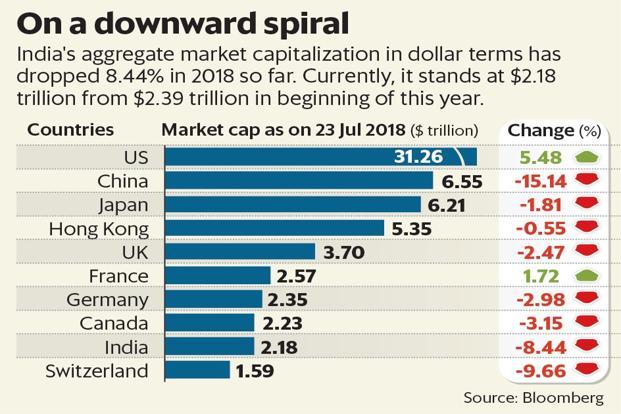
Source: Indices at record highs but India’s market cap down over 8% in 2018. Live Mint

Related ETFs:

  • WisdomTree India Earnings (EPI)
  • iShares S&P India Nifty 50 Index Fund(INDY)
  • PowerShares India ETF (PIN)

Disclosure: No Positions
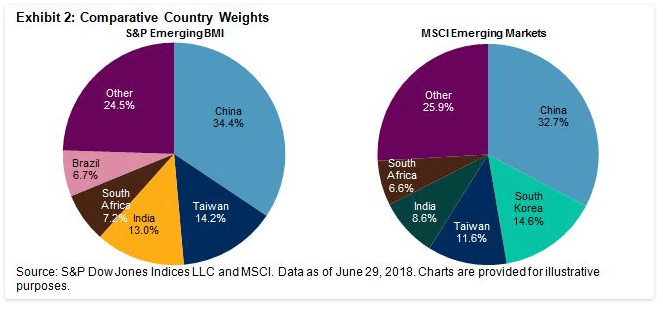
Two Key Differences Between S&P Emerging BMI and MSCI Emerging Markets Indices

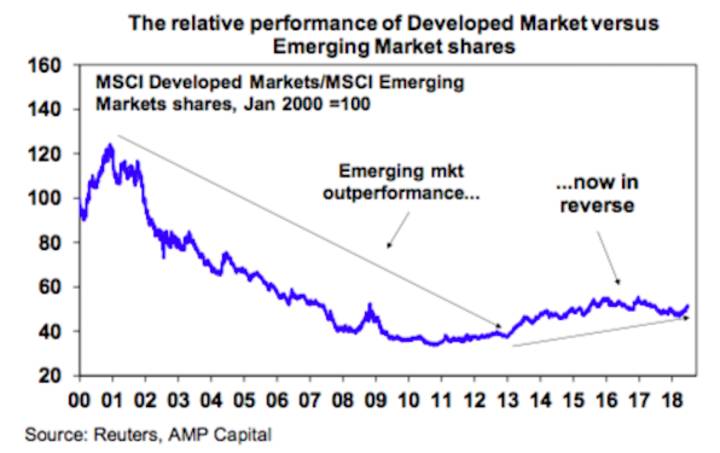
The three largest index providers in the world are S&P DJI, MSCI, and FTSE Russell. For emerging markets, the MSCI Emerging Markets Index is the most popular and widely used benchmark globally. Though MSCI and S&P indices are similar there are significant differences between the indices offered by these companies. It is important to understand these differences especially for investors that go with derived products such as an Emerging Markets ETF for example.

Click to enlarge

Source: A Primer on Country Classification in the Context of Saudi Arabia’s Upgrade to Emerging Market StatusMichael Orzano , S&P Indexology

The first key difference is that S&P has classified South Korea as a developed country since 2001. But MSCI continues to consider it as an emerging market. So South Korea is part of the MSCI Emerging Markets Index and accounts for 15% of the weightage. This potentially crowds out other less-developed market from the index.

The second difference is that MSCI initiated a partial inclusion of China A-shares in its benchmarks as of June 1, 2018. However S&P DJI and FTSE Russell have not included these shares in their indices yet. These firms are currently reviewing Chinese shares for potential inclusion in their respective emerging market indices.

In addition to China’s A-Shares, Argentina and Kuwait are also under review by S&P for reclassification from frontier to emerging markets.

Related ETFs:

  • Vanguard MSCI Emerging Markets ETF (VWO)
  • iShares MSCI Emerging Markets ETF (EEM)
  • PowerShares MENA Frontier Countries ETF (PMNA)

Disclosure: No Positions

Earlier:

Why Invest In Emerging Market Bank Stocks

Emerging market banks offer distinct advantages over their developed world peers. Other than the obvious diversification benefits, banks in the developing countries tend to have higher growth and profitability rates leading to much better share price appreciations. For instance, in most developing markets a few banks dominate the industry and hence have higher pricing power.

I came across an April article by Tan Van Nguyen and Justin Leverenz at Oppenheimer Funds discussing their strategy for picking EM bank stocks. They identified four factors that determine their investment philosophy. I believe the first factor is more important than the others. From the article:

1. Market Structures Matter Enormously

A concentrated market structure gives banks pricing power, allowing them to consistently generate returns above their cost of capital. Banking is an economy-of-scale business where the largest lenders enjoy inherent advantages in low funding costs, better risk-adjusted net interest margins (NIMs), and superior return on assets (ROAs). Exhibit 1.

Few banks in the world operate in such attractive market structures as Russia and Peru, where the leaders Sberbank and Credicorp control between 30% and 50% of the assets in the banking system. With their extensive branch networks and entrenched brand awareness, these are the go-to banks for customers’ deposits. This explains their competitive risk-adjusted NIMs and their long-term, superior ROAs of 2.0%-2.5%.

Source: Secrets from the Vault: How We Invest in EM Banks, Oppenheimer Funds

Seven emerging market banks trading on the US markets are listed below with their current dividend yields for further research:

1.Company:Banco Santander- Chile (BSAC)
Current Dividend Yield: 4.60%
Country: Chile

2.Company: Banco de Chile (BCH)
Current Dividend Yield: 3.35%
Country: Chile

3.Company: HDFC Bank Ltd (HDB)
Current Dividend Yield: 0.52%
Country: India

4.Company: Credicorp Ltd (BAP)
Current Dividend Yield: 1.87%
Country: Peru

5.Company: Bancolombia (CIB)
Current Dividend Yield: 3.48%
Country: Colombia

6.Company: Nedbank Group Limited (NDBKY)
Current Dividend Yield: 5.04%
Country: South Africa

7.Company: Standard Bank Group Limited (SGBLY)
Current Dividend Yield: 4.81%
Country: South Africa

Note: Dividend yields noted above are as of July 25, 2018. Data is known to be accurate from sources used.Please use your own due diligence before making any investment decisions.

Disclosure: Long CIB and BCH

On the Risks and Rewards of Investing in Single Country Emerging Market Funds

Single country funds are highly risky especially those related to emerging markets. Holding these funds for the long-term defined as five years or more requires strong conviction and patience and there is no guarantee that the bet would be a winner. I recently came across an article that discussed the risks and benefits of investing in single country funds. From the article:

Scottish American Investment Company was founded by William Menzies in the 1870s, after a series of visits to the US left him impressed by the wealth and opportunities the rapidly industrialising country presented. Being the most exciting emerging market of its day, America, it was hoped, would provide strong returns for investors in the UK.

Similarly, today, many investors are drawn to emerging markets undergoing their own economic transformations, typically by investing through an actively managed fund or investment trust. While many investors may opt to access such economies through broadly spread emerging market or regional funds or trusts, picking a single-country focused investment has become increasingly popular.

‘There has been a sudden rise in the popularity of single-country emerging market funds,’ notes Chady Jouni, senior portfolio manager at Barclays Wealth Management.

It’s not hard to see why. While emerging markets as a whole have done well in recent years, some individual countries have raced ahead of their peers. The Investment Association’s emerging markets sector returned 46.8 per cent over the past five years, while Asia Pacific excluding Japan returned 70.3 per cent. By contrast, funds in the China/Greater China sector more than doubled in value on average over that timeframe. It’s no surprise that China outperformed its peers in both the emerging market and Asia Pacific sectors, but it does underline an important point: going after a broader grouping of countries can act as a drag on returns.

SourceInvesting in a country-specific fund – the risks and rewards by Tom Bailey, Money Observer

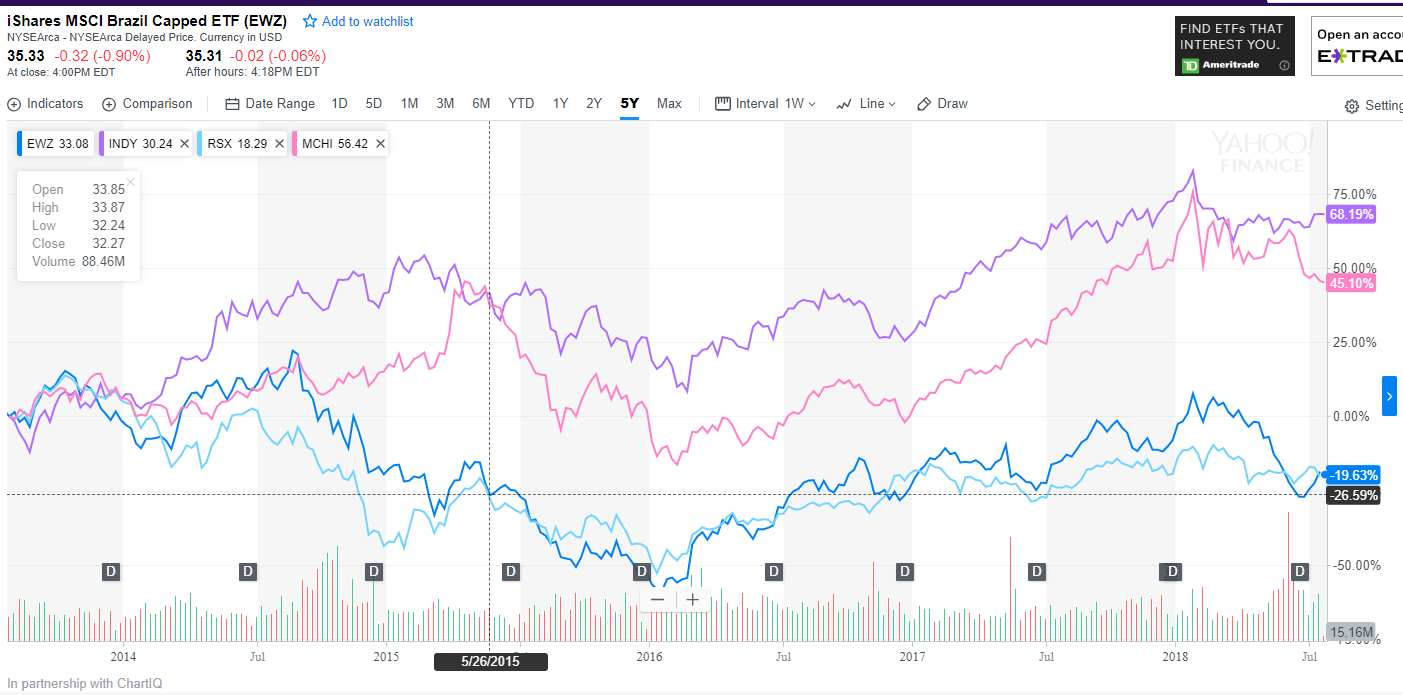
The following chart shows the performance of country ETFs for China, India, Brazil and Russia over the past 5 years:

Click to enlarge


ETFs shown:

  • iShares MSCI China ETF(MCHI)
  •  iShares S&P India Nifty 50 Index Fund (INDY)
  • VanEck Vectors Russia ETF (RSX)
  • iShares MSCI Brazil ETF (EWZ)

Source: Yahoo Finance

China and India have been the biggest success in terms of returns over the time period while Russia and Brazil were poor performers with a decline of about 20%. This shows that an investor that believed in the growth of Russia and Brazil and invested in an ETF and held on for the past 5 years, lost money. The bet did not turn out as expected as Russia was hit hard with collapse in oil prices and Brazil plunged into chaos with a massive fraud at Petrobras(PBR)and other political instability issues.

So they key takeaways for investors is that investing in single country funds is not for the faint hearted. Emerging countries can easily go from top performing to worse performing. So diversify and do not bet too much of a portfolio on one country.

Disclosure: Long PBR