Social Spending as a Percentage of GDP in OECD Countries: Chart

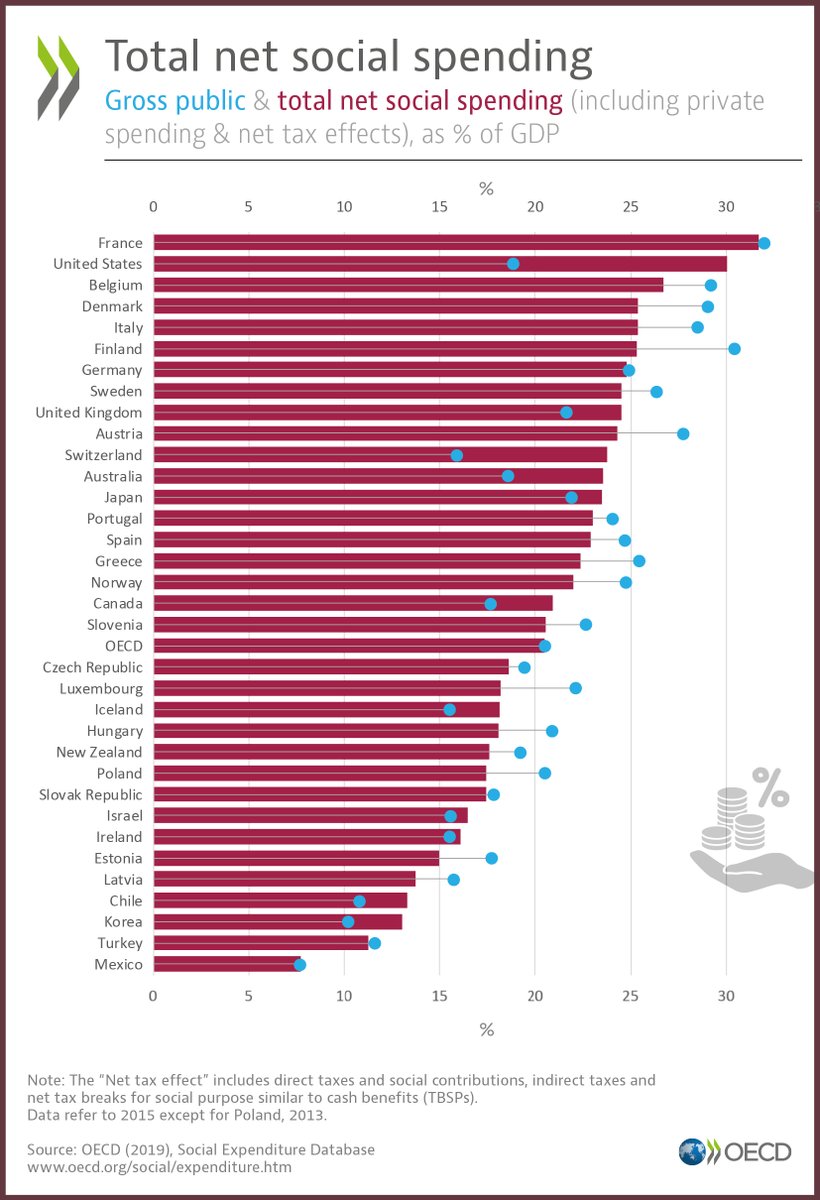
European member countries in the OECD are some of the big spenders on social spending. France tops the ranking in terms of gross public and total net social spending as a percentage of GDP. This is not surprising as the country has some of the best safety net systems in the world. It is not uncommon to see unemployed people in France go on vacations that are funded by liberal unemployment and other social benefits.

The US is the 2nd largest social spender after France. This may be shocking to many readers since the US is the world’s top capitalist country and any social spending by the government is considered as wasteful and is hated by some sections of the society. However the US has some of the biggest social spending in the planet with programs such as Medicare, Medicaid, VA and thousands are others where the state tries to protect and offer a safety net to the poor and the disadvantaged. While Medicare and other social programs are totally unnecessary in a pure capitalist system, the society as a whole has come to the realization that such programs are needed in modern times since in the land of the largest number of billionaires and millionaires it would be disgrace if millions of other suffer in abject poverty or even face starvation if left to the market forces. In after defense, the Medicare program that offers free health care to senior citizens is the biggest expenditure in the Federal budget.

Countries such as Mexico and Turkey spend the lowest on social spending as a percentage of GDP.

The following chart shows the gross public and total net social spending as a % of GDP for OECD countries:

Click to enlarge

Source: OECD

Which Emerging Markets Are Cheap Now?

Global investors are turning their attention to emerging markets this year. Though these markets had a lackluster to poor performance last year, this year they are heading in the right track. Some of the major markets are already up by double digit percentage points year-to-date. The returns for few of the emerging market indices are listed below:

China’s Shanghai Composite: 5.0%
India’s Bombay Sensex: 1.5%
Brazil’s Sao Paulo Bovespa: 11.9%
Russia’s RTS Index: 14.5%
Chile’s Santiago IPSA: 6.8%
Mexico’s IPC All-Share: 6.5%

Turkey’s BIST 100: 12.2%

Source: WSJ

Despite the strong rises, many of the emerging countries are attractive their developed world peers. According to an article by Frank Holmes, emerging markets could soar should the US dollar fall. From the article:

Eastern Europe Trading at Attractive Valuations

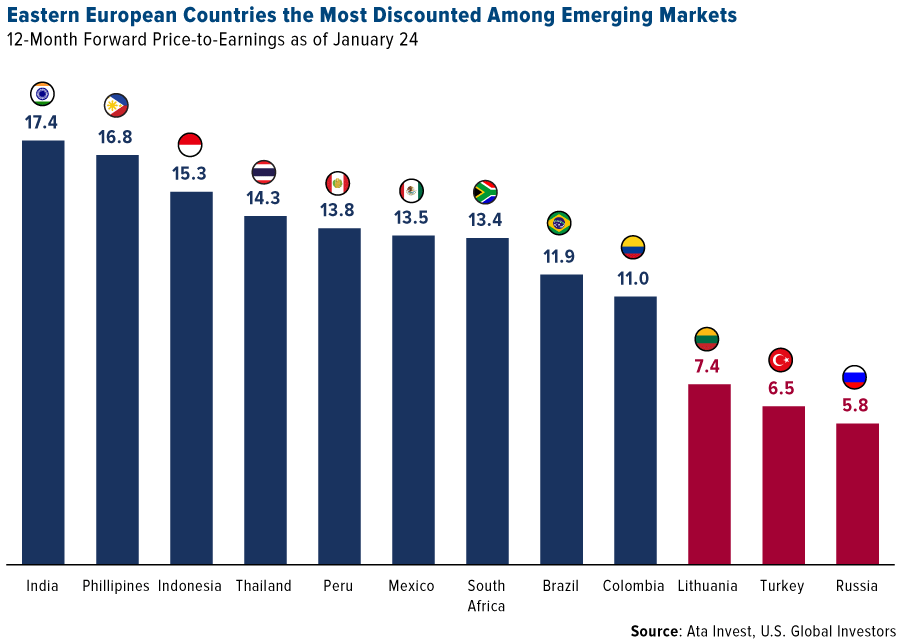
The best performing emerging economy in 2018 was Russia, which slipped only 1.5 percent. The country not only proved to be the most resilient to higher U.S. rates and trade war fears, but it also has both attractive dividend rates and strong valuation support. As you can see below, Russian stocks were trading at a very low 5.8 times earnings, a discount of nearly 50 percent against MSCI’s index of 24 emerging economies. Fellow Eastern European countries Turkey and Lithuania also had very attractive valuations, trading at 6.5 times earnings and 7.4 times earnings.

On an annualized basis, Russia has been a good bet for the 10-year period as well, delivering 9.21 percent on average through December 31, 2018.

What’s more, Central and Eastern European (CEE) economies are projected to grow 3.4 percent this year. That’s slower than in 2018, but stronger than Western Europe and the U.S.

Besides a weaker U.S. dollar, CEE countries should benefit this year from more favorable monetary policy. A number of central banks are expected to cut rates in 2019, including Turkey’s, which could lower them from 24 percent to 18 percent, according to Credit Suisse. Russia is also expected to ease, though likely by only 50 basis points.

Source: These Emerging Markets Could Soar If the Dollar Falls, U.S. Funds

Ten stocks from the countries shown in the above chart are listed below with their current dividend yield for further research:

1.Company: Bancolombia SA . (CIB)
Current Dividend Yield: 2.89%
Sector: Banking
Country: Colombia

2.Company: Ultrapar Participacoes SA (UGP)
Current Dividend Yield: 2.70%
Sector: Oil, Gas & Consumable Fuels
Country: Brazil

3.Company: Nedbank Group Limited (NDBKY)
Current Dividend Yield: 4.80%
Sector: Banking
Country: South Africa

4.Company:Fomento Economico Mexicano SAB de CV (FMX)
Current Dividend Yield: 1.55$=%
Sector:Beverages
Country:Mexico

5.Company: Braskem SA (BAK)
Current Dividend Yield: 6.33%
Sector: Chemicals
Country: Brazil

6.Company: Credicorp Ltd (BAP)
Current Dividend Yield: 1.75%
Sector: Banking
Country: Peru

7.Company: Gazprom OAO (OGZPY)
Current Dividend Yield:4.88%

Sector: Oil
Country: Russia

8.Company: Standard Bank Group Limited (SGBLY)
Current Dividend Yield:5.00%
Sector: Banking
Country: South Africa

9.Company: Petrobras SA (PBR)
Current Dividend Yield: 0.78%

Sector: Oil
Country: Brazil

10.Company: Itau Unibanco Holding SA (ITUB)
Current Dividend Yield: 0.66%
Sector: Banking
Country: Brazil

Note: Dividend yields noted are as of Feb 5, 2019. Data is known to be accurate from sources used.Please use your own due diligence before making any investment decisions

Disclosure: Long PBR,CIB, ITUB

Dividend Withholding Tax Rates by Country for 2019

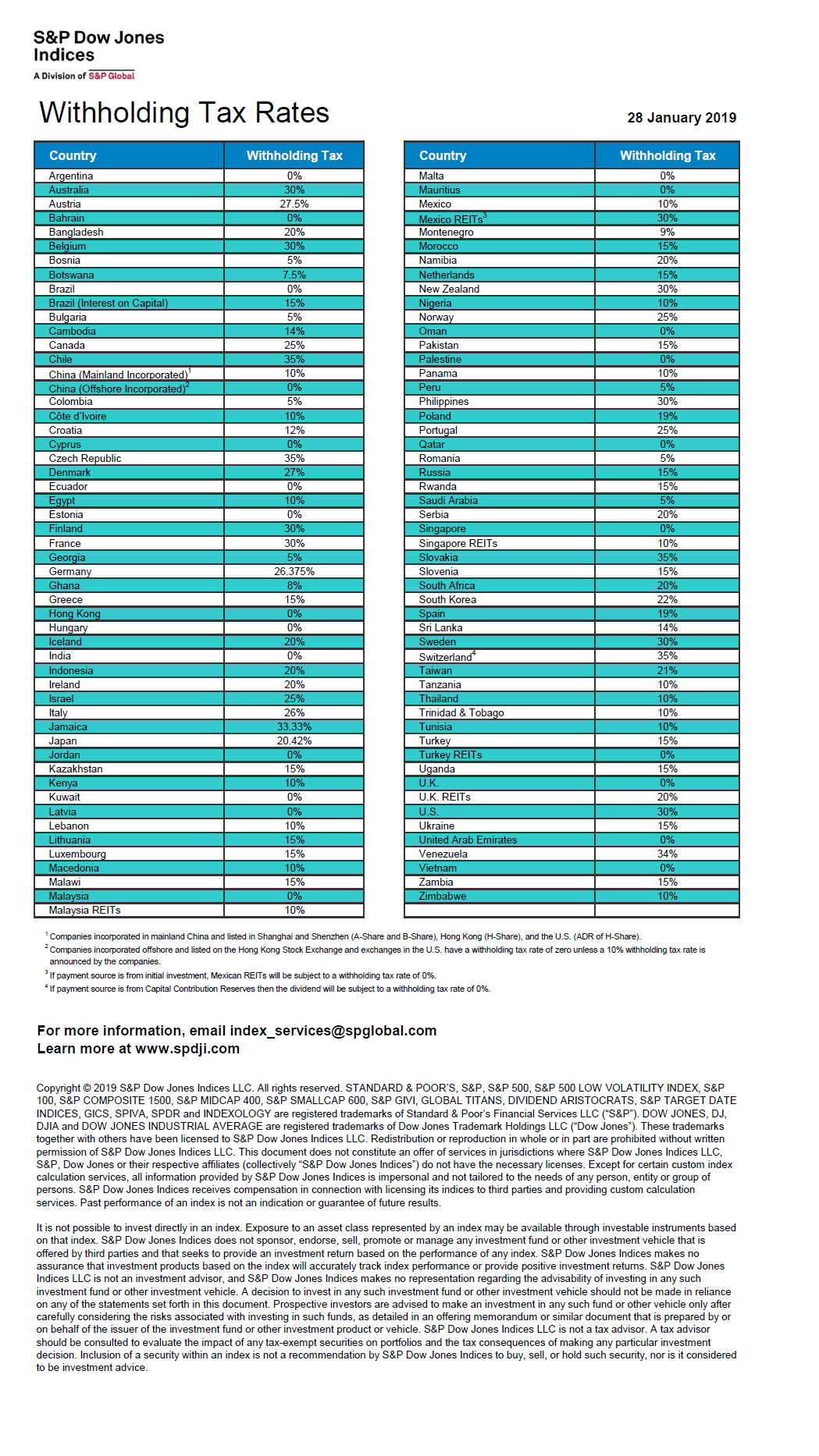
S&P Global has published the 2019 version of the Withholding Tax Rates for Foreign Stock Dividends by country. This simple table is highly useful for investors buying overseas stocks as withholding tax rates vary significantly among countries and high tax rates can cut a big chunk of the payouts. For example, in developed Europe Switzerland has a very high 35% withholding tax rate for non-residents while the UK charges 0% (for stocks only) for Americans. This difference is due to tax treaties between these countries and the US.

Update: Dividend Withholding Tax Rates by Country for 2021

Click to enlarge

Source: S&P Dow Jones Indices

Download:

Why Germany’s Blue Chips Are Best For Long-Term Investment

Germany is the largest economy in Europe and the country’s blue chips are also some of the top dividend payers in the continent. Unlike other indices, the benchmark DAX Index is a total-return index and higher dividend payouts tend to further increase returns. Below is a quote from one my article back in 2014:

In hindsight, there is no doubting that the DAX has created wealth. It has increased more than eightfold in its nearly 25 years of existence. Put another way: Someone who put 1,000 (or close to 2,000 DM) euros into the DAX back then would have around 8,500 euros at the end of May 2013. It has been,despite all the highs and lows, a good investment.It’s interesting to note: 46 % of DAX performance came from dividend distributions.

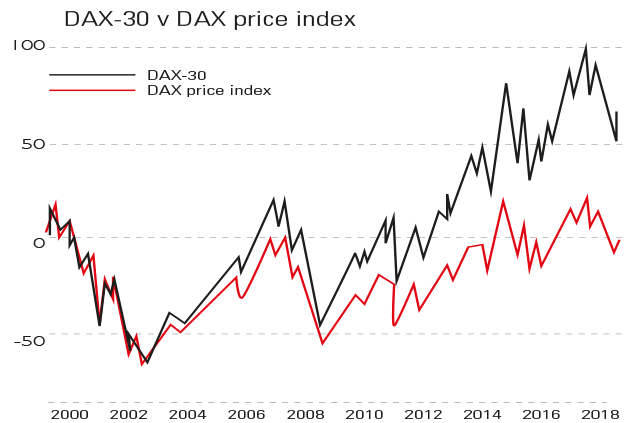
Moneyweek published the following chart showing the difference in returns between the DAX Index and the DAX price index:

Click to enlarge


Germany’s blue-chips are about to start paying their annual dividends, says the Frankfurter Allgemeine Zeitung. And there’s a record sum in the kitty: according to estimates from Commerzbank, some €38bn will be handed out for 2018, 3% more than in the previous year. The higher dividends are excellent news, as reinvested income is crucial to healthy long-term returns.

The chart shows the blue-chip DAX-30 index (a total-return index, so it includes reinvested income) and the Dax price index, which only reflects price movements. The cumulative impact of reinvesting dividends since the turn of the century is huge. Investors who did so would have gained around 60% by now; those who didn’t are marginally in the red.

Source: Chart of the week: German blue-chips dip into the kitty, Money Week

As an investor based in the US, how can you invest in German stocks?

One easy option to invest in German stocks is via the iShares MSCI Germany ETF (EWG). This ETF tracks the MSCI Germany Index and not the DAX Index.

For investors looking to invest in individual companies, a handful of German ADRs trade on the US exchanges. However over 100 firms trade on the OTC markets. Some of the stocks that investors can consider for further research are listed below:

1.Company: Henkel AG & Co KGaA (HENKY)
Current Dividend Yield: 2.36%
Sector:Household Products

2.Company: Fresenius Medical Care AG & Co (FMS)
Current Dividend Yield: 1.70%
Sector: Health Care Providers & Services

3.Company: Adidas AG (ADDYY)
Current Dividend Yield: 1.36%
Sector:Textiles, Apparel & Luxury Goods

4.Company: BASF SE (BASFY)
Current Dividend Yield: 4.95%
Sector: Chemicals

5.Company: Allianz SE (AZSEY)
Current Dividend Yield: 4.50%
Sector:Insurance

6.Company: Continental AG (CTTAY)
Current Dividend Yield: 3.48%
Sector:Auto Components

7.Company: E.ON SE (EONGY)
Current Dividend Yield: 3.25^
Sector:Multi-Utilities

Note #1: Dividend yields noted above are as of Feb 1, 2019. Data is known to be accurate from sources used.Please use your own due diligence before making any investment decisions.

Note #2: The dividend withholding tax rate is nearly 27%. This will substantially reduce the net yield. In addition, foreign currency exchange rate also will impact the actual dividend yields received by US investors.

Earlier:

Disclosure: Long EONGY, RWEOY, CTTAY