Concentration Risk is High in Australian Equity Market

One of the important factors to consider when investing in equity markets is concentration risk. To put in simple terms, if a market is highly concentrated or dominated by a handful of firms then the risk is high and vice versa. This is because high concentration leads to severe declines in a down market. A market is well diversified if one sector or a group of firms do not have a high weightage relative to the overall market.

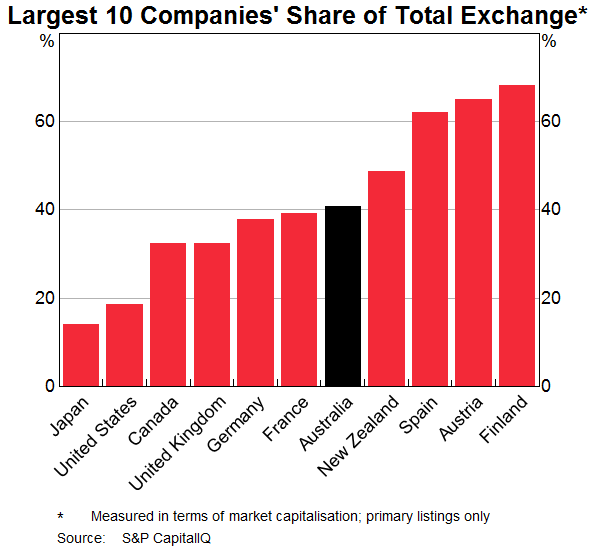
The Australian stock market is highly concentrated relative to other developed markets. In fact, at the end of 2018 the market capitalization of the top 10 firms in the Australian Stock Exchange accounted for over 40% of the market. This more than double the rate of the US market and is even higher than countries like France, UK, Germany, etc. Though Australia is one of the world’s major economies, certain sectors such as financials, natural resources, etc. tend to dominate the economy. Accordingly some of the firms from these sectors are the top firms in the benchmark equity index.

The following chart shows the share of the largest 10 companies of select developed markets:

Click to enlarge
Source: The Long View on Australian Equities by Marion Kohler, Head of Domestic Markets Department, RBA

From the above article:

Let’s have a closer look at the companies that make up the Australian securities exchanhas ge (or, abbreviated, the ASX). Graph 6 compares the concentration of the stock exchange for different countries. The bars show what share of the total market capitalisation is accounted for by the top 10 companies. On this metric, the ASX is quite concentrated in large companies, with the top 10 companies accounting for a bit less than half of the market capitalisation of the ASX.

You will notice that the countries with the larger concentrations (on the right-hand side of the graph) tend to be smaller economies. Among similar-sized exchanges, the level of concentration seen at the ASX is not unusual. It means, however, that an investor in a market capitalisation-weighted portfolio of equities is exposed to developments in a smaller set of companies.

As of September 30, 2019 the top 10 constituents the S&P/ASX 200 index account for 45.1% of the index. On the other hand, the top 10 firms in the S&P 500 had a weightage of just 21.6% of the index.

Another way to look at the concentration risk is the sector breakdown of the ASX 200 index.

Click to enlarge

Source: S&P

Financials and Resources account for nearly 50% of the index. The four major banks in the top 10 of the index are: Australia & New Zealand Banking Group Limited (ANZBY) ,  Commonwealth Bank of Australia (CMWAY), National Australia Bank Limited (NABZY) and Westpac Banking Corp (WBK).

What risks investors face with investing in highly concentrated markets such a Australia?

Investors that invest in an ETF or other products that track the S&P/ASX 200 index, are vulnerable to movements in the small number of firms that dominate the index. Since this index is a market cap weighted index, firms with higher market caps get higher weightage. So in a bull market, Australian market may soar driven by a handful of firms and in a downward market the growth will be in the other direction.

Related ETF:

  • iShares MSCI Australia Index Fund (EWA)
  • SPDR S&P 500 ETF (SPY)

Disclosure: Long NABZY, WBK

Why Dividend Reinvestment is Important Even When the Yield is Low

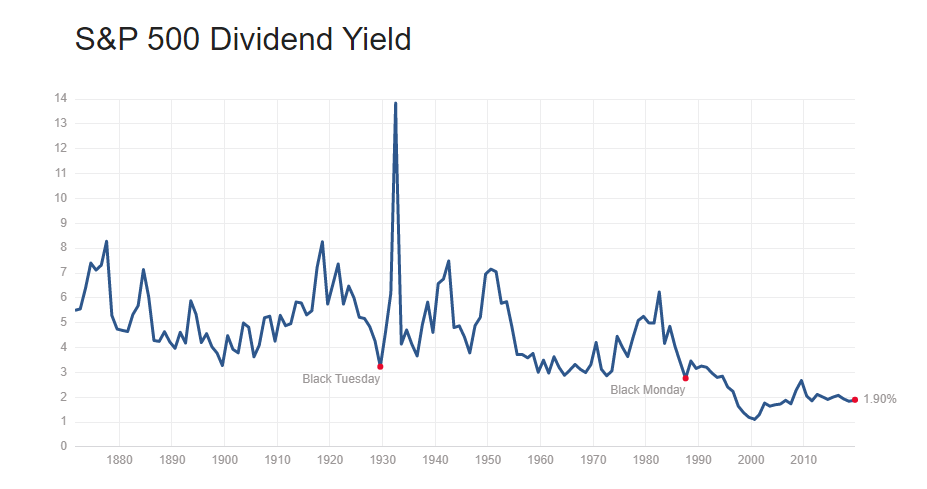
The current dividend yield of the S&P 500 is 1.90%. The yield has hovered around 2% for many years now. Since the 1990s the dividend yield has declined consistently year over year to reach the current low rates. The following chart shows the dividend yield since 1870:

Click to enlarge

Source: multipl.com

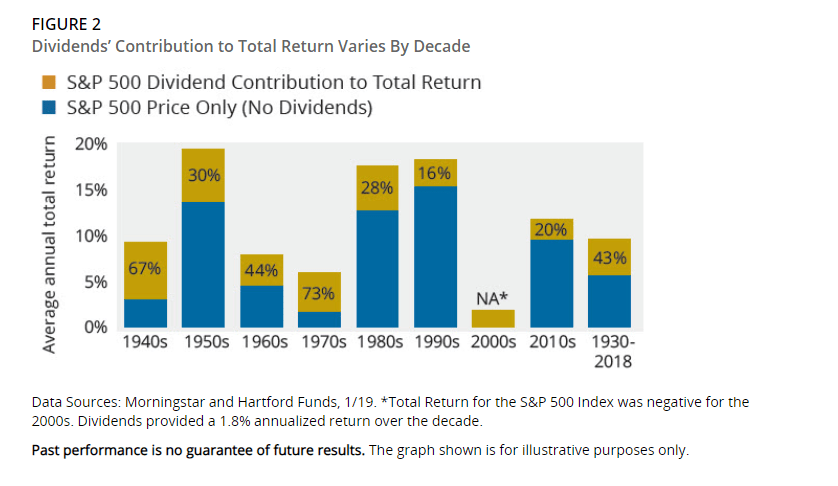
However though the yield so low relative to other developed markets, the contribution of dividends to the overall total return over many years cannot be underestimated. In fact, even during the dot com era of the 90s dividends accounted for 16% of the total return of the index. Total return includes both price return and reinvested dividend return. During the 1st decade of the 21st century, dividends amounted to one-fifth of the total return. In the decades before, dividends played a much bigger role in total returns.

The following chart shows the ratio of dividend returns and price returns to total return of the S&P 500 by decade:

Click to enlarge

Source: The Power of Dividends, Hartford Funds

From the above article:

Decade By Decade: How Dividends Impacted Returns

Looking at average stock performance over a longer time frame provides a more granular perspective. From 1930–2018, dividend income’s contribution to the total return of the S&P 500 Index averaged 43%. Looking at S&P 500 Index performance on a decade-by-decade basis shows how dividends’ contribution varied greatly from decade to decade.

Dividends played a large role in terms of their contribution to total returns during the 1940s, 1960s, and 1970s, decades in which total returns were lower than 10%. By contrast, dividends played a smaller role during the 1950s, 1980s, and 1990s when average annual total returns for the decade were well into double digits.

Key Takeaway: Just because the dividend yield is low, investors should not NOT avoid dividend stocks or reinvesting dividends. In the long run, dividend reinvestment can be boost total return by a significant percentage.

Related ETF:

  • SPDR S&P 500 ETF (SPY)

Disclosure: No Positions

Dividend Yields by Country 2019: Chart

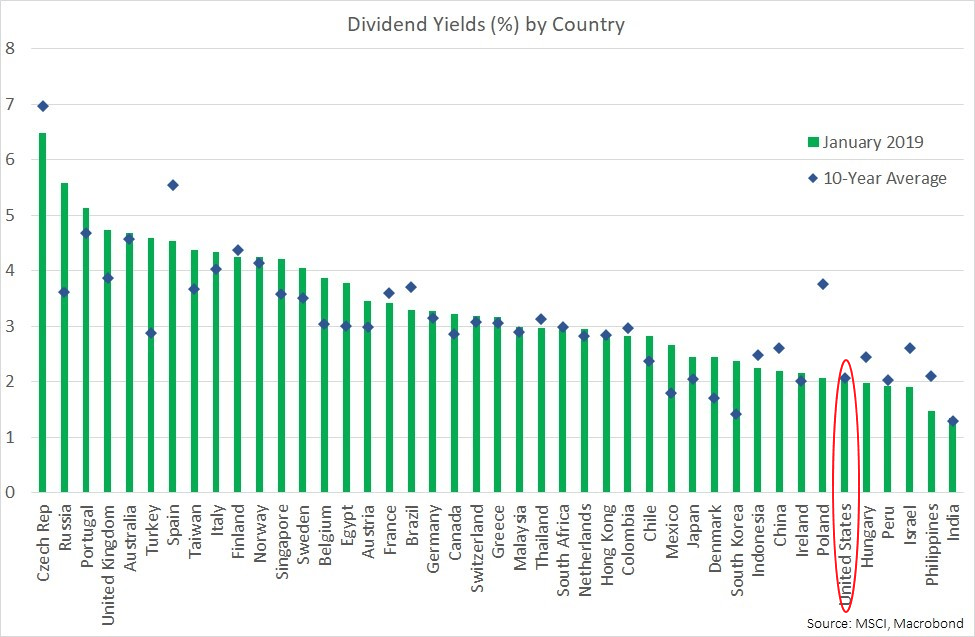
As we head towards the end of this year, let’s take a look at which countries had the highest dividend yields at the start of the year. India has the lowest yield and Czech Republic has the highest. The U.S. rate of around 2% is lower than many emerging countries as shown in the chart below:

Click to enlarge

Note: The yields shown are based on MSCI indices.

Source:Targeting high dividends: common sense or flawed promise? by Shaun Port, Nutmeg


The Top 20 Global Firms by R&D Expenditures 2018

Innovation is one of the important attribute’s of the world’s leading companies. High investment in research and development (R&D) leads to great innovation. Hence one way to evaluate top quality firms is to focus on their R&D budgets. Firms that lag in innovation are easily left behind in today’s hyper competitive market. Highly successful firms are generally leaders in innovation. For example, a drug firm cannot a global leader without innovation.

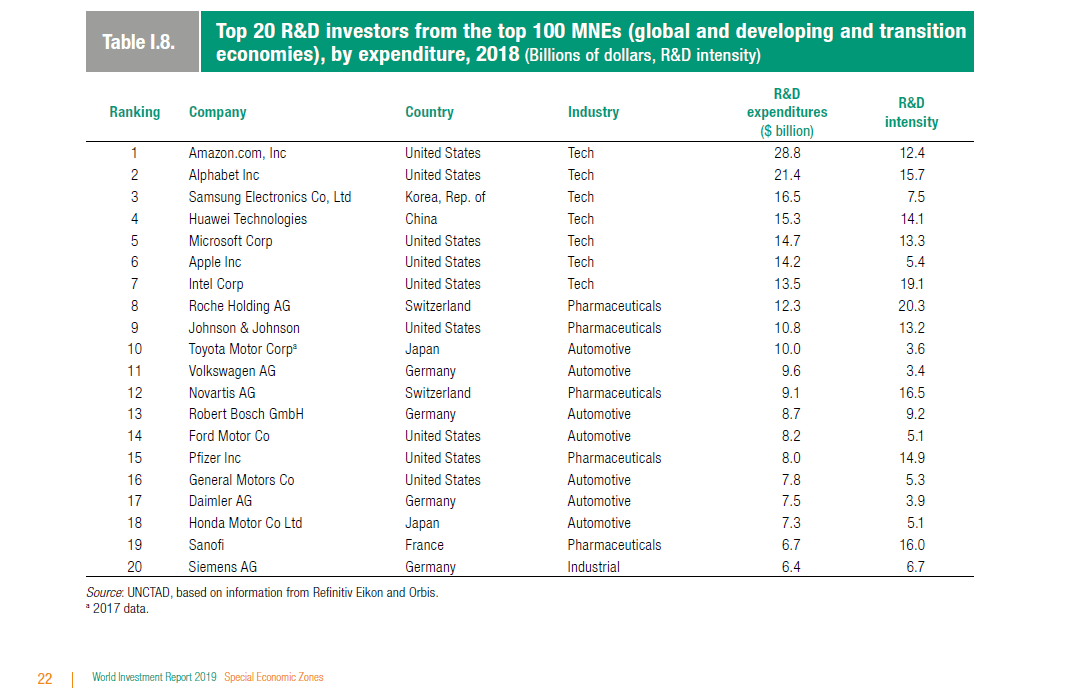
With that said, the top 20 firms in R&D are shown in the table below. These firms are from the top 100 MNEs list published in the World Investment Report by UNCTAD.

Click to enlarge


Source: The World Investment Report 2019UNCTAD

A few observations:

  • The top five global R&D leaders Amazon(AMZN), Alphabet(GOOG), Samsung, Huawei and Microsoft(MSFT).
  • As usual, US firms dominate the list accounting for nearly half of them.
  • All the Top 7 companies are in the tech sector, This shows the importance of R&D in this sector.
  • The pharma sector has five firms in this list with all of them from the US and Europe.
  • Except Huawei all the other companies from the developed world.
  • Firms from developing countries have a long way to go before they can be world leaders in R&D.

Disclosure: No Positions

The Callan Periodic Table of U.S. Equity Investment Returns 1999-2018

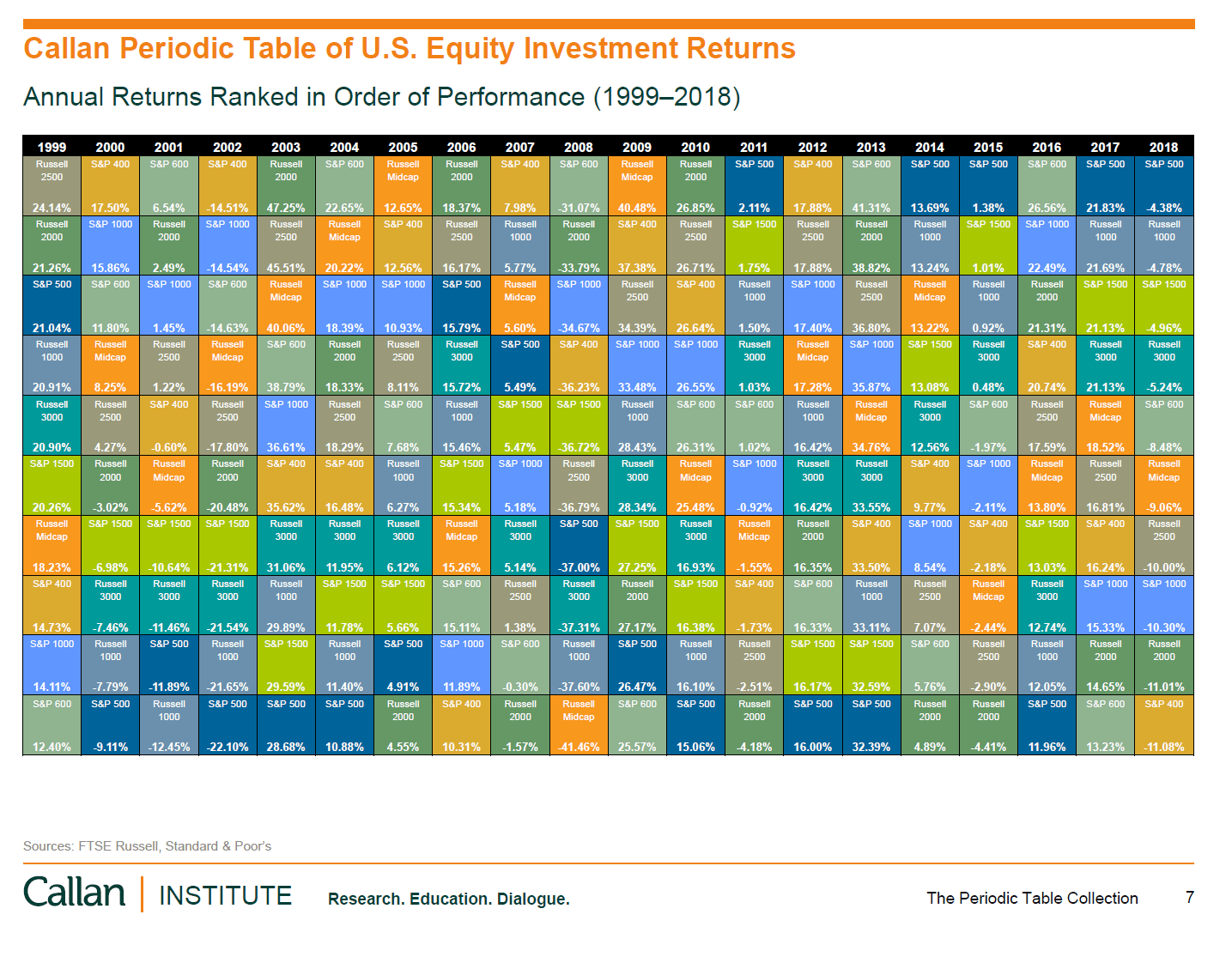
The following is the Periodic Table of U.S. Equity Investment Returns from 1999 thru 2018. It shows the annual returns of various US equity indices such as the S&P 500, Russell 1000, Russell  3000, etc. in the order of performance:

Click to enlarge

Source: The Periodic Table Collection –  20th  Anniversary Edition,  Callan Institute

In the past five years, the S&P 500 has been the best performing index in 4 years. So far this year, the index is up by double digit percentage points. It remains to be seen if the solid gains will hold thru the end of the year.

Download:

Related ETFs:

  • SPDR S&P 500 ETF (SPY)
  • S&P MidCap 400 SPDR ETF (MDY)

Disclosure: No Positions