Latest Dividend Yields by Country: Chart

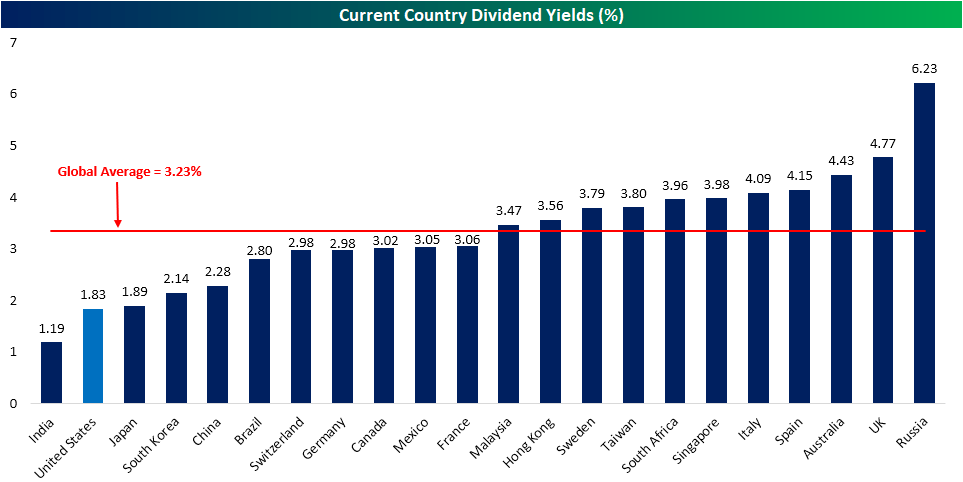
Dividend yields of equity markets vary across countries significantly. The following chart shows the latest dividend yields for select countries as of December, 2019.

Russia has the highest dividend yield in the world at 6.23% while India has the lowest rate at just 1.19%. Many of key companies in Russia such as those in oil and gas, banking industries are owned by the state and the state encourages them to payout a high portion of their profits as dividends, India is traditionally not known for its dividend culture. Global investors primarily invest there for growth. Among emerging countries, Brazil is also not a big dividend payer. Countries such as Malaysia, Colombia and Chile offer much higher yields than India and others. So those countries are better for income investors.

Among the developed countries, the US has the lowest yield at 1.83%. The yield on the S&P 500 has stayed under 2% for many years if not decades. This is because US firms invest most of their retained earnings in R&D, capital expenditures and others that are geared towards growing the company. Very few firms are interested in sharing most of the profits with shareholders in the form of dividends. Even if they want to payout more than the average yields they prefer stock buybacks as opposed to cash dividends. This is due to a major quirk in the Federal tax  code in that taxes on dividends are charged at the ordinary income tax rates which is high while the tax on capital gains is low. So some if not all investors also are content with this strategy followed by American companies.

Australia is known as one of the top countries for dividends. Dividends are high there due to the concept of franking. Moreover Aussie firms do not have much opportunity for growth and historically have preferred to share the wealth with equity holders in cash dividends.

Click to enlarge
Source: Bespoke

Below are few examples showing the big difference in dividend yields between firms in different countries:

1) US & UK – Utility Sector:
Company: National Grid PLC (NGG)
Current Dividend Yield: 4.97%
Country: UK

Company: Consolidated Edison Inc. (ED)
Current Dividend Yield: 3.34%
Country: US

2)US & Australia – Banking:
Company: Wells Fargo & Company (WFC)
Current Dividend Yield: 2.68%
Country: US

Company: Westpac Banking Corp (WBK)
Current Dividend Yield: 7.11%
Country: Australia

3)India & Chile – Banking:
Company: HDFC Bank Ltd (HDB)
Current Dividend Yield: 0.70%
Country: India

Company: Banco Santander-Chile (BSAC)
Current Dividend Yield: 4.82%
Country: Chile

Note: Dividend yields noted above are as of Jan 3, 2020. Data is known to be accurate from sources used.Please use your own due diligence before making any investment decisions.

Key Takeaway: Country selection is key when looking to invest in foreign countries for income. This is especially important in emerging countries. Non-US developed countries are better for income investors although the net yields received could be lower due to dividend withholding taxes, foreign exchange rate fluctuations and other factors.

Disclosure: Long WBK

Knowledge is Power: Dividend Contribution to S&P 500 Return, Latin America Oasis, Oil Services Stocks Edition

The bull market in US equities in 2019 was one of the best in recent years. However for many folks it did not feel like a bull market because stocks heavily in the last quarter of 2018. In addition, not all sectors participated in the roaring. For instance, energy stocks never recovered to their greatness and continue to struggle. Some of the sectors soared. The PHLX Semiconductor Index shot by over 60% with some US semiconductor stocks such as Cirrus Logic(CRUS), Advanced Micro Devices(AMD), Lam Reseearch(LRCX), etc. more than doubling in their prices.

Among the foreign semiconductor stocks trading on the US markets trading as ADRs the following were notable for their returns:

STMicroelectronics (STM) – 94%

ASML (ASML) – 90%

Semiconductor Manufacturing International (SMI) – 77%

Taiwan Semiconductor Manufacturing (TSM) – 57%

With that said, let’s review some of the interesting articles from around the web:

The Roman Forum, Rome, Italy

Even Small Fees Will Substantially Reduce A Portfolio’s Return

Investing in equities involve analyzing a multitude of factors. Some of these factors include worrying about Trump’s impeachment, who will win the US Presidential elections net year, US-China Trade wars, oil prices, Fed’s QE programs, value of the dollar, etc. All of these factor’s are beyond an investor’s control. One of the few factors that an investor can control is fees. Typical fees include annual fees, investment advisory fees, 12b-1 fees, commissions, etc. These fees vary from one firm to another. Though some of these fees may seem small over the long run they will reduce a portfolio’s return by a huge amount. So investor’s have to carefully analyze the impact of fees when making their investments. Simply ignoring small fee rates such as annual 0.5% or 1% is foolish.

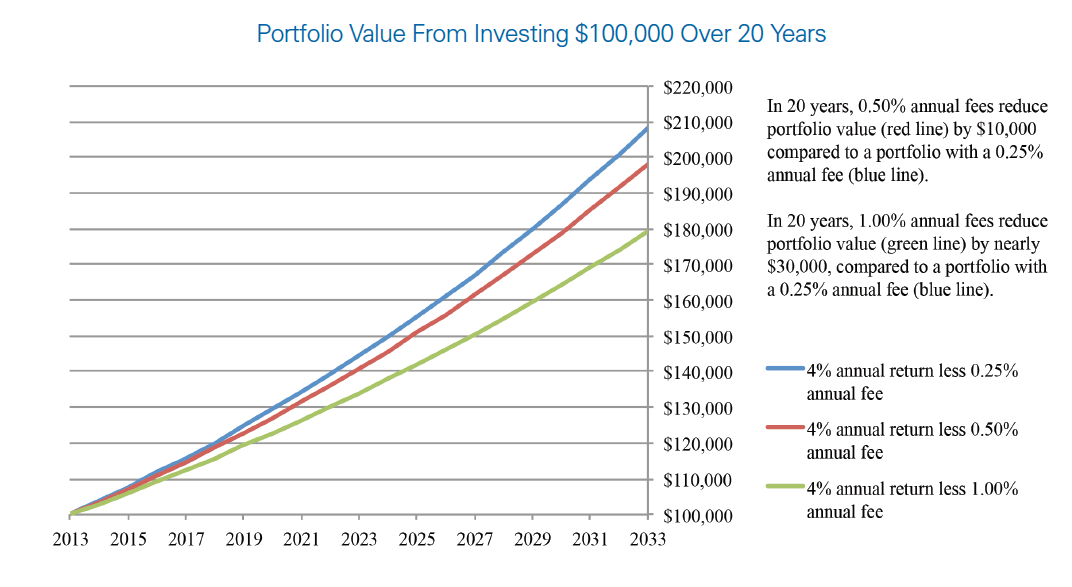
The following chart shows the impact of fees at 0.25%, 0.50% and 1% for a $100,000 investment over 20 years:

Click to enlarge

Source: How Fees and Expenses Affect Your Investment Portfolio, SEC

Over 20 years, someone who chose a 0.25% fee option will have nearly $30,000 more than someone who chose a 1% fee option. This is significant amount indeed.

It should be noted the SEC uses a potential return of 4%. If this figure was higher say 7% or 10% then the fees over the same 20 years will be even higher as the fees are deducted annually.

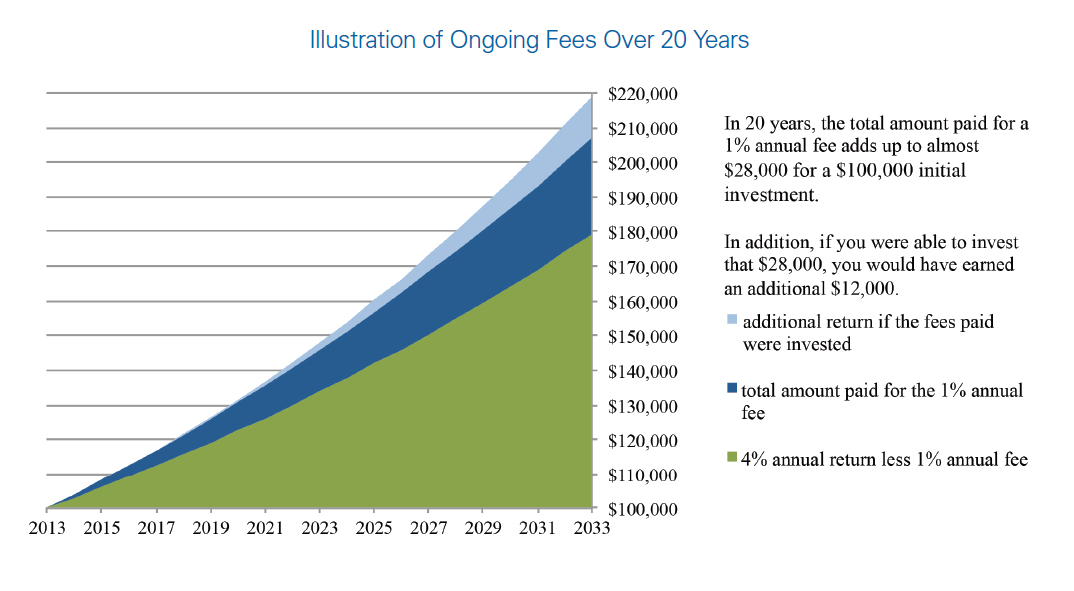
In addition, there is also the impact of opportunity costs. This simply means fees that are paid annually could have been invested to generate additional returns for the portfolio. The following chart illustrates this logic:


Source: How Fees and Expenses Affect Your Investment Portfolio, SEC

One way investors can reduce fees paid is going with ETFs than mutual funds.

Singapore Leads The World in Saving For Retirement

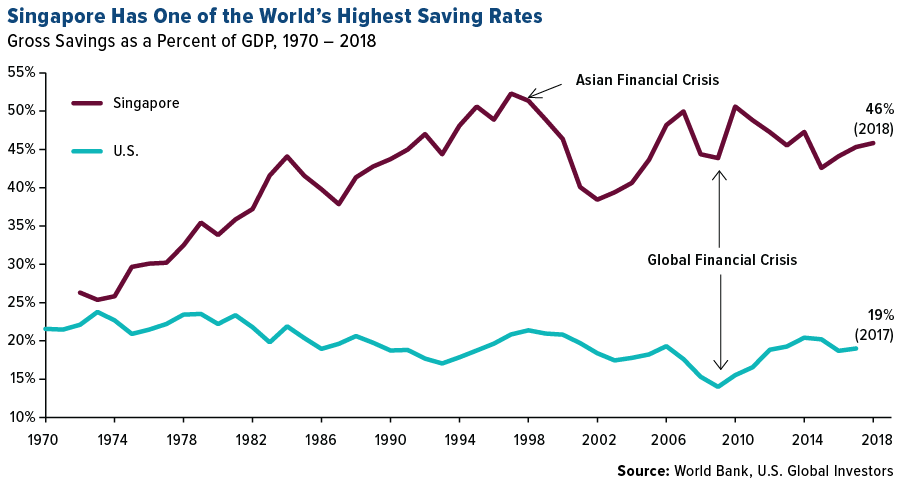
The tiny city state of Singapore is one of the best run countries in the world. Singapore is the world’s top saving country.Both the government and citizens take pride in responsibility and act accordingly. One of the areas that other countries can emulate from Singapore is saving for retirement.Unlike other developed countries including those in Europe and North America, the state acts in the best interests of the country and its citizens. For example, while the west focuses on the trivial issues like the ban on bubble gums it fails to pay attention to important policies such as saving for retirement. According to a recent article at U.S. Global Investors Singapore is a masterclass in fiscal responsibility. From the article by Frank Holmes at U.S. Global Investors:

Brown’s idea is incredibly similar to what Singapore already does, starting with the Central Provident Fund (CPF)—a sort of Social Security-401(k) hybrid that all Singaporeans are required to participate in. The CPF not only provides participants with retirement earnings but can also be withdrawn before retirement for specific housing and medical expenses. Both employees and employers are responsible for making contributions—20 percent of income on average for the former, 17 percent for the later—which are then invested to earn about 5 percent annually.

The CPF program, launched in the mid-1950s, is often cited for helping residents of the Asian city-state become among the world’s most fiscally responsible. Compared to people in most other developed countries, Singaporeans save a much larger portion of their earnings as a percent of GDP.

A recent study, in fact, found that six in 10 Singapore millennials—those aged 25 to 34—currently save over 20 percent of their salary. Most are not just adequately prepared for retirement, but they’re even more prepared for retirement than their middle-aged counterparts, according to the study.

Again, Singapore has managed to do this without levying huge taxes to support entitlements.

Personal income is taxed progressively between 2 percent and 22 percent, and because there’s no capital gains tax, dividends paid by Singapore-resident companies are completely tax-free.

Corporations pay a reasonable 17 percent on average, and there’s no payroll tax.

What this means is that Singapore’s tax revenue as a percent of gross domestic product (GDP) stands at only 14.1 percent, about two and a half times lower than the OECD average of 34.2 percent.

Some might initially think that lower taxes would result in a lower standard of living, with crumbling infrastructure and services, and yet Singapore’s infrastructure is regularly regarded as the best in the world, with the World Economic Forum (WEF) ranking it first in quality of roads, railroad density and efficiency of air transport and seaport services. The city-state came in first overall in the WEF’s Global Competitiveness Report 2019, followed by the U.S. Hong Kong, the Netherlands and Switzerland rounded out the top five.

Source: Expecting a Market Downturn? Make Sure You’re Following the “Noah Rule”, U.S. Global Investors

Though Singapore is also a developed country on par with developed Europe and the US, the high saving rate is indeed surprising. In addition to state policies that encourage savings, cultural and other factors may also be a factor that drive Singaporeans to save a high portion of their household income.

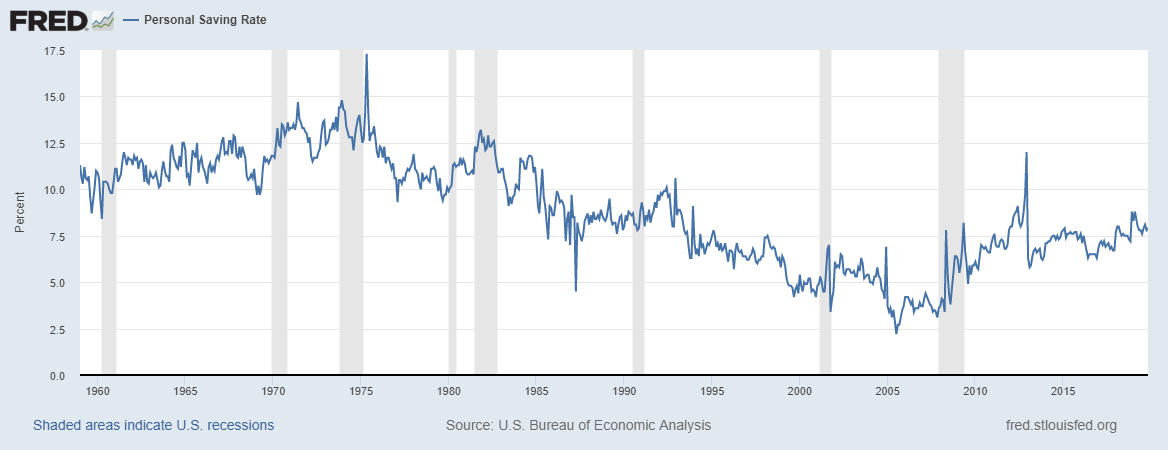
To put things in perspective, the current personal saving rate in the US is just 7.9% of disposable income. The following chart shows the rate since the 1960s:

Click to enlarge

Source: St. Louis Fed