Why Investors Need to Consider Political Risk in Emerging Markets

Investing in emerging markets involves more risk than investing in the developed world. In addition to foreign currency, economic and transparency issues in these markets, investors need to be aware of political risks. Unlike in developed markets such as in Europe and North America, political risks can appear almost overnight in emerging countries.

Let’s take the example of the country of Chile, an emerging market in Latin America. Until very recently the country was a shining star in the region known for its economic stability and democracy. While others like Brazil, Mexico, Peru, Bolivia, etc. were plagued by chaos, Chile remained strong and stable.

However years of that stability vanished almost overnight when protests erupted in later 2019. What started as a small protest against higher subway fare turned into a major countrywide protest movement leading to many deaths and economic collapse. International investors fled Chilean equities in panic leading to further crash in the local equity market.

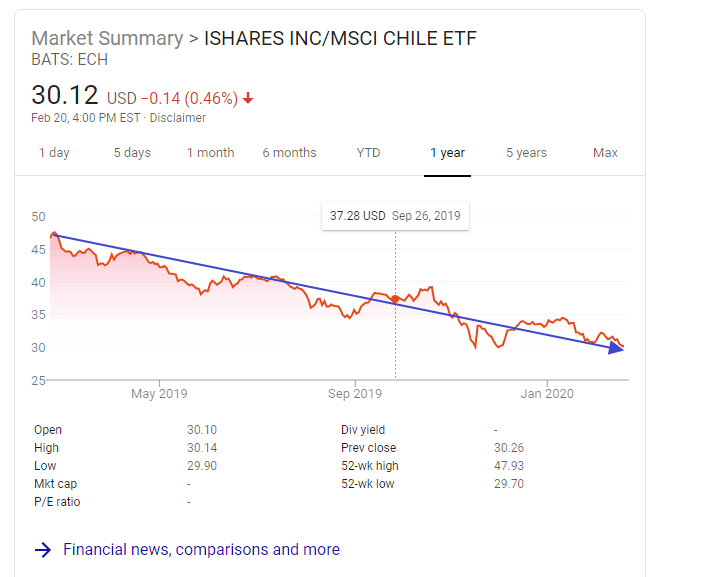
The impact of political risk can be seen in the decline of Chilean stocks and ETFs. The fall in the iShares Chile ETF (ECH) is shown in the chart below:

Click to enlarge
Source: Google Finance

From over $47 in early 2019, the ETF fell dramatically in later in the year to as low as $30 per share.Yesterday it closed at $30.12.

Some of the Chilean ADRs have also fallen heavily in the past 6 months or so. But recovery can be expected later in the year after government policy changes are launched in April. Investors willing to wait for at least a year can consider adding some of these stocks at the current prices.

Chile ADRs to consider adding at current levels include:

  • Banco de Chile (BCH)
  • Banco Santander- Chile (BSAC)
  • Empresa Nacional de Electricidad SA (EOC)
  • Soc. Quimica y Minera de Chile (SQM)
  • Compania Cervecerias Unidas (CCU)

How political risk is real and severe to equity markets in developing countries than developed markets?

Chilean stocks lost over 50% in just a few months as a result of the political protest that was triggered by a subway fare increase. Similar collapses in the developed world are highly unlikely.

For instance, a rise in New York city subway fares is 100% unlikely to trigger a national protest movement and the crash of the stock market. Even if a protest were to start, it will be a local news and will swiftly contained.

Hence events such as this episode in Chile are usually normal in developing countries with weak institutions and political systems.

Disclosure: Long BCH
How Much Dividends Contribute To Stock Returns Over The Long Run?

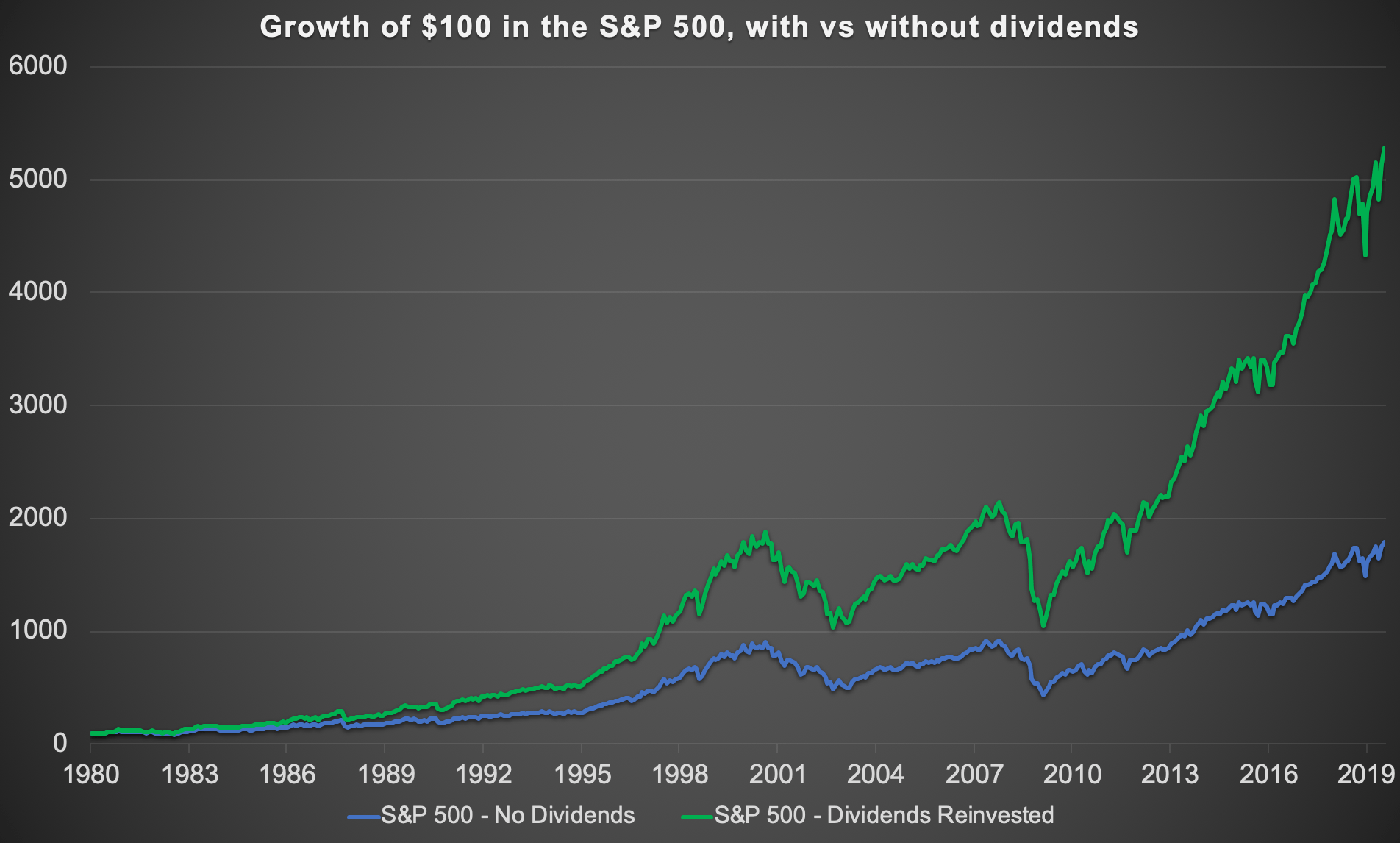
Dividends account for a substantial portion of total returns especially over the long run. Though the yield on the S&P 500 has stayed around 2% for many years now, total return is boosted in the long run with dividend reinvestment.

The following chart shows the growth of $100 with and without dividends from 1980 thru mid 2019:

Click to enlarge

Source: 75% of S&P 500 Returns Come From Dividends: 1980-2019, GFM Asset Management

From the above article:

Today’s chart shows the growth of an initial $100 in the S&P 500 ignoring dividends vs with dividends reinvested. The S&P 500 index has risen to 17.9x its 1980 value, but with dividends reinvested, $100,000 would have grown 52.9x to $5,285,910.

Related ETFs:

  • iShares Dow Jones Select Dividend ETF (DVY)
  • SPDR S&P Dividend ETF (SDY)
  • Vanguard Dividend Appreciation ETF (VIG)
  • Vanguard High Dividend Yield ETF (VYM)
  • SPDR S&P 500 ETF (SPY)

Disclosure: No Positions

The BIggest News in Chemistry in 2019: Infographic

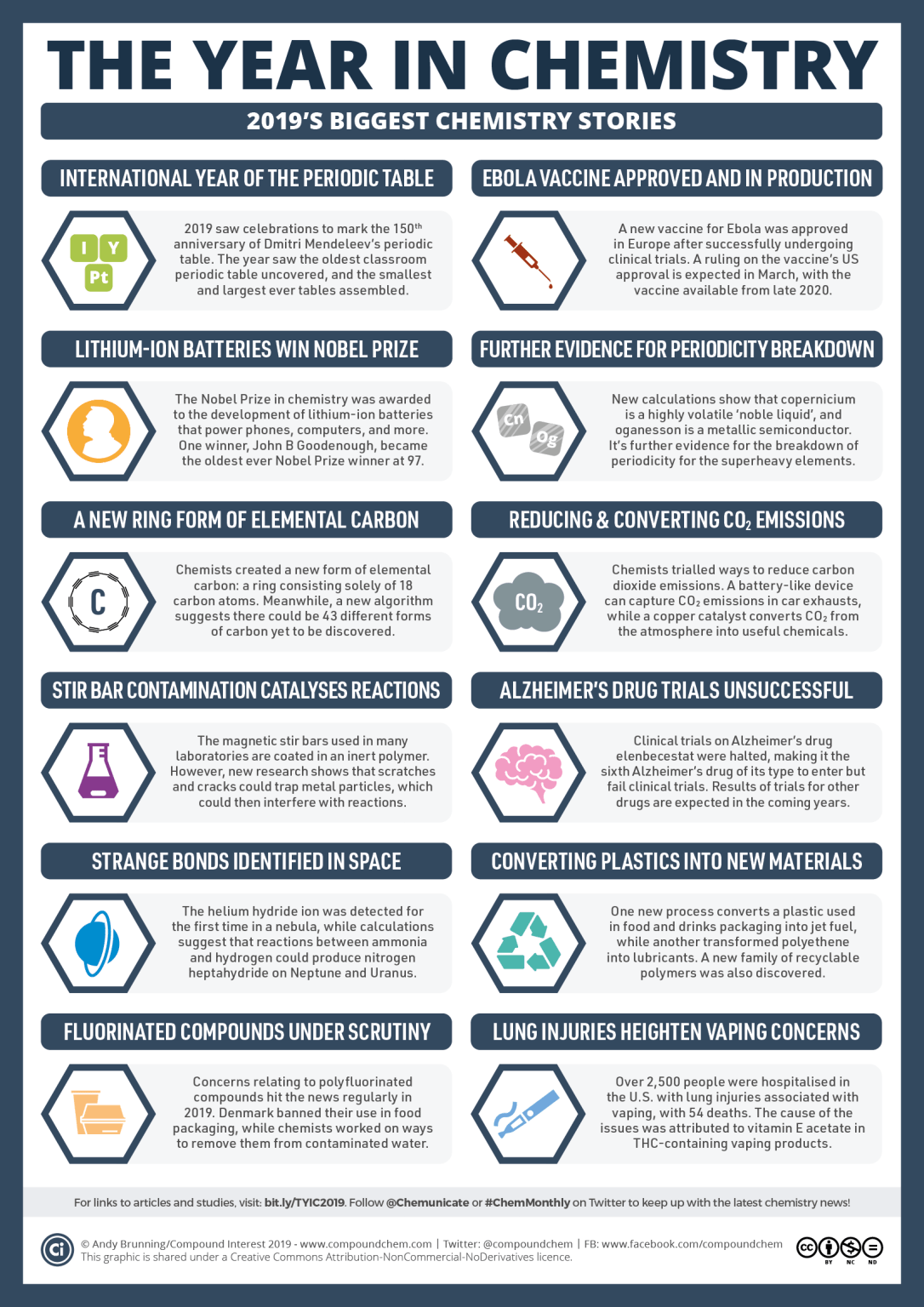
2019 turned out to be another great year for Chemistry. Nobel prize in Chemistry went to the development of Lithium batteries which seem to be the future of powering everything from automobiles to cell phones. In addition, a vaccine for the deadly Ebola virus that plagued Africa a few years ago was approved in Europe and production started this year.

The following infographic shows some of the important stories from the field of Chemistry in 2019:

Click to enlarge

Source: Compound Interest

ADR Fees: 5 Additional Important Facts To Be Aware Of

One of the factors that investors in ADRs have to consider is the ADR Fees. This fee is charged by the depositories of the ADR program. My earlier articles on ADR fees were well received by this site’s visitors. You can find those articles below:

While those articles covered many facts about this fees, in this article I will list five additional important facts to be aware of. As the tax filing season is underway for US residents, investors may be wondering about how to deal with this fees may find these points helpful.

1.How often is the ADR Fee charged?

Usually the ADR fee is assessed once in 12 months or annually by the depository.

2. Can I include the ADR fee I paid to the purchase price of an ADR and calculate the cost basis?

Nope. You cannot add ADR fee to the cost basis.

3. How are ADR fees collected?

The depository will collect the fees based on the record date of the investor holding the ADR. For dividend paying stocks, the broker will deduct this fees from any dividends received and send it to the depository.

4.What if my ADR does not pay a dividend? How will I pay this fee?

If your ADR does not pay any dividends, then the ADR fee will be deducted from your cash portion of your account. So it is wise to hold some cash in the account.

5.Which ADRs are subject to ADR Fees?

Visit the depository sites to check if the ADR fee is applicable to the ADR you own.

BNY Mellon:

https://www.adrbnymellon.com/fees-and-disclosures/depositary-service-fee-info

Citi:

https://depositaryreceipts.citi.com/adr/guides/dsf.aspx?pageId=8&subpageid=190

Deutsche Bank:

https://adr.db.com/drwebrebrand/dr-universe/depositary-service-fee-list


5. Can I deduct 1099-DIV ADR fees in my tax returns?

Nope. You cannot deduct this fees in taxes. Investment expenses are no longer deductible in Federal tax returns.

ADR fees paid in qualified retirement accounts also cannot be deducted in taxes.

So the key takeaway for ADR investors is that ADR fees should be considered as another expense for investing in foreign stocks.

Related Posts:

U.S. Military Presence in the Middle East

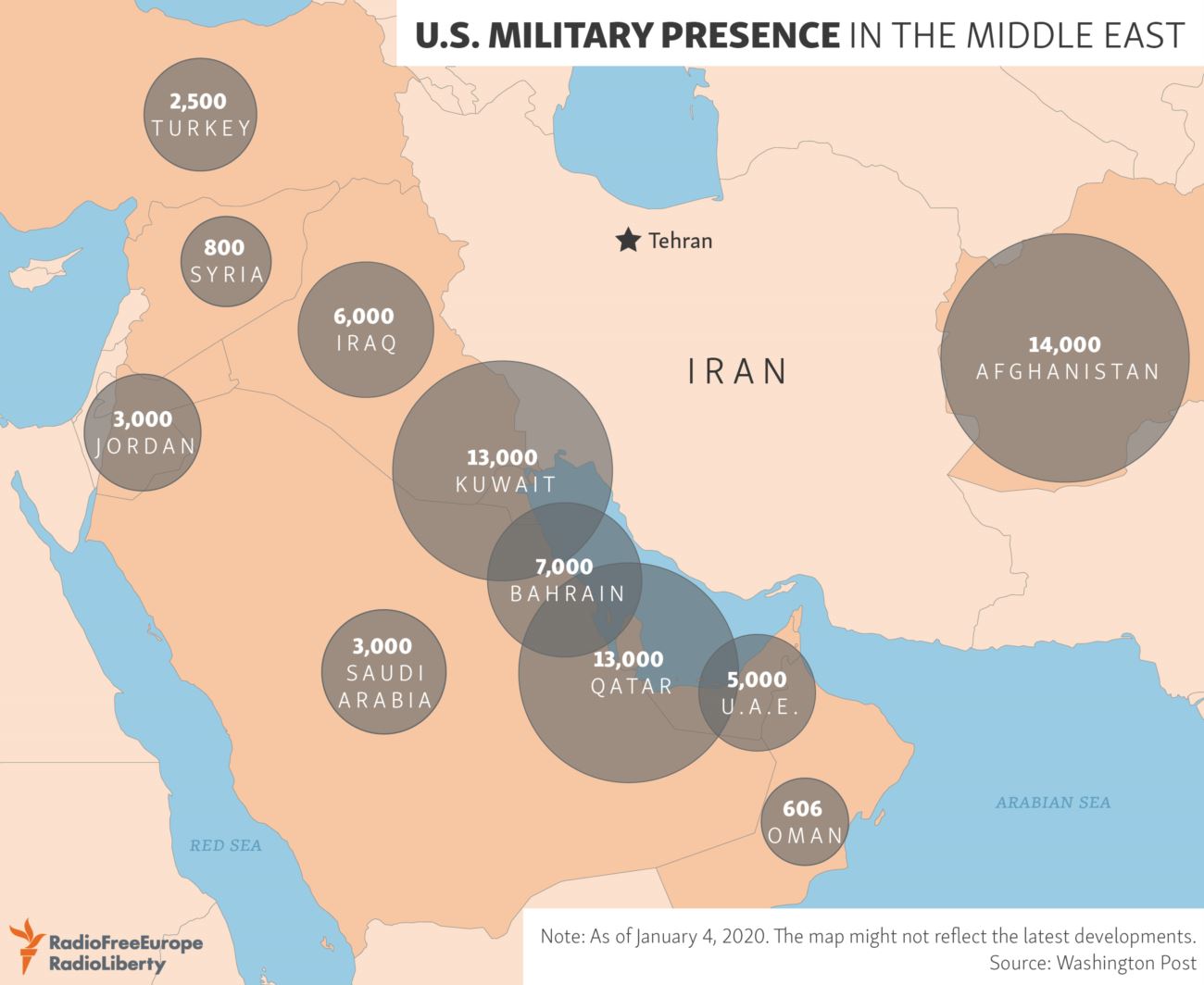
Thousands of American soldiers are stationed in the Middle Eastern countries to support continuing wars in places like Afghanistan, Syria, etc. and support work in countries like Iraq. Long after the first Gulf War, Kuwait has become an important base for US forces.  Currently some 13,000 soldiers are stationed there. Other countries such as Qatar also have a significant US military footprint.

The following chart the US military presence in the Middle East:

Click to enlarge

Source: RFE/RL

From the map, it looks like Iran is completely surrounded by US forces at least on two sides.