German Airline Lufthansa To Be Booted Out Of The DAX Index

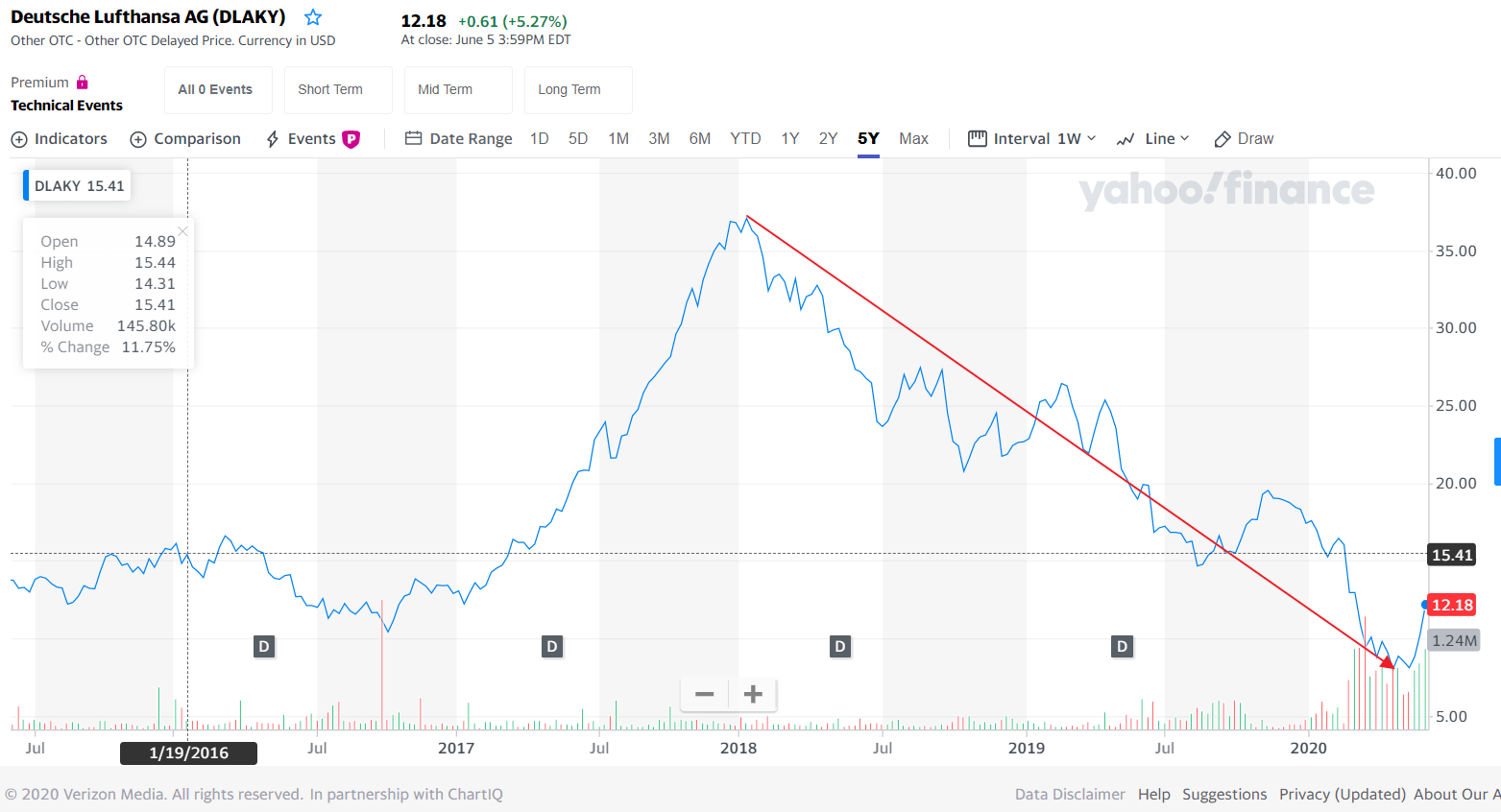
The German airline group Lufthansa will be kicked out of the benchmark DAX Index on June 22nd this year according to a release by Deutsche Boerse Group. The company will be added to the MDax index which represent mid-cap companies. Lufthansa’s stock price has fallen dramatically this year due to the collapse in air travel in the Corona pandemic. Though the price has increased recently the price is still 33% lower than at the end of 2019.

The 5-year return of Lufthansa’s ADR (DLAKY) on the OTC market in the US is shown in the chart below:

Click to enlarge
Source: Yahoo Finance

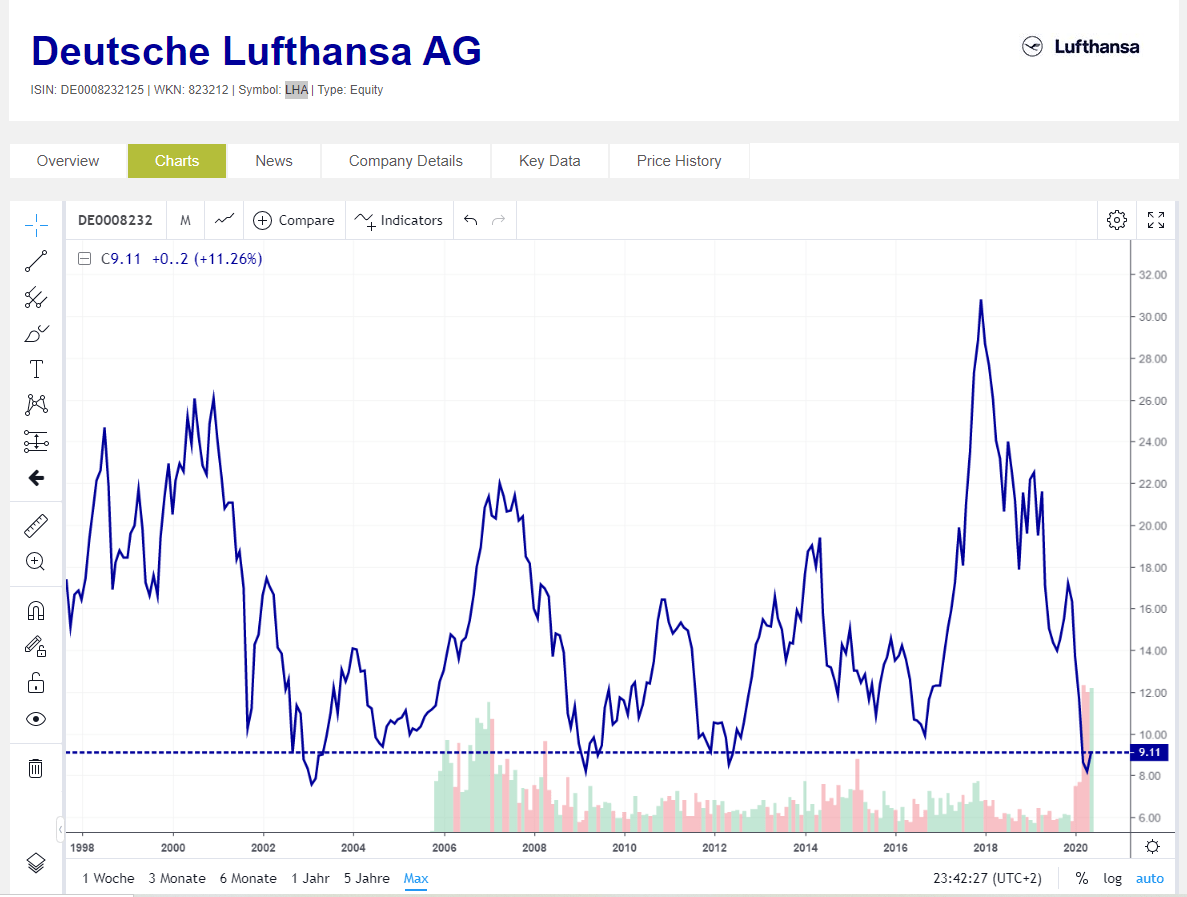
The company trades on the Frankfurt Exchange under the ticker LHA. The below chart shows the long-term return on the Frankfurt-traded stock:

Click to enlarge
Source: Deutsche Boerse

The airline is unlikely to go bankrupt as it is being bailed out by the German government with an loan of 9.0 Billion Euros. Below is an excerpt from an article at Deutsche Welle:

Major losses for Lufthansa

Lufthansa’s share price was already falling well before the pandemic, but lockdowns and global freezes on passenger travel have hit the company especially hard.

On Wednesday, the company said it would undergo “far reaching” restructuring after posting a first quarter net loss of €2.1 billion.

The German government and Lufthansa agreed to a €9 billion ($10.2 billion) bailout package earlier this week.

Under the deal, the German government will take a 20% stake in Lufthansa, making it the group’s biggest shareholder. Shareholders will be asked to back the deal during an online meeting on June 25.

Source: Lufthansa loses spot on Germany’s DAX stock index, Deutsche Welle

Lufthansa has been part of the DAX since it was first created in 1988.

Lufthansa will replaced by Deutsches Wohnen, Germany’s second-largest property company.

Key Takeaways:

  • Since bankruptcy is avoided with the bailout, investors can pick up shares with some confidence. However revival of the airline industry is up in the air unless a vaccine is found for Covid-19.
  • Funds holding Lufthansa will be forced to sell on June 22. The iShares MSCI Germany ETF (EWG) has less than 0.5% weighting in Lufthansa. UK-listed iShares Core DAX® UCITS ETF (DAXEX) which tracks the DAX will also be forced to liquidate the position. Another smaller size ETF that holds Lufthansa is the UK and Swiss-listed Vanguard DAX UCITS ETF (VDXX).
  • Lufthansa has suspended the 2019 dividend payment due to the 99% drop in passenger volume due Covid-19.

Related:

Disclosure: No Positions

The Top 10 Countries in Tobacco Usage: Infographic

The Top 10 countries with the highest tobacco usage is shown in the graphic below. In Europe, the heaviest smokers are Serbia, Bosnia-Herzegovina, Bulgaria and Greece. Over 45% of the people in Burma(Myanmar) smoke making it the top country in Tobacco use in the world. Burma is followed by Chile and Lebanon. Indonesia, with a population of over 267 million is a major market for tobacco companies.

Click to enlarge

Source: RFE/RL Infographics

Four Ways to Destroy Coronavirus: Infographic

The coronavirus pandemic has affected over 5.4 million people worldwide and the global death toll has exceeded 345,000 according to NY Times. The US case total exceeded 1.6 million with a death toll of over 98,000. As the nation heads towards a 100K toll, the Times published a brilliant front page on Saturday, May 24th listing the names of 1,000 victims under the news headline “An Incalculable Loss“.

Experts predict these numbers to go even higher as all 50 states reopen to business as usual with some modifications.

With that said, below is an useful infographic on how to destroy COVID-19:

Click to enlarge

Source: Compound Interest

Interesting Article on Manchurian Plague, 1910-11

Many of the epidemics and pandemics in modern times originated in China. For example, the Asian Flu (1956-1958), SARS (Severe Acute Respiratory Syndrome) in 2002, H7N9 in 2012, etc. all started in China. Of course, the country is also the source for the current coronavirus pandemic (Covid-19). The reasons for why China is the originator of many deadly diseases are many. The following excerpt from an article early this years offers a few:

All of these outbreaks originated in China, but why? Why is China such a hotspot for novel diseases?

“It’s not a big mystery why this is happening… lots of concentrated population, with intimate contact with lots of species of animals that are potential reservoirs, and they don’t have great hygiene required. It’s a recipe for spitting out these kinds of viruses,” Dr. Steven Novella recently opined on an episode of the Skeptics’ Guide to the Universe.

South Central China is a noted “mixing vessel” for viruses, Dr. Peter Daszak, President of EcoHealth Alliance, told PBS in 2016. There’s lots of livestock farming, particularly poultry and pigs, with limited sanitation and lax oversight. Farmers often bring their livestock to “wet markets” where they can come into contact with all sorts of exotic animals. The various birds, mammals, and reptiles host viruses that can jump species and rapidly mutate, even potentially infecting humans. Experts are pretty sure this is precisely what happened with the current COVID-19 coronavirus, which is why, on January 30th, China issued a temporary ban on the trade of wild animals.

There are also cultural reasons why China plays host to large outbreaks.

“Many Chinese people, even city dwellers, insist that freshly slaughtered poultry is tastier and more healthful than refrigerated or frozen meat,” journalist Melinda Liu wrote for Smithsonian in 2017. “The public’s taste for freshly killed meat, and the conditions at live markets, create ample opportunity for humans to come in contact with these new mutations.”

Source: Why Do New Disease Outbreaks Always Seem to Start in China?, Real Clear Science

While doing some research online I came to know about the Manchurian plague of 1910-11 which also started in China. From an article on this plague:

In the autumn of 1910, the press in China began to report that a rare and deadly pneumonic plague had reached Harbin in the extreme Northeast of China, then known as Manchuria.[1] Though confined largely to China’s Northeastern provinces, cases were reported sporadically throughout the empire, in Tianjin, Beijing and along the Beijing-Hankou railway line stretching down into central China, reflecting the scale of the epidemic.[2] It is difficult to attain precise statistics about the death toll of the plague; however reports suggest that between 50,000 and 60,000 people died, with an unprecedented mortality rate of 100 per cent.[3] As a point of comparison, this places the death toll of the Manchurian plague in the same region as that of the more familiar Great Plague of London (1665-66).[4]

CAUSATION

The plague is likely to have originated amongst tarbagan marmot hunted for their fur in Manchuria.[5] As the German chemical industry developed new dyes, cheap marmot fur could be manufactured into imitation sable, mink and otter fur.[6]Consequently, the value of marmot fur rose from a ‘few kopecks a skin to a rouble’, causing migrant hunters to flock to Manchuria. These migrants, however, were inexperienced. Whereas local hunters, many of whom were from the region’s Buryat ethnicity, could identify and avoid diseased marmots, the migrant hunters collected unhealthy marmots, infecting themselves with the plague bacilli the diseased animals carried.[7]

The spread of the plague was exacerbated by the bitter cold of the northern winter, which caused the hunters to huddle together in huts, quickly spreading the airborne pneumonic plague. Manchuria’s extensive railway network further aided the rapid transmission of the disease by facilitating the movement of large numbers of migrant workers returning home for the New Year Festival.[8]

From Khailar in October the plague spread to Harbin, where thirteen cases had been reported to be ‘fatal’[9] and by November 8th the city had a death toll of 5,272 deaths. Quarantine and control had been put in place in order to prevent the spread, however by January, Mukden (today’s Shenyang) had over 2,571 deaths,[10] soon spreading south to the capital city, Peking where an additional five cases were found.[11] Thus, the plague quickly spread throughout towns and cities along the railway lines in Manchuria, thriving in areas defined by ‘dense population, high human mobility and poor hygiene conditions’.[12]Subsequently, cities throughout Manchuria experienced high death rates, such as Kuancheng, near Jilin, which reported over 200 deaths per day.[13]

Due to the popularity of the relatively cheap, third-class tickets offered by the South Manchurian Railway most cases of plague infected cities along the rail line first, then spread further to small villages, with some being reported as far as Tientsin.[14]There were fears it would spread further, especially to Peking, as workers travelled home and shopped for Chinese New Year (30th Jan). The worst hit areas were the crowded provincial capitals Changchun, Harbin, and Mukden, with deaths of up to 150, 130, and 60 daily respectively.[15] The majority of infections fell on poor, middle-aged Chinese who lived in crowded conditions with poor sanitation; very few foreigners contracted the plague, if so, they were medical staff.[16],[17] Through carrying out recommended procedures (isolation) infection in most cities and villages died out within two weeks; by the middle of March, Manchuria had resumed normality with plague existing only in hospitals. Schools, factories, and businesses including the whole of the South Manchurian Railway were open, working harder to recover lost ground.[18]

Note: All the references noted above are in the linked site.

Source: Manchurian plague, 1910-11, Investment Office

The entire article is worth a read. History does indeed repeat itself even with respect to pandemics, epidemics and plagues.