Gold Offers Portfolio Protection During Drawdowns

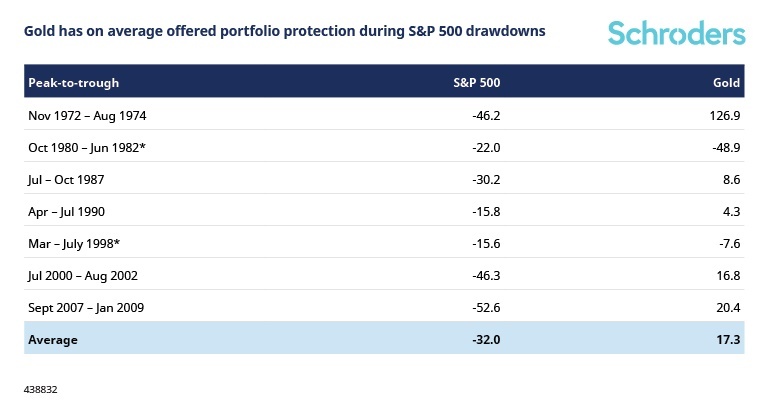
Gold offers excellent protection to a well diversified portfolio during market crashes. Gold, as an asset class is not a great tool for generating income. However when markets head south most investors dump stocks and try to seek refuge in assets like gold. In general, gold tends to perform well during crises. For example, during the Global Financial Crisis(GFC) 2007-2009, the S&P 500 fell nearly 53% but gold actually went up by over 20%. The difference in returns is of course over 70%. Similarly during the dot com collapse also gold performed very well.

In the current crisis also gold should perform well relative to other assets.

The following table from a recent article at Schroders compares the returns of S&P 500 and gold during drawdowns:

Click to enlarge
Past performance is not a guide to future performance and may not be repeated.
Source: Refinitiv Datastream and Schroders. Notes: S&P 500 drawdown calculated as change in index price level from peak to trough. *Exceptions in 1980-1982 can be attributed to real yields jumping from -5% to 8% while dollar debasement fears subsided, and in 1998, when the Asian Financial Crisis triggered a rapid reversal in Asian gold jewellery demand.

Source: Is now the time to own gold?, Schroders

Below is another interesting chart that shows the performance of gold vs. S&P 500 during the past 11 crises periods:

Click to enlarge
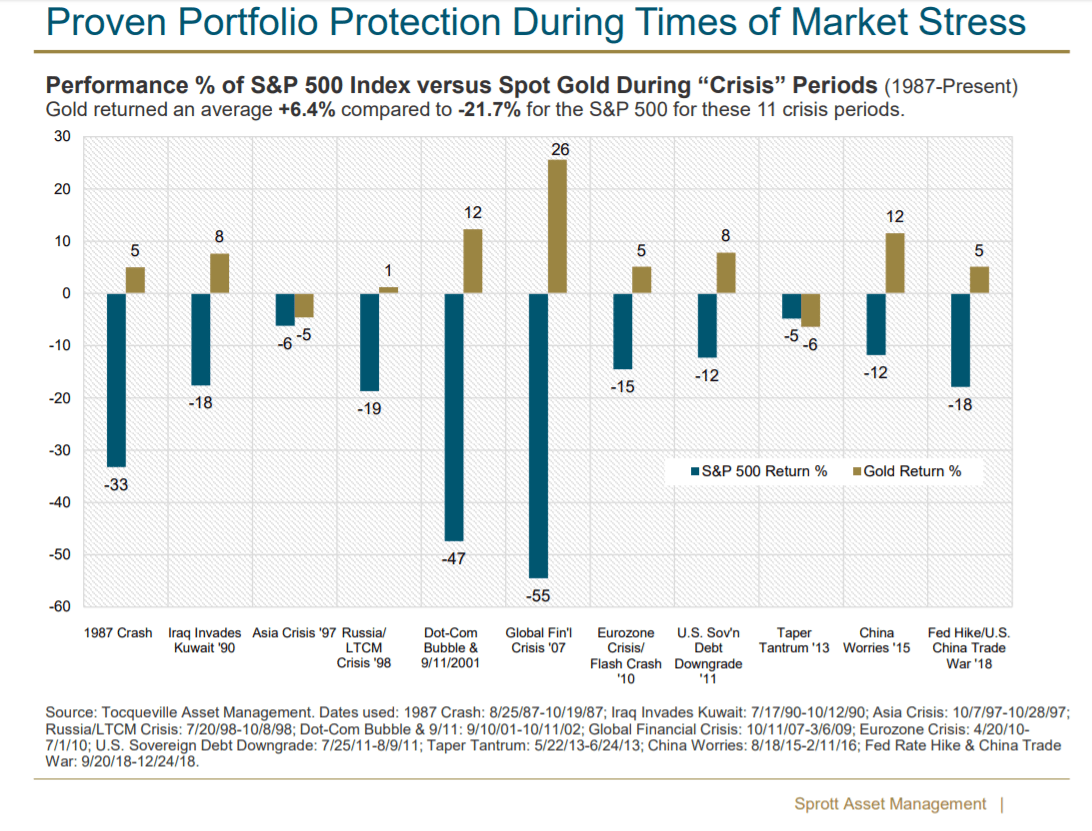
Source: Sprott Asset Management 

Related ETFs:

  • SPDR S&P 500 ETF Trust (SPY)
  •  SPDR Gold Trust (GLD)

Disclosure: No Positions

Expensive Stocks Get Even More Expensive ! : Chart

US stocks have roared back since the lows reached in March. None of the factors that would normally crush the market seems to have any impact on the market in the current scenario. Millions of unemployment people, a scary global pandemic, economic devastation to name a few seems to be nothing more than just noise to the market. Some are attributing the dramatic recovery in equity prices to the Fed printing unlimited amounts of money. Some others are stating that the unemployed Americans getting some extra $600 in unemployment, millennials living in basements of their parents’ using the Robinhood App and the work-from-home crowd are simply playing the market since they are bored at home. Obviously thousands of kids playing the market with $100 here and $1,000 there are NOT going to cause the market to boom like it did in the past few months.

With that said, the tech-heavy NASDAQ has shot up over 26% in the past 3 months and is up over 11% year-to-date. The market cap of already richly valued firms has exploded to even higher levels. The market caps of the five major firms on the NASDAQ Exchange are shown below:

  • Facebook Inc (FB) – $674.0 Billion
  • Apple (AAPL) – $1.5 Trillion
  • Amazon(AMZN) – $1.3 Trillion
  • Microsoft (MSFT) – $1.5 Trillion
  • Alphabet Inc (GOOG) – $1.5 Trillion

The P/E ratios of these giants show they are not cheap. Facebook for example has a TTM of over 34. Amazon’s P/E is even worse at over 124.

It appears that some investors are actually assuming that these firms are benefiting from Covid-19. The thinking goes that millions of people sitting at home are simply ordering everything online from Amazon for instance and hence the growth for Amazon is infinite.

However extreme caution is needed when the crowds believe that stocks especially those in the tech sector can only go up.

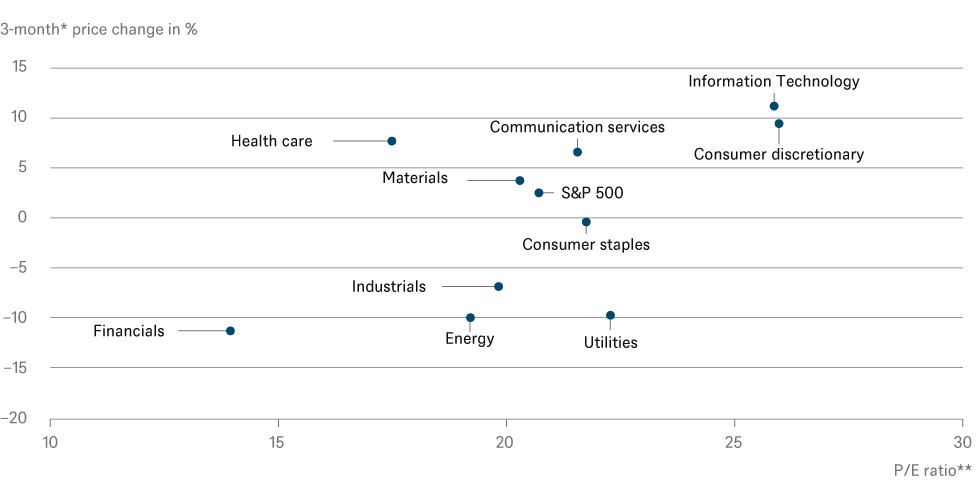
A recent article by folks at DWS shows that the already expensive sectors even more expensive after the three month rally:

Click to enlarge

Source: Expensive stocks become more expensive as cheap ones stay cheap, DWS

Hat Tip: David Stevenson: my take on six bull arguments for markets, CityWire

The two sectors with high P/E ratios that rose the most in the three months are: IT and Consumer Discretionary.

Key Takeaway:

Some of the mega-cap stocks in the NASDAQ were expensive even before the pandemic induced crash. They are now trading at much higher levels in terms of stock prices and their market caps have ballooned accordingly. So investors need to remain cautious and not buy these stocks just because they keep going up.

Disclosure: No Positions

A Simple Chart Of The US Healthcare System

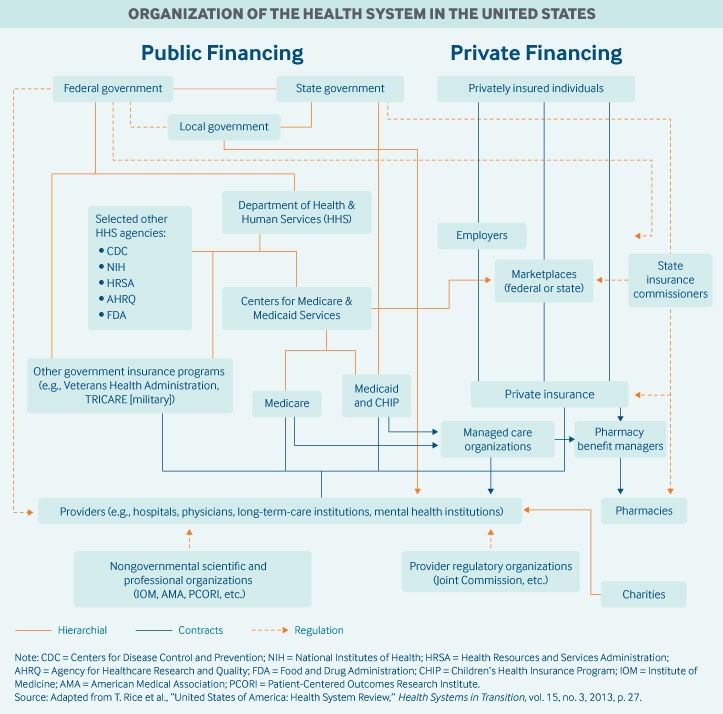
The healthcare “system” in the USA is a mess to put it mildly. Multiple players are involved in taking care of the health needs of the population. Some of the stakeholders include: Federal, State and Local governments, private companies, charities, drug companies, etc.

The following chart shows the organizational structure of the healthcare system in the US:

Click to enlarge

Source: The Commonwealth Fund

Technological Innovations Take Years To Boost Productivity: Chart

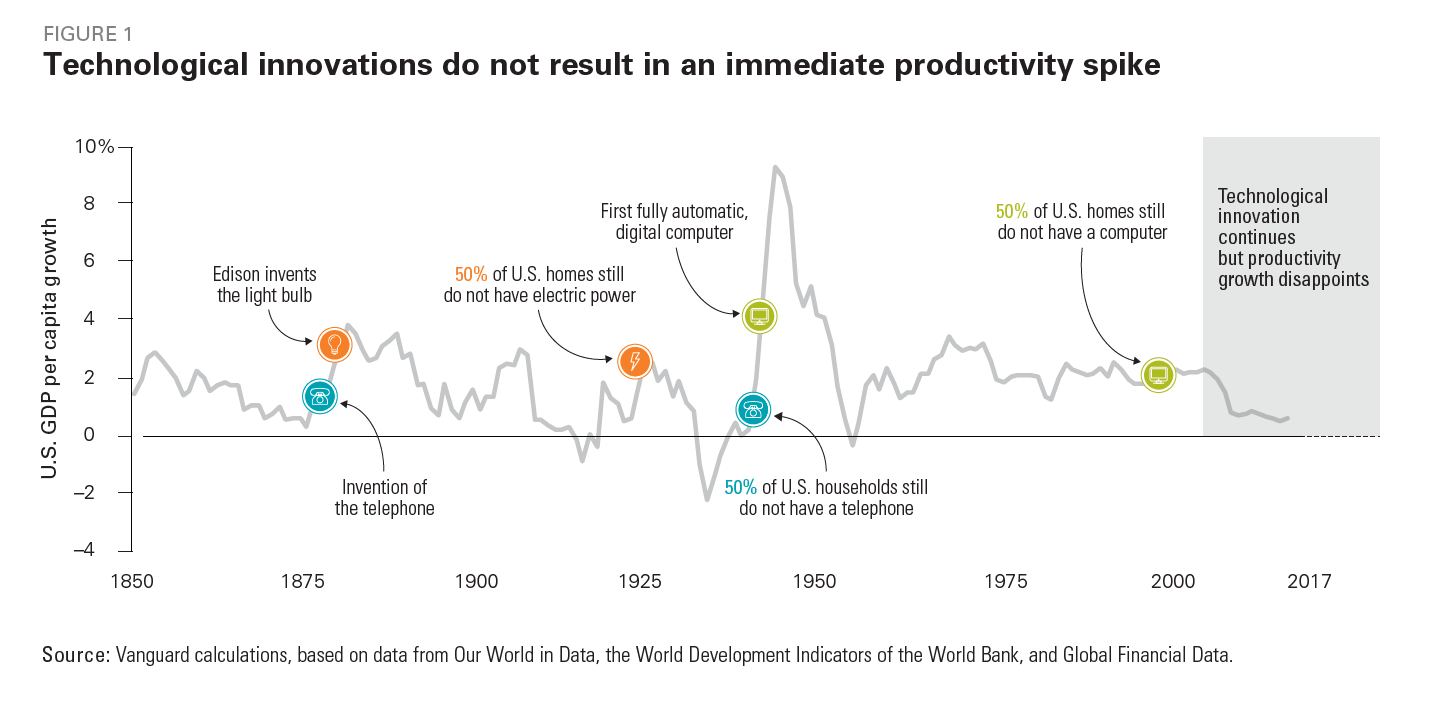
I posted an interesting chart from a research paper on innovation multipliers by Vanguard showing the many ideas that went into the development of a smart-phone. The below chart from that paper shows that tech innovations do not result in an immediate boost to productivity. It takes years or even decades before innovations are widely embraced by the population to increase productivity. The authors explain this logic using the examples of the light bulb, telephone and computer.

Click to enlarge

Source: Megatrends – The Idea Multiplier: An acceleration in innovation is coming, Vanguard


The 2019 Vanguard Index Chart: The Australian Edition

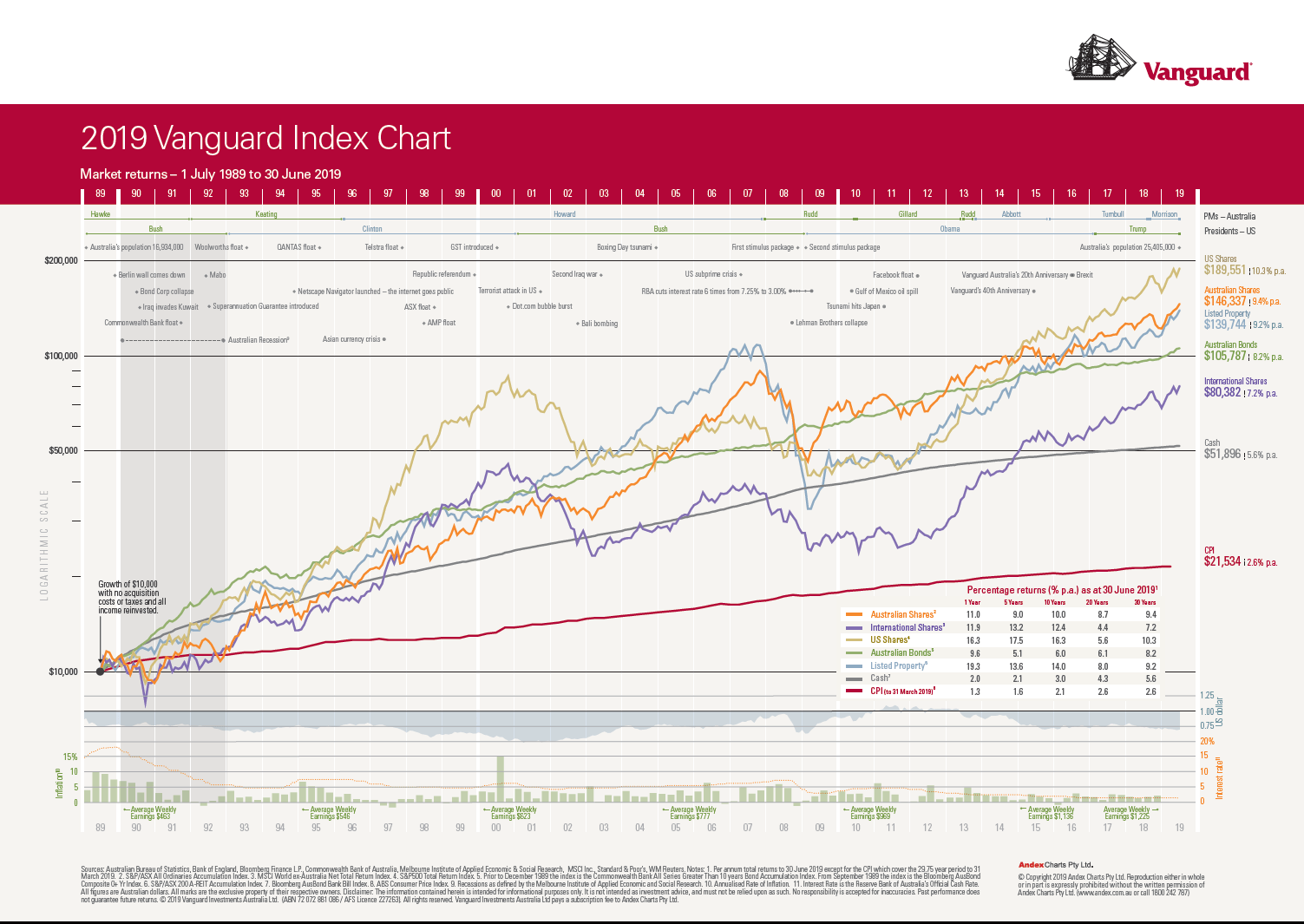
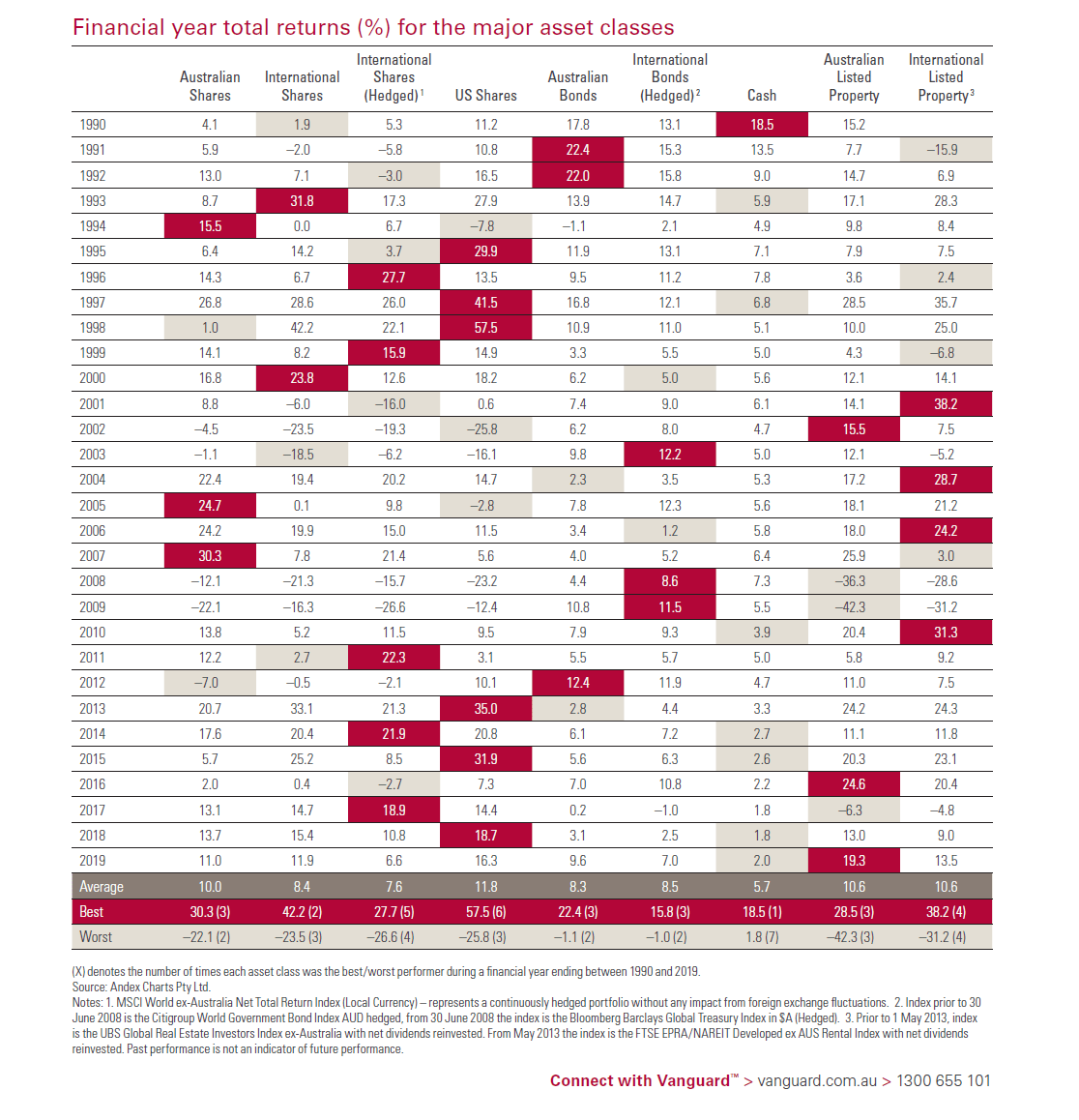
Diversification and investing for the long-term are the key ingredients for success in equity investing. I found the following chart from Vanguard showing the returns of various assets over the long-term (from June-1989 to June-2019) in the context of the Australian market:

The 2019 Vanguard Index Chart:

Click to enlarge

Financial Year Total Returns of Major Asset Classes:

Source: Stay the course –  2019 Vanguard Index Chart, Vanguard Australia

The above chart also shows some of the key economic and political events.

The key takeaway is that US shares were the top performers over the 30-year period followed by Aussie stocks. Cash yielded the lowest return during the same period.