Why Long-Term Investors Should Not Lose Their Faith in Stocks

Stocks can be volatile in the short-term. However over the long-term measured in years they tend to be outperform other types of assets such as bonds, cash, gold, etc. The trick is to be patient and not sell out when there is a downturn in the equity markets. Investors that ignore the short-term declines and hold steady usually come out ahead of those that sell out at the trough. The recent market decline in March this year is a classic example. After declining sharply stocks rose so fast that you would have missed it if you blinked. Past bear markets also confirm the same scenario repeat. A while I came across an article that showed the importance of long-term investing. From the article:

Propensity to recover from losses and make new highs subsequently

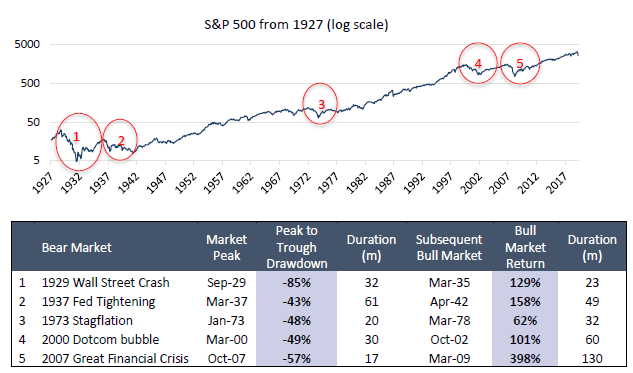
Owing equities, however, comes with risks, as stocks are subjected to large drawdowns during periods of market uncertainties. Nonetheless, equities—as history has shown—have rebounded after every crisis and even breached new highs subsequently. Referencing five of the worst equity drawdowns since 1927, stocks had suffered peak-to-trough drawdowns of around -40% to -85%. But no permanent impairment was experienced by investors unless they impatiently sold out of stocks during the market downturns. During subsequent bull markets, equities recovered all the earlier losses and generated higher returns thereafter (see Chart 3). As such, exiting equities in the midst of a deep sell-off could do more harm than good to investors, especially those with a long-term investment horizon.

Chart 3: Equities always rebound from sharp drawdowns and generate strong returns thereafter
Source: Long-term investors shouldn’t lose faith in equities, Nikko Asset Management4

The entire article linked-above is worth a read.

Related ETF:

  • SPDR S&P 500 ETF Trust (SPY)

Disclosure: No Positions
 

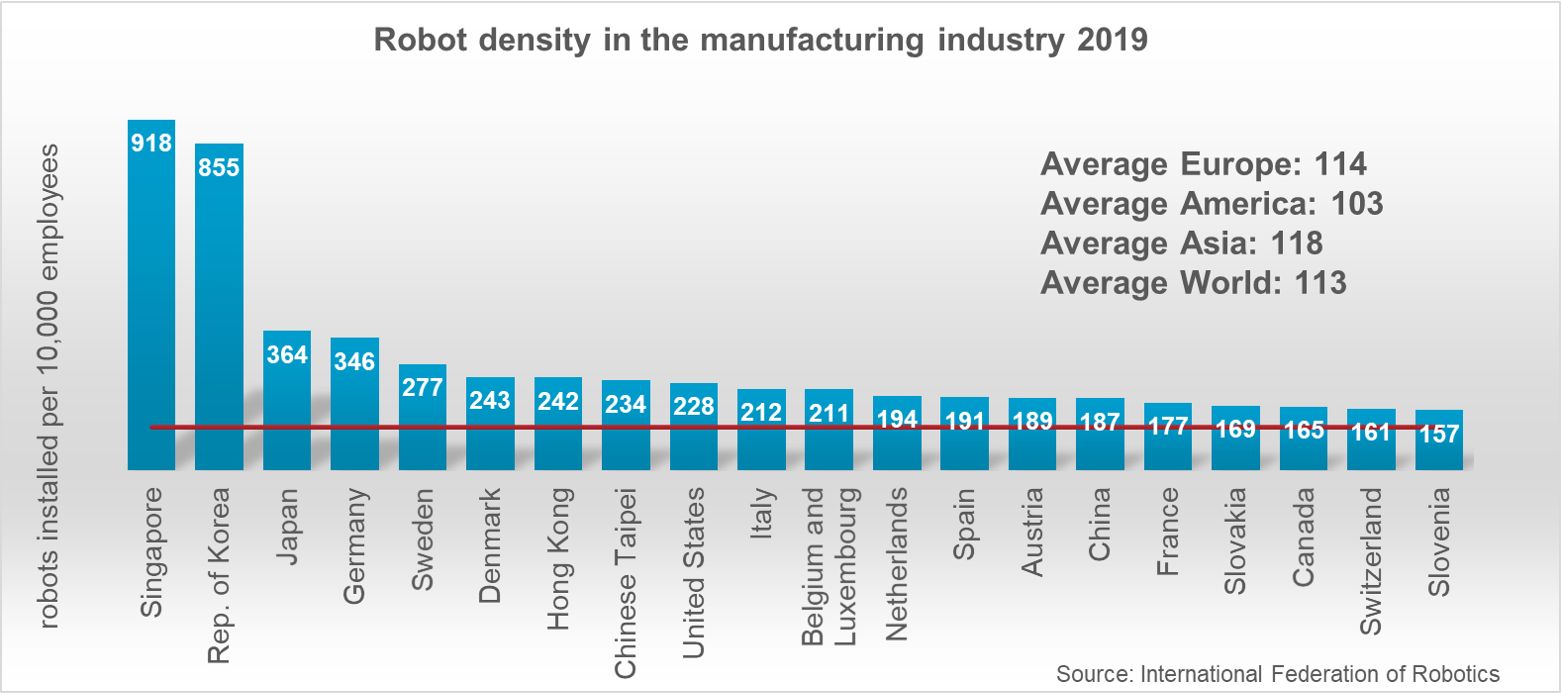
Robot Density in the Manufacturing Industry by Country 2019

We looked at the chart of annual installations of industrial robots last week. The following chart shows the robot density in the manufacturing industry in 2019 by country. Asian countries top the ranking with Singapore, South Korea and Japan taking the top three spots. Among the developed European countries, Germany leads the list with 346 installed per 10,000 employees.

The US has just 228 robots installed per 10K employees which is lesser than Japan and Germany and far below than South Korea.

Click to enlarge

Source: IFR presents World Robotics Report 2020

Is it Time to Consider Oil Stocks?

Oil prices have fallen from over $68 per barrel earlier in January to around $43 now as measured by Brent Crude. In April when Coronavirus lockdowns were imposed in most countries price plunged to around $20 a barrel. Though prices have recovered as economies have slowly opened up, it is still a far cry from over $68. Not to mention demand may decline again as new restrictions are imposed again in Europe. The US may not be far behind either since the US was lagging Europe by a few months from the start of the pandemic. Travel restrictions not only curtail gasoline usage but also other derivatives of oil such as jet fuel for example.

As oil prices declined so do the stock prices of oil producers. Many of the foreign oil company stocks have seen declines ranging from 38% to 71%. With prices so low, some investors especially contrarian investors may see a bargain. I have been keeping an eye on this industry as well since March. On Friday, John Stepek at MoneyWeek published an interesting article on this very topic. From the article:

The oil sector is staggeringly cheap

Louis-Vincent Gave at research group Gavekal has just put out a piece on oil prices. As ever with Gave, it’s extremely interesting. His core point – one we’ll return to in the future – is that oil, the US dollar, and US government debt have all been trading in a tight range since March. Those are all really important prices. If they start to trend properly in one direction or another, then we’ll have a very different investment environment on our hands.

But in this piece he focuses on oil. He looks at both the bearish and the bullish case, but I really just wanted to highlight some of the incredible statistics that are in his piece. He points out that energy stocks are now the smallest sector in the MSCI World index, with a weighting of just 2.48%. That compares to Apple, with a weighting of 4.46%. In other words, Apple by itself is almost twice as significant as the entire listed energy complex.

OK, Apple is the virtual, shiny, ultra-hygienic future into which we are being propelled, while oil is the real-world, gritty, dirty present day that we are apparently leaving behind. But we don’t all run on batteries yet, and even in lockdown some of us need to get from A to B and sometimes even to C. And the latter requires cars and occasionally planes.

So does that disparity in valuation make sense on the fundamentals? Or is it being driven more by an environment that puts little value on the present relative to the future, because of ultra-low interest rates? Is it all part of the “long duration” bubble? I’m guessing it’s the latter.

Meanwhile, for the first time ever, says Gave, “the broad energy industry is trading at below book value.” In other words, companies are trading for less than the value of the assets on their balance sheets.

That’s fascinating and it’s genuinely unprecedented. It’s also only happened this year. For roughly the decade after the financial crisis, the MSCI World energy index traded at around 1.5 to two times book value. Prior to that it was a lot higher – from 1996 to the financial crisis the low was about two and the high above 3.5.

Source: Oil shares have never been this cheap – but will they just get even cheaper? by John Stepek, MoneyWeek

The table below shows the year-to-date price returns of major foreign oil companies trading on the US exchanges:

S.No.Company NameTickerStock Price (as of Oct 16, 2020)Year-to-date Change(%)Country
1EquinorEQNR$14.17-28.83%Norway
2Transportadora de Gas del SurTGS$4.75-33.75%Argentina
3China Petroleum & ChemicalSNP$38.83-35.44%China
4TOTALTOT$33.00-40.33%France
5PetroChinaPTR$28.32-43.73%China
6China National Offshore Oil-CNOOCCEO$93.57-43.86%China
7EniE$15.21-50.87%Italy
8EcopetrolEC$9.66-51.60%Colombia
9Petroleo Brasileiro-PetrobrasPBR$6.85-54.09%Brazil
10BPBP$16.25-56.94%United Kingdom
11Royal Dutch Shell - A SharesRDS.A$25.27-57.15%United Kingdom
12Royal Dutch Shell - B SharesRDS.B$24.29-59.50%United Kingdom
13YPFYPF$3.56-69.26%Argentina
14SasolSSL$6.25-71.08%South Africa
15Vista Oil & GasVIST$2.25-71.34%Argentina

Source: BNY Mellon

Norwegian oil major Equinor (EQNR), formerly known as Statoil,  has held up well relative to others. Though the three Chinese oil giants have lost over 40%, the Chinese economy is growing strongly and hence the oil stocks may outperform others. Global investors punished Shell and BP a few months ago when they slashed dividend payments.

While predicting the future price of oil or the demand is a futile exercise, wise investors can nibble at these record low stock prices.

You many also want to checkout Oil stocks: share prices in this hated sector are back at their Covid-19 lows – time to buy? by John as well.

Disclosure: Long EC

Wuhan is a Hot Tourism Destination Again: Video

Wuhan, China was the original epicenter of the coronavirus that causes Covid-19. It was first traced there in December, 2019. On January 23, 2020 China imposed a strict lockdown on Wuhan. The lockdown ended on April 8, 2020. From the start of the pandemic till today the whole of China has 94,183 cases and 4,634 deaths according to NYTimes data.

Compared to China, the US death count stands at 218,924 and infected cases 8,122,865 as per the latest figures. The question on everyone’s mind is not just why the US totally lost control of the virus but more importantly when will it end.

Below is an interesting WSJ video of how Wuhan has emerged as a hot tourist destination again. The rapid transformation of Wuhan from ground-zero of Coronavirus to hosting the largest number number of domestic tourists in just a few months is shocking to say the least.


Source: WSJ