US Direct Auto Supplier Manufacturing Employment by State: Chart

The US auto parts industry is the second most important industry after the auto manufacturing industry. Direct employment by auto parts suppliers was over 907,000 in 2019. When indirect jobs are included the total reached out 4.8 million jobs in that year according to a report by Motor & Equipment Manufacturers Association.

Mid-western states have the largest auto parts employment with Michigan as the top state for auto parts supplier employment followed by Ohio and Indiana. The top 10 states accounted for 67% of total direct employment and the top account for 88% of the total. Obviously Alaska and Hawaii rank the last in auto parts employment.

Click to enlarge
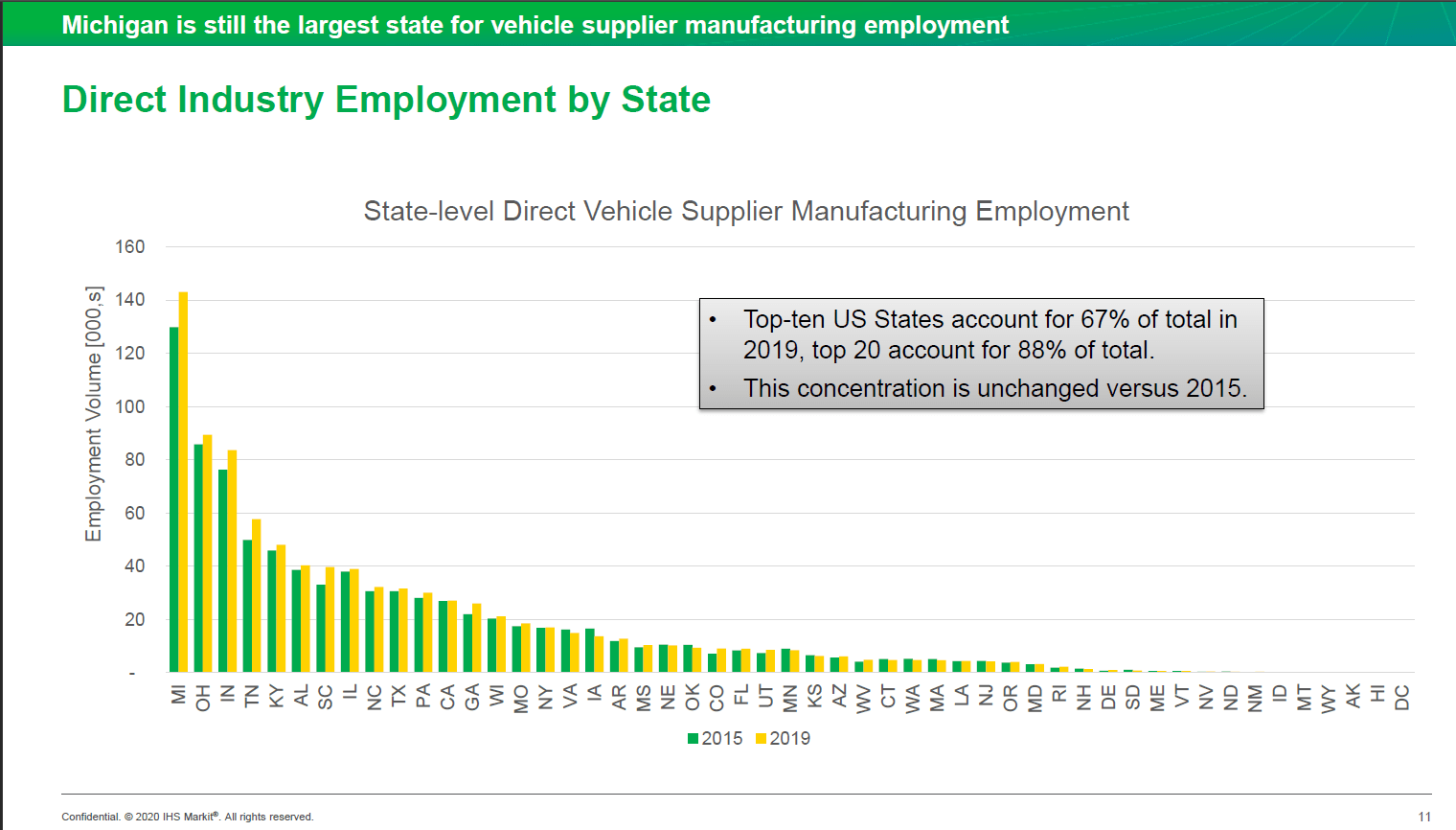
 

SourceUS Labor & Economic Impact of Vehicle Supplier Industry 2019CY Final Report for Motor & Equipment Manufacturers Association, December 2020 2.0, MEMA

In a future post we will look at the auto parts employment figures in Mexico.

Related lists:
On The Impact of Inflation on Equity Returns – An Australian Example

Inflation has become one of the main topics in the US media in recent weeks. Prices of autos to food and restaurant meals are going up to the surprise of the general population which generally was protected from the ravages of inflation for many years now. Curious investors are wondering about the impact of inflation on equity returns. While it is well known that stocks traditionally yield a return that beats inflation, it is still important how stock returns are affected during different phases of inflation.

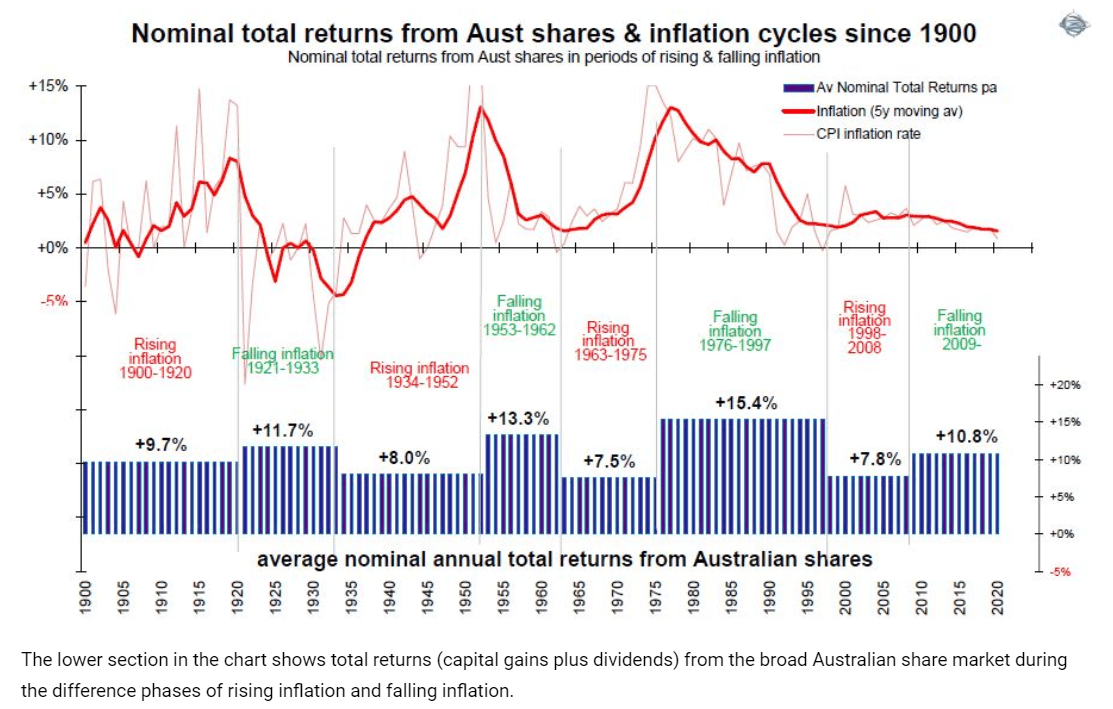
I recently came across an excellent piece at Firstlinks that discussed the very topic from an Australian perspective. The gist of the article is during rising inflation periods, equity returns decline. But during periods of falling inflation, equity return increases as shown in the chart below:

Click to enlarge

Source: How inflation impacts different types of investments, Ashley Owen, Firstlinks, Australia

It should be noted that the returns shown above are not adjusted for inflation. So the total return of 7.8% during the rising inflation period of 1998 to 2008 is lesser when accounted for inflation. The “real” return during that period was just 4.3%.

The key takeaway is investors can expect to earn lower returns from equities during periods of rising inflation and vice versa. As the US is in the rising phase of inflation cycle currently equity returns would be lower not higher in the future.

Related ETFs:

  • iShares MSCI Australia Index Fund (EWA)
  • SPDR S&P 500 ETF (SPY)

Disclosure: No positions

Performance of Gold vs. S&P 500 During Major Crises

Gold is an important asset class to own in a well diversified portfolio. The performance of gold is negatively co-related to risky assets such as the S&P 500. In this post, let’s review the return of gold vs. the S&P 500 during major crises in the past few decades.

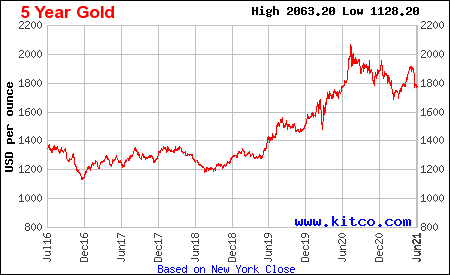
Before we get to that a quick note on the price of gold. Gold topped out at over $2,000 during the pandemic last year. This year gold has been an average performer so far. Yesterday gold prices closed at $1,775.00 an ounce. From a historical perspective, gold has returned 516% since 2000.

Click to enlarge

Source: Kitco

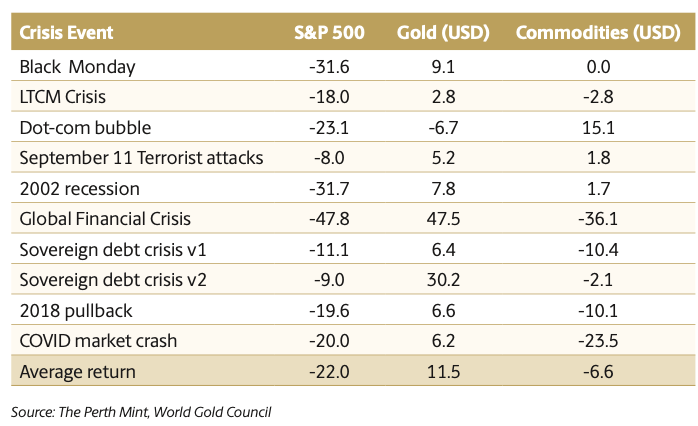
As mentioned above, gold tends to have strong growth when stock prices decline and vice versa. This is because gold is considered a safe haven asset and as investors flee from risky stocks they try to take shelter in gold. In addition, gold is traditionally regarded as good source for holding value. So when the world is engulfed in major crisis gold attracts hordes of investors. For example, during the Covid crash of 2020 S&P 500 plunged 20%. But gold was a winner with just over 6% gain. The case for gold was even more pronounced during the Global Financial Crisis when stocks crashed by about 48% and gold rose over 47%.

Click to enlarge


Source: The case for a modest allocation to gold in super funds by Jordan Eliseo, First Links, Australia

The key takeaway is gold can cushion a portfolio when equities fall. So it is wise to allocate some portion of assets to gold.

Related ETF:

  •  SPDR Gold Trust (GLD)

Disclosure: No Positions

European Companies That Have Increased Dividends For More Than 20 Years

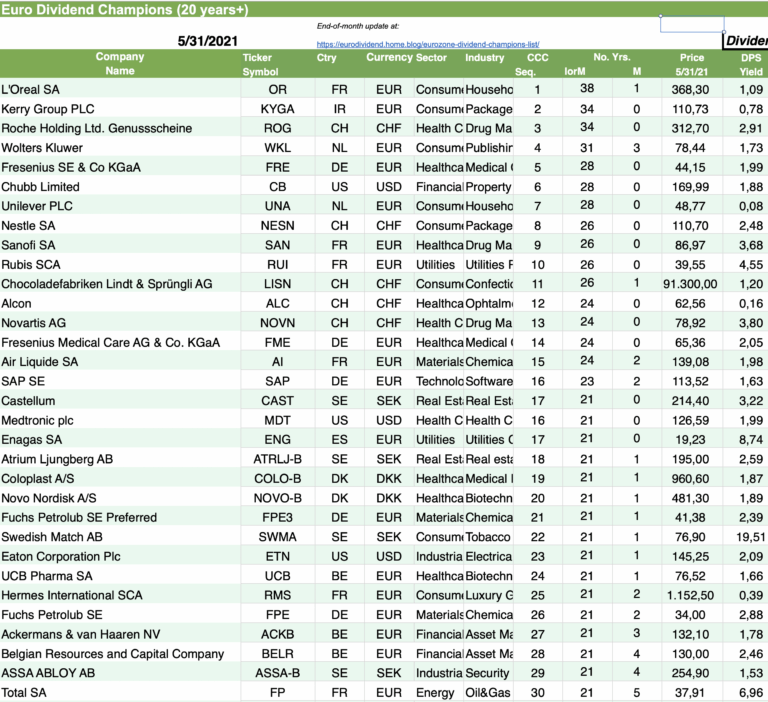
The S&P 500 Dividend Aristocrats measures the performance of companies that have increased for 25 consecutive years. Similar to these US Dividend Aristocrats there are many European firms that are consistent dividend growers. In this post, let us take a look at companies from Europe that have raised dividends for 20 years or more. For investors that are interested in the European Dividend Aristocrats, the S&P Europe 350® Dividend Aristocrats® measures the performance of companies in the S&P Europe 350 index that have increased the dividend payments for at least 10 consecutive years.

Click to enlarge


Source:DRIPInvesting.org via Tim Schaefer

A few observations:

  • France-based, cosmetic giant L’Oréal S.A. (LRLCY) has increased dividends for 38 years ! Currently the ADR has a market cap of over $255.0 billion and the stock has a dividend yield of 1.99%. L’Oreal stockholders that own the stock for more than two years can receive a 10% loyalty bonus dividend as well.
  • Swiss pharmaceutical leader Roche Holding AG (RHHBY) currently pays a 2.57% dividend. Roche has raised dividends for 34 years.
  • Other drug firms in the above list include Fresenius Medical Care AG & Co (FMS), Novartis AG (NVS) and Novo Nordisk A/S (NVO).
  • Unilever PLC (UL) and Nestle SA (NSRGY) in the consumer staples sector have increased their dividend payments for 28 and 26 years respectively.

A Note on Dividend Withholding Tax:

Dividend withholding taxes for US residents will reduce the actual yield reported above. This tax for foreigners varies by county and can be as high as 35% in the case of Switzerland. The full list of rates by country can be found here.

Disclosure: No Positions

The Best 20 US Regional Banks For Creating Value

The banking industry in the US is one of the highly regulated and competitive industries. Thousands of banks operate in the country with some as small as one or branches. In addition, a few banks operate as online only banks. Of these banks, investors have quite a few options to invest in some of the publicly-listed banks. There are over 50 banks listed on the NYSE and the NASDAQ is home to over 325 banks.

With so many bank stocks listed, which ones are the best in terms of value creation for shareholders?

One way to identify such stocks is to perform due diligence on your own using various metrics and some subjective factors. Another option is to consider list of banks that were analyzed and ranked as the best banks for creating value by the Bank Director magazine. The magazine recently published its annual list of the Top Banks in various categories. The winners for creating value were based on many factors which are detailed in the below excerpt:

To identify the best bank for creating shareholder value, Bank Director examined and ranked each institution based on its ability to consistently generate a high level of profitability, through average return on assets and return on equity from December 2014 to December 2019, as well as the standard deviation of both metrics. We also looked at growth in ROE, ROA and pre-tax pre-provision (PTPP) income over the same time frame. And we factored in dividend growth and average trade volume to understand the liquidity of each bank’s stock. These factors were ranked to produce an overall score. The category rewards growth but places a greater emphasis on consistency.

Source: Best Bank for Creating Value, Bank Director

Abilene, Texas-based First Financial Bankshares (FFIN) is the winner among the 20 banks selected in this category. The bank has been consistently growing earnings for the past 34 years. From the article:

“It’s a different breed of bank than most players out there,” says Hovde Group analyst Brett Rabatin, citing First Financial’s culture, conservative lending strategy, fortress balance sheet and successful M&A track record. Another factor is its strategy to compete with a handful of banks in its small-town markets; the bank prefers to skirt around metropolitan areas. First Financial is also a true relationship lender, Rabatin adds. “A lot of banks like to say, ‘we’re relationship lenders,’ [but] this is one of the few banks where it shows up. It shows up in their loan yield, it shows up in the profitability.”

The Top 20 Banks for creating value are shown in the table below:

RankBank NameTickerScoreROA (Avg.) - YE 2014 – YE 2019Avg. Trade Volume - SEPT. 2020
1First Financial BanksharesFFIN7.921.79%511,782
2Southside BancsharesSBSI81.17%123,885
3Glacier BancorpGBCI8.881.42%661,117
4Lakeland Financial Corp.LKFN8.921.44%132,968
5Bank OZKOZK9.252.05%970,818
6Meta Financial GroupCASH9.291.08%240,842
7Independent Bank Corp.IBCP9.921.17%125,709
8Stock Yards BancorpSYBT10.081.54%88,751
9The First BancorpFNLC10.291.17%15,787
10Prosperity BancsharesPB10.381.34%494,390
11Community Bank SystemCBU10.461.37%263,598
12Auburn National Bancorp.AUBN10.631.03%10,584
13City Holding Co.CHCO10.831.53%74,314
13Southern Missouri BancorpSMBC10.830.96%14,695
15Greene County BancorpGCBC11.421.20%3,900
16Horizon BancorpHBNC11.631.05%152,587
17Eagle Bancorp MontanaEBMT11.710.87%30,150
18WSFS Financial Corp.WSFS11.921.21%270,004
19Hingham Institution for SavingsHIFS13.131.33%3,581
20First CapitalFCAP14.041.07%7,810

A few observations:

  • Consistent growth is the key factor shared among the above banks. One way this can be measured is reviewing their dividend payment history.
  • For example, Montana-based Glacier Bank(GBCI) has paid dividends for 143 consecutive quarters and has increased dividend 46 times. In recent years, the company has also paid out a special dividend. The last special dividend was $0.15 per share paid out in January of this year.
  • All the above banks have decent dividend yields with room to increase.
  • Long-term returns of stocks are also excellent. For instance, a $10,000 investment in Prosperity Bancshares (PB) five years ago would have grown to over $17,200 as of June 25, 2021 according to S&P. The same amount in First Financial Bankshares, Inc(FFIN) would have grown to over $33,300.
  • With the economy recovery projected to be strong this year, banks are bound to generate higher profits and these regional banks offer excellent choices for an investor looking to profit from the growth potential.

Disclosure: Long GBCI