Update: Nestle ADR Stock Split 2008

On April 6th, 2008 we wrote an article about Nestle’s (NSRGY) proposal to split its shares. You can find that article here.This post is an update to that article. On May 23rd, Nestle’s board of directors approved the split proposal. The split details are as follows:

Company: Nestle
Ticker: NSRGY
Record Date: June 27th,2008
Ex-Date: June 30th,2008
Split Ratio: 2.5 shares for 1 ADR share.

Current Nestle share price is $118.90. Let’s say that the share price remains the same on June 27th. Then the price after the split will be $47.56.

Nestle’s Swiss shares are being split at the ratio of 1:10. But that does not mean that the ADR share will be split at 1:10. Currently the ADR share trades at 4 for 1 Swiss share. Nestle’s is changing the ratio between ADR to Swiss ordinary share to 1:1. So the correct split ratio for ADR shares will be 2.5 shares for each ADR share.

The current Swiss share price CHF 493.00. After the split it will trade for CHF 49.30. At today’s exchange rate of 0.95934 to a US$, that will equal $47.30. This closely matches to the ADR split adjusted price of $47.56.

Nestle says it is is splitting the stock “to increase the liquidity and tradability” of its shares.

Nestle (NSRGY) Dividend History:

DateDividends
4/23/2012$2.11
4/18/2011$1.92
4/19/2010$1.49
4/24/2009$1.20
4/11/2008$1.21
4/20/2007$0.86
3/31/2006$0.69
4/8/2005$0.67
4/16/2004$0.56
3/28/2003$0.53
4/5/2002$0.38
3/30/2001$0.32


Nestle ADR Split History:

Jun 11, 2001 – 2: 1 Stock Split
Jul 3, 2008 – 25: 10 Stock Split

Nestle (NSRGY) Long-Term Return Chart:

Click to enlarge
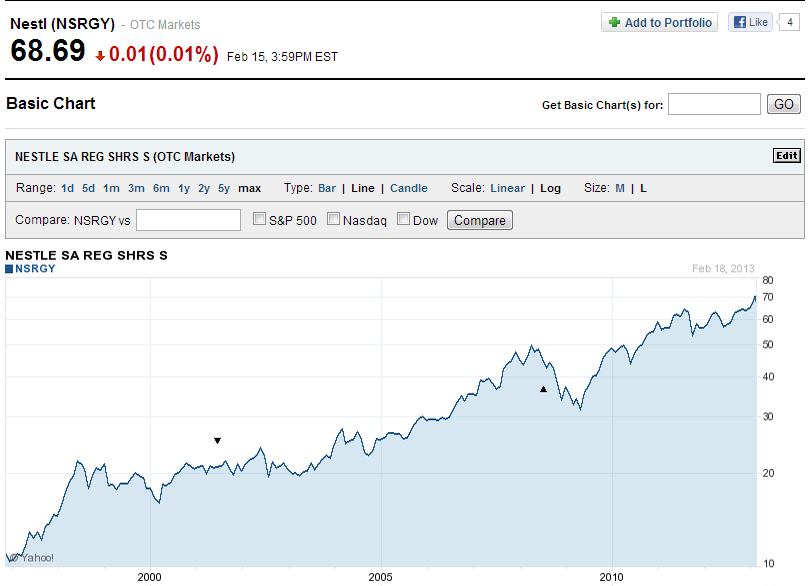
NSRGY-Long-Term-Chart

Source: Yahoo Finance

Related Post:

Food and Beverage ADR Stocks !!

Foreign stocks that return 50% in Dividends alone in just 5 years

If you are a dividend investor have you ever wondered the following:

Are there any foreign stocks in which I can invest and re-coup 50% of my original investment in dividends alone in 5 years?.

Well the answer is a resounding yes. There are plenty of stocks that will pay you lots of dividends – so much so that you can recover half your investment in just 5 years without doing anything. We did some research and our results are discussed below.

We looked at 5 foreign bank stocks that pay dividends. Our goal was see if the total dividends in 5 years per share was at least 50% of the cost basis of the stock price. The year we used was from 2003 thru 2007. The cost basis of the stock was the price at the close on December, 2002. We assumed that the investor bought the stock at the close on the last trading day of 2002. All prices and dividends are split-adjusted.

The five banks that we analyzed for this simple study were:

1. ING Groep (ING) – The Netherlands

2. Royal Bank of Canada (RY) – Canada

3. National Australia Bank (NABZY) – Australia

4. Banco Santander (STD) – Spain

5. Bank of Ireland (IRE) – Ireland

Out of these five stocks, four of them returned more than 50% in just dividends alone in 5 years. These four winner and their dividend returns are:

RY – 60%

NABZY – 57%

STD – 57%

IRE – 62%

The top stock is Bank of Ireland with total dividends of $12.40 and the cost basis of a share was $32.45. This works out to 62% returns in dividends. IRE has performed so well due to the tremendous growth of the Irish economy in the past few years.

The next top stock was RY with total dividends of $5.97 and the cost basis per share at$14.98.

ING came just a little of 50% at 45% – which is not bad. An investor who bought a share at $12.79 in December 2002 would have got $7.08 in dividends alone.

NABZY and STD were a tie with a return of 57%.

Conclusion:

It is possible to invest in high quality dividend paying stocks and recover a good portion of the original invest in just 5 years. The trick is to find winners like the above five. There are thousands of foreign stocks out there but not many can qualify to meet such criteria. If the calculation is extended to 10 years were are sure that many of these stocks would have returned the complete original investment amount to an investor.

Another “moral of the story” is that dividends are an important factor when looking at returns. Like we saw in the above study sometimes they contribute a good part of the total returns.

From the result of the study, we can also infer that the dividends and total returns will even higher if an investor reinvests the dividends instead of taking them out in cash. Together with reinvested dividends and capital appreciation some of these hi-yield stocks can return many times over the initial investment if the stock is held for long-term usually 5, 10 years or more.

Caution: Dividends are not guaranteed and can be reduced or cut at any time.This study just shows that it is possible to recoup 50% of a original investment if companies continue to pay dividends as in the past.

The results of this study can be replicated for sectors like utilities, REITs etc. Was this post useful to you?.Feel free to leave your comments/suggestions.
[tags]investing,adrs,dividends[/tags]

Spanish Bank Stocks

Recently there was a mention in the BusinessWeek that Spanish Banks seem to have “escaped” the sub-prime crisis. This was made possible due to savvy strategies followed by the managements of these banks.There are only two Spanish Banks listed in the US. Banks of Spain provide an indirect entry into the Latin American market as they have a presence there.Recently they are also trying to gain a foothold in the US banking market.

Details about the two banks are as follows (all data as of June 16,2008):

1.Company: Santander Finance Preferred SA
Ticker: STD
Price per share: $19.12
Dividend Yield: 8.99%

S&P rates STD as a five star stock.Santander is a giant bank with a market cap of over $120B and 6 Billion shares outstanding comparable to Bank of America (BAC). The stock is cheap with a PE of 10.33 whereas BAC has a PE of 12.56. Dividend yield is also higher than BAC. Over the past 52 weeks BAC has fallen over 40% but STD has been flat with a 3.93% growth. The 5 year earnings growth at 11.98% for STD is significantly higher than BAC(2.26%).

2.Company: Banco Bilbao Vizcaya Argentaria S.A.
Ticker: BBV
Price per share: $20.63
Dividend Yield: 8.24%

Banco Bilbao stock has fallen just over 13% in the past 52 weeks.The 5-year Earnings growth is projected to be over 21%.PE is just 8.12. S&P rating is 4 stars.

Related Article:
1. From IBD – Spanish Bank Sticks To What It Knows Best And Spreads Globally

Emerald Isle ADRs

In this post, lets list all the Irish ADRs trading in the US.Irish stocks have not been doing well for the past few months or so due to slowdown in the Irish economy. However they may be good picks at this time since some of these stocks have excellent dividend yields. For eg. – The Governor and Company of The Bank of Ireland (IRE) has a yield of 11.40%.

The complete list of sponsored Irish stocks are as follows:

[TABLE=60]

Another easy way to invest in Ireland is to pick up a fund such as the The New Ireland Fund (IRL), a closed-end fund. It is cheap now as it is trading at a discount of 8.51% to its NAV.

Why should you invest in Foreign Stocks?

The answer to the title question is: For better returns and diversification purposes.

Simply put, in this age of globalisation it is almost a requirement to invest in foreign countries if ones to make above average returns. It does not mean putting 5 to 10% as most Americans do. it means allocating 30-40% of ones portfolio to foreign equities. An average investor in the US has less than 10% of his portfolio invested in foreign stocks.

Of course there are many risks to investing in foreign stocks.For a brief summary go to the SEC page on International Investing.

Today foreign companies are competing and growing rapidly when compared with US companies. For example, the market capitalization of all the stocks listed in the New York Stock Exchange (NYSE) is about $27.1 Trillion as of December 31,2007. Out of this, 421 foreign companies’ capitalization is $11.4 Trillion. This shows that foreign companies are increasingly becoming more powerful and important in the global market place. On a worldwide basis the US markets constitutes only 45% of the total market capitalization of all companies. In addition to the NYSE there are many more foreign stocks listed in the Amex,Nasdaq and the OTC markets.

In addition to the above reasons, investing in foreign stocks may provide higher returns than investing in US stocks.

The following table and chart compares the Total Return of MCSI EAFE against US Indices for a period of 25 years. The MCSI EAFE Index is the all Non-US major stock markets of the world including Australasia, Europe and the Far East.

Total Return – MCSI EAFE Vs. US Index

[TABLE=59]

Chart: Total Return – MCSI EAFE Vs. US Index

US-NonUS-Returns

As we see in the above table and chart, in the past 25 calendar years foreign stocks have outperformed US stocks in 15 years.

From the above data, we can also infer the following:

1. In the past 5 years (2003 to 2007), foreign stocks have returned far higher returns than US stocks for each year. The year by year return difference is as follows:

Years 2003 and 2004 – Foreign stocks returned 10% higher than US stocks
Year 2005 – Foreign equities’ return was 8% higher than US stocks
Year 2006 – International stocks returned 12% higher then US stocks
Year 2007 – Foreign stocks returned 6% higher then US stocks

While some portion of this higher returns is due to the dollar depreciation, the majority is due to foreign companies making higher profits than our domestic ones.

2. From 1995 to 1999 during the high tech craze, the US markets outpaced international markets.

So overall foreign stocks performed better in most of the past 25 years. As US economy struggles to recover it may be the right time for US investors to take a fresh look at foreign markets and invest according to their risk appetite.

Question:

What is you portfolio allocation for foreign stocks?. Do you think you need to re-allocate your portfolio now?. Which country/region is your favorite? Post your story on portfolio allocation in the comments section.