Portugal Utiltity – Energias de Portugal

Energias de Portugal is an electricity and natural gas utility in Portugal.  The stock trades on the OTC market with the ticker EDPFY.

EDPFY has been for the past 52 weeks and the dividend yield is 3.54% as of June 20th stock price.The company has paid dividend since 1998. YTD the stock is down about 16%+.

A $10K invested 5 years ago would have grown to $32,445 as opposed to $19,324 for the industry.

Six Foreign Utilities whose stock is down YTD

Since we are almost half-way thru 2008, I thought it would be a good idea to list a few foreign utilities which are down Year-To-Date.

1.Company: Huaneng Power International
Ticker: HNP
Country: China
YTD Share Change(%): – 13.22%

2.Company: MetroGas
Ticker: MGS
Country: Argentina
YTD Share Change(%): – 14.61%

3.Company: National Grid
Ticker: NGG
Country: UK
YTD Share Change(%): – 17.74%

4.Company: Korea Electric Power
Ticker: KEP
Country: South Korea
YTD Share Change(%): – 27.10%

5.Company: Veolia Environnement
Ticker: VE
Country: France
YTD Share Change(%): – 37.32%

6.Company: Edenor
Ticker: EDN
Country: Argentina
YTD Share Change(%): – 41.77%

BASF ADR Stock Split 2008

BASF SE, the world’s largest chemical company, announced on March 4th,2008 to split its stock in the ratio of 2:1.

Split Details:
Company: BASF SE
Ticker: BASFY
Record Date: June 26,2008
Ex-Date: July 2,2008
Split Ratio – 2:1

BASFY ended at $144.45 today.

Today BASF announced a new share buyback program under which shares worth of €3 billion will be purchased back up to mid-2010. More details can be found here.

Update: Nestle ADR Stock Split 2008

On April 6th, 2008 we wrote an article about Nestle’s (NSRGY) proposal to split its shares. You can find that article here.This post is an update to that article. On May 23rd, Nestle’s board of directors approved the split proposal. The split details are as follows:

Company: Nestle
Ticker: NSRGY
Record Date: June 27th,2008
Ex-Date: June 30th,2008
Split Ratio: 2.5 shares for 1 ADR share.

Current Nestle share price is $118.90. Let’s say that the share price remains the same on June 27th. Then the price after the split will be $47.56.

Nestle’s Swiss shares are being split at the ratio of 1:10. But that does not mean that the ADR share will be split at 1:10. Currently the ADR share trades at 4 for 1 Swiss share. Nestle’s is changing the ratio between ADR to Swiss ordinary share to 1:1. So the correct split ratio for ADR shares will be 2.5 shares for each ADR share.

The current Swiss share price CHF 493.00. After the split it will trade for CHF 49.30. At today’s exchange rate of 0.95934 to a US$, that will equal $47.30. This closely matches to the ADR split adjusted price of $47.56.

Nestle says it is is splitting the stock “to increase the liquidity and tradability” of its shares.

Nestle (NSRGY) Dividend History:

DateDividends
4/23/2012$2.11
4/18/2011$1.92
4/19/2010$1.49
4/24/2009$1.20
4/11/2008$1.21
4/20/2007$0.86
3/31/2006$0.69
4/8/2005$0.67
4/16/2004$0.56
3/28/2003$0.53
4/5/2002$0.38
3/30/2001$0.32


Nestle ADR Split History:

Jun 11, 2001 – 2: 1 Stock Split
Jul 3, 2008 – 25: 10 Stock Split

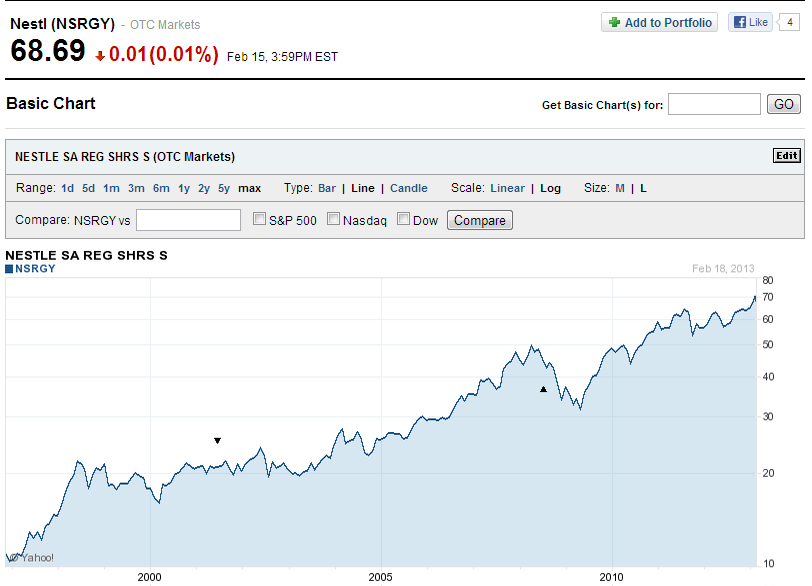
Nestle (NSRGY) Long-Term Return Chart:

Click to enlarge

NSRGY-Long-Term-Chart

Source: Yahoo Finance

Related Post:

Food and Beverage ADR Stocks !!

Foreign stocks that return 50% in Dividends alone in just 5 years

If you are a dividend investor have you ever wondered the following:

Are there any foreign stocks in which I can invest and re-coup 50% of my original investment in dividends alone in 5 years?.

Well the answer is a resounding yes. There are plenty of stocks that will pay you lots of dividends – so much so that you can recover half your investment in just 5 years without doing anything. We did some research and our results are discussed below.

We looked at 5 foreign bank stocks that pay dividends. Our goal was see if the total dividends in 5 years per share was at least 50% of the cost basis of the stock price. The year we used was from 2003 thru 2007. The cost basis of the stock was the price at the close on December, 2002. We assumed that the investor bought the stock at the close on the last trading day of 2002. All prices and dividends are split-adjusted.

The five banks that we analyzed for this simple study were:

1. ING Groep (ING) – The Netherlands

2. Royal Bank of Canada (RY) – Canada

3. National Australia Bank (NABZY) – Australia

4. Banco Santander (STD) – Spain

5. Bank of Ireland (IRE) – Ireland

Out of these five stocks, four of them returned more than 50% in just dividends alone in 5 years. These four winner and their dividend returns are:

RY – 60%

NABZY – 57%

STD – 57%

IRE – 62%

The top stock is Bank of Ireland with total dividends of $12.40 and the cost basis of a share was $32.45. This works out to 62% returns in dividends. IRE has performed so well due to the tremendous growth of the Irish economy in the past few years.

The next top stock was RY with total dividends of $5.97 and the cost basis per share at$14.98.

ING came just a little of 50% at 45% – which is not bad. An investor who bought a share at $12.79 in December 2002 would have got $7.08 in dividends alone.

NABZY and STD were a tie with a return of 57%.

Conclusion:

It is possible to invest in high quality dividend paying stocks and recover a good portion of the original invest in just 5 years. The trick is to find winners like the above five. There are thousands of foreign stocks out there but not many can qualify to meet such criteria. If the calculation is extended to 10 years were are sure that many of these stocks would have returned the complete original investment amount to an investor.

Another “moral of the story” is that dividends are an important factor when looking at returns. Like we saw in the above study sometimes they contribute a good part of the total returns.

From the result of the study, we can also infer that the dividends and total returns will even higher if an investor reinvests the dividends instead of taking them out in cash. Together with reinvested dividends and capital appreciation some of these hi-yield stocks can return many times over the initial investment if the stock is held for long-term usually 5, 10 years or more.

Caution: Dividends are not guaranteed and can be reduced or cut at any time.This study just shows that it is possible to recoup 50% of a original investment if companies continue to pay dividends as in the past.

The results of this study can be replicated for sectors like utilities, REITs etc. Was this post useful to you?.Feel free to leave your comments/suggestions.
[tags]investing,adrs,dividends[/tags]