Global Trade To Decline 9% in 2009

The WTO sees a 9% global trade decline in 2009 as recession strikes. In a press release today, the WTO said:

“The collapse in global demand brought on by the biggest economic downturn in decades will drive exports down by roughly 9% in volume terms in 2009, the biggest such contraction since the Second World War, WTO economists forecast today (25 March 2009). “Trade can be a potent tool in lifting the world from these economic doldrums. In London G20 leaders will have a unique opportunity to unite in moving from pledges to action and refrain from any further protectionist measure which will render global recovery efforts less effective,” said Director-General Pascal Lamy.” (emphasis added)

For more details click here.

Also today, the Canadian oil producer and marketer, Petro-Canada (PCZ) was acquired by Suncor Energy Inc (SU) of Canada for US$15.5 billion. SU paid a premium of 25% for PCZ based on the 30-day weighted average of the share price. As a result, Petro-Canada shares jumped over 25 percent to close at $29.29. Petro-Canada gas stations are found all over Canada. More here.

Another Canadian oil marketer is Imperial Oil (IMO) which owns the Esso brand of gas stations.

Top Five Global Oil Service Companies

The world’s most sustainable oil service companies list was released by the consulting firm Management and Excellence (M&E) together in partnership with Oil and Gas Journal Research Center. This is an annual study and this year’s list will published later this year.Based in Madrid, Spain M&E analyzes companies and ranks them “in the areas of ethics, sustainability, corporate governance, transparency and corporate social responsibility” with a special on Latin America and Spain.

Though the following are rankings for 2008, these companies are some of the best in the industry and it is highly likely that some of them will be in the top for 2009 as well. The first three companies listed below were in the top five rankings in 2007 also. These top firms were selected based on  the “M&E Facts Only method, measuring companies’ compliance with recognized standards in sustainability, corporate governance, social responsibility and ethics customized to the oil industry.”

Oil service companies provide advanced products and services to help their clients in the oil industry drill, evaluate, produce and maintain oil and natural gas wells. They also provide other valuable services such as consulting, engineering, etc. to the oil majors. Hence their performance is closely tied to the ups and downs of the oil industry.

The World’s Most Sustainable and Ethical Oil Service Companies for 2008 are (by ranking order):

1. Schlumberger Ltd(SLB) is a Houston,Texas based oil service provider with 100,000 employees. SLB is down 48% in the past 52 weeks and the stock has an yield of 2.02%. Due to the rise in demand for crude oil, over the last 5 years revenues increased at an annual rate of 22%.

2.Halliburton Company(HAL) currently pays a dividend of 2.14%. Compared to Schlumberger, the annual revenue growth has been a little lighter at 19.7%.On March 10th, the company announced an issue of $2 Billion in Senior Notes. After reaching a high of $55 in 2008,  HAL closed at $18.06 today.

3.Holding the number three spot in the list is Houston,TX based Baker Hughes Inc.(BHI). With a market cap of $10.6B the stock has an yield of 1.93%. The company is better at converting its revenues to profits on a net and operating basis compared to its peers. As of this week, Baker Hughes has 1,346 rigs in operation in North America.

4.Cameron International Corp(CAM) is a smaller oil service provider with a revenue of $5.8B last year. CAM does not pay a regular dividend and the current market cap is $5.4B. Last month, the company warned of a weakness in its 2009 profit numbers.

5.The Switzerland-based Weatherford International Ltd (WFT) ranked number five in M&E’s list. Weatherford “operates in approximately 100 countries, which are located in nearly all of the oil and natural gas producing regions in the world.” Total revenues was $9.6B last year. WFT pays no regular dividends.

Knowledge is Power: Timothy Geithner Saves The World? Edition

1. The Obama administration unveiled its plan to remove toxic assets from the books of the nation’s banks, betting that it can revive the U.S. financial system without resorting to outright nationalization. Treasury Announces $1 Trillion Public-Private Plan to Buy Banks’ Bad Debt

From the Blog World:

Barry Riholtz: Public-Private Investment Program

TARP Part II

Calculated Risk: Some Positive Comments on the Geithner Toxic Plan

Naked  Capitalism: Guest Post: Why Does Failure Merit Reward?

Infectious Greed: Is Geithner a Fool With a Plan?

Mishs Global Economic Analysis: Geithner’s Galling (and Dangerous) Plan For Bad Bank Assets

2. The sheer, staggering stupidity of using “unconventional measures” is that they don’t work; if they worked, they would be conventional. The US Federal Reserve finds this hard to figure out. Which is why we are truly doomed!!!!. Unconventional stupidity

3.The global downturn has hit Eastern Europe with particular vengeance. Countries that profited more than many others from globalization and were previously capitalism’s rising stars are now seeing demand for exports collapse, along with their currencies. They are bracing for a hard landing. Eastern Europe’s Economic Crash

4. Two million people are unemployed in Britain, the worst figures in a generation. This is a tragedy for the people who are suffering. Each loss of a job has its own consequences, on the unemployed themselves, their partners, their children, and their parents.Trust bankers? You’d be safer on the Titanic

5.LONDON : While the global aviation industry is retreating and scaling back amid a downturn in air traffic demand, the long-haul low-cost carrier AirAsia X is bucking the trend by continuing its aggressive expansion.AirAsia X continues to expand its wings

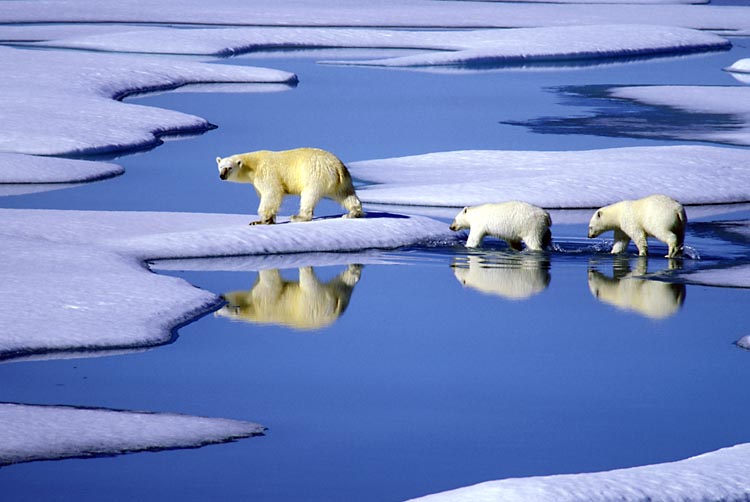
6. Photo: Polar Bear

Polar Bears

Polar bears may be in trouble. As ice around the North Pole melts, the seal hunting season becomes shorter, particularly for those polar bears who live further south.

Via: www.spiegel.de

No Bank Failures in Australia in Modern Era

According to the Australian Bankers Association, “Australia has not had a thorough bank failure in the modern era*, and so has not experienced the fallout from a collapse first-hand.”

However other countries have had their share of bank of bank failures. Some examples are:

1970

USA

US Penn Central Bank – collapse of market liquidity

1974

Germany

Herstatt – bank failure following foreign exchange trading losses

1984

USA

Continental Illinois Bank – failure following loan losses

1985

Canada

Regional banks – failures following loan losses

1993

France

Credit Lyonnais Bank – crisis

1995

UK

Barings Bank – collapse due to trading losses

1995

USA

Daiwa Bank – record trading losses

1996

Japan

Banking system – crisis following loan losse

In all the above cases depositors lost money or taxpayers had to subsidize the loss.

*Bank failure is here defined as an episode where ordinary depositors lose their money. It is recognized that Australian banks have gone through periods of turbulence. The late 1980s and early 1990s was a transitional period characterized by volatility. The State Banks of South Australia and Victoria collapsed. The loss of public confidence took its strongest turn when Pyramid Building Society went into insolvency, costing the Victorian Government $900m to bail out. Credit Union and Friendly Societies also faced problems. That said, the fact remains that Australia has not faced widespread social dislocation as a result of a financial crisis since at least the 1890s depression.

Source: Australian Bankers Association

Three Australian banks trade in the US markets. One of them in the NYSE and the other two in the OTC exchange.

1. Westpac Banking Corp – WBK
Current Yield: 7.92%

2. Australia & New Zealand Banking Grp Ltd – ANZBY
Current Yield: 10.32%

3. National Australia Bank Ltd – NABZYCurrent Yield:10.28%

The iShares MSCI Australia ETF (EWA) provides exposure to many Australian equities.

Listing Of Shutdowns At Europe’s Car Assembly Plants

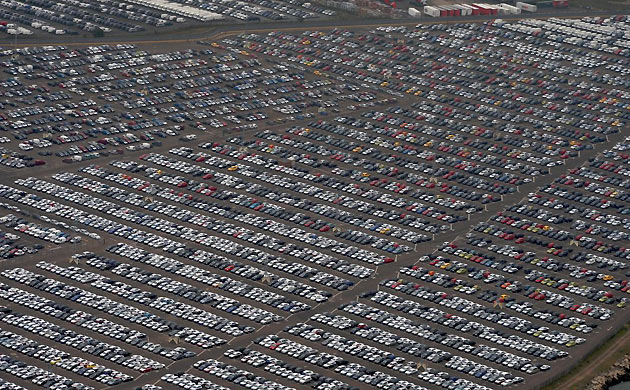
In response to falling sales many car makers around the world have announced temporary shutdown of their assembly plants. The severity of the situation was evident from the recently published photos of unsold new cars parked in ports, factories, etc. in various countries. A sample photo is shown below.

New Cars parked

Photo: Imported cars stored at Sheerness open storage area awaiting delivery to dealers
Credit: David Goddard/Getty
Source: The Guardian, UK

For more photos go to: Growing stocks of unsold cars around the world

As ports and other places struggle to keep up with the unsold inventory, car makers in Europe have announced shutdowns of a few days to two months or more. A study by the Policy Department of the European Parliament compiled the various factory closings in Europe.

Listing of Shutdowns of Major Vehicle Assembly Plants in Europe

(click to enlarge):

Car Assembly Plant Shutdowns in Europe

Car Assembly Plant Shutdowns in Europe

In addition to car makers, auto parts suppliers have also been affected. Some of them have announced temporary closings of their plants as shown below:

Car Assembly Plant Shutdowns in Europe

Source: Impact of the Financial and Economic Crisis on European Industries,Policy Department Economic and Scientific Policy, March 2009, European Parliament

European car makers deal with over 800 suppliers procuring parts worth about 30B Euros per year.

According to the paper mentioned above, at this stage of the recession, “even a marked improvement in availability of vehicle financing now would not prevent the market falling heavily for the rest of the year”.