Update: The Ten Most Traded ADRs

The ten most traded foreign ADR stocks by daily volume are:

Companhia Vale do Rio Doce-CVRD – RIO
Taiwan Semiconductor Manufacturing – TSM
Nokia – NOK
Petroleo Brasileiro – PBR
Itau Unibanco – ITU
Banco Bradesco – BBD
Alcatel-Lucent – ALU
Siliconware Precision Industries – SPIL
BP – BP
America Movil – AMX

Four of the above ten stocks are from Brazil.America Movil is from Mexico.

Six Stocks With Attractive Yields

Many stocks in the oil&gas and utility sectors have attractive dividend yields at current prices. Six of them are listed below with their current yields. Though they may fall further due to volatile market conditions, they are definitely worth looking into for potential long-term investment opportunities.

1.Company:ENI SPA (E)
Country: Italy
Dividend Yield: Oil & Gas – Integrated
Sector: 8.43%

2.Company:National Grid PLC (NGG)
Country: UK
Dividend Yield: Electric Utilities
Sector: 4.86%

3.Company:TransCanada Corp (TRP)
Country: Canada
Dividend Yield: Natural Gas Utilities
Sector: 5.02%

4.Company:PetroChina Company Ltd (PTR)
Country: China
Dividend Yield: Oil & Gas – Integrated
Sector: 4.05%

5.Company:Petrobras Energia Participaciones SA (PZE)
Country: Argentina
Dividend Yield: Oil & Gas – Integrated
Sector: 6.15%

6.Company:Statoilhydro ASA (STO)
Country: Norway
Dividend Yield: Oil & Gas – Integrated
Sector: 4.37%

S&P 500 Index Returns by Year

The S&P 500 is down 7.50% as of market close today (April 6,2009). The worst performing sectors is the financials at 24.7% and the best performing sector is IT with a return of 9.98%. Traditional defensive sectors such as utilities and consumer staples are down 11.11% and 8.25% respectively year-to-date.

The current bear market is the worst market since the great depression. Since the start of the credit crunch in October,2007 the S&P fell to a low of 56.8%. This is worse than the dot com bubble crash when the index was down 49.1% only.However during the great depression, the Dow index was off a horrendous 89.2%.The current crash is also worst than the 1973 oil crisis crash when the S&P was down 48.2%. From a trough of being down around 57%, the S&P has rallied some basis points in the past four weeks (Data Source: dshort.com)

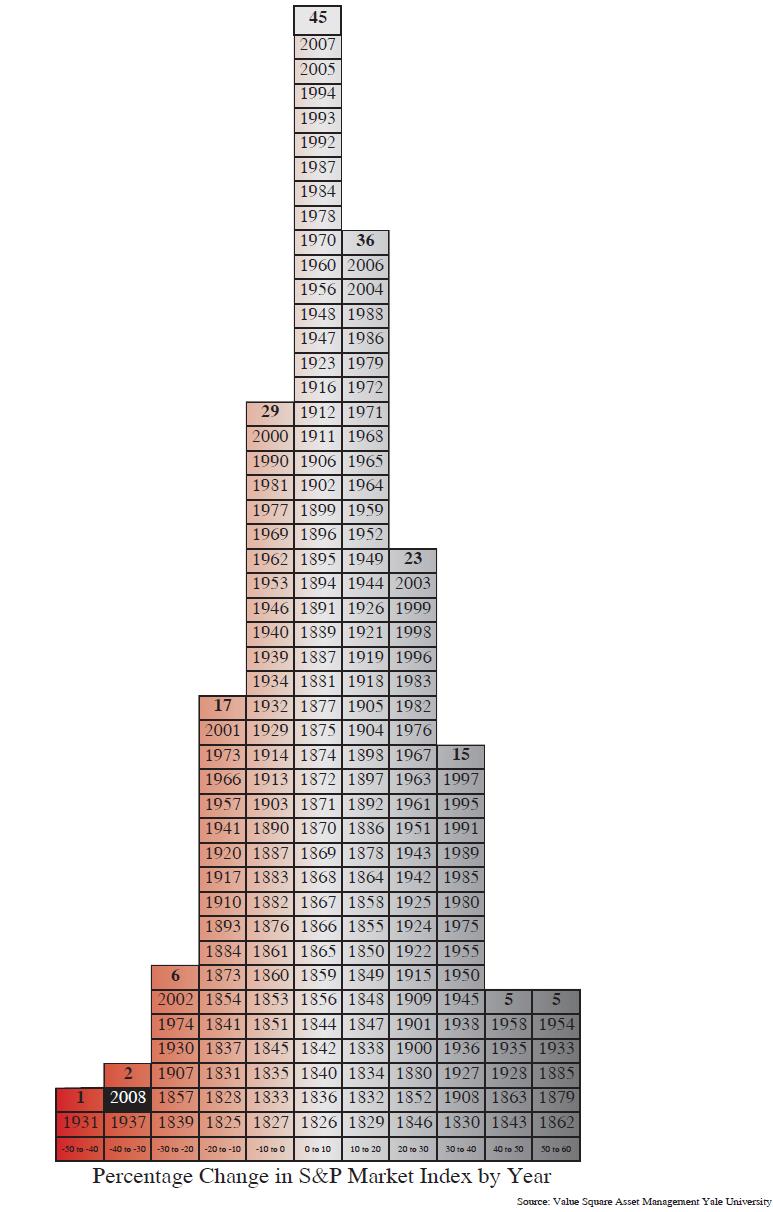
The following chart was developed by Yale University’s Value Square Asset Management.  It shows the % change in S&P each year. It is not clear how data for 1800s were found and used (click to enlarge)

Sp Index returns by year

Knowledge is Power: Zombie Banks Edition

1.Billionaire George Soros said the change to fair-value accounting rules will keep troubled banks in business, stalling a recovery of the U.S. economy.“This is part of the muddling through scenario where we are going to keep zombie banks alive,” Soros, 78, said today in an interview with Bloomberg Television. “It’s going to sap the energies of the economy.” Soros Says New Mark-to-Market Rules Will Help Keep `Zombie’ Banks Alive

2.China’s decision not to allow Coca Cola to buy local soft drinks champion Huiyuan Juice, announced on March 18, and the latest World Bank report predicting growth will slow to 6.5% from the previously forecast 7.5%, has caused some commentators to wonder whether China could turn inwards. The fear is that China could turn away from its relatively open economic model and copy Japan’s ‘mercantilist’ model, defined as manipulating the terms of trade in one’s favour through currency depreciation and non-tariff barriers to imports and investments, and thus ‘stealing’ growth from one’s neighbours.Could China become another Japan?

3.SHOPPING centre giant Westfield (wdc.ASX:Quote,News) is struggling to deal with a “perfect storm” of retailing problems at its flagship London complex.

The Australian developer opened Europe’s biggest urban shopping mall at Shepherd’s Bush, west London, just as the worst recession in generations hit Britain, the Herald Sun reports.Westfield owned London shopping centre in trouble – a ‘ghost town’

4.Banks’ 1st-Quarter Results May Show Improvement: Whitney

Bank earnings may show some improvement in the first quarter, though the sector still has far to go in recovering from the credit crisis, well-known analyst Meredith Whitney told CNBC.

“I think you’ll see a directional turn,” Whitney said in a live interview. “Banks will make a little money, as little as a penny a share, but they won’t lose money.”

5. Optimism for near-term China recovery, fueled by the widely reported $587 billion two-year stimulus package, is running high heading into the G-20 summit this week. Many countries are expecting Chinese demand to spur a new round of increased consumption. These hopes are unfortunately misplaced at the moment.Can China Save the World?

Review: Canadian Banks and Select ETFs Performance using Charts

In this post lets take to a look at the performance of the five large Canadian bank stocks and a select few ETFs using charts. This does not involve a deep technical analysis but just a simple review of these charts and making some observations.

1.Performance of five Canadian banks over the past 2 years:
TD Bank(TD) and Royal Bank(RY) have been much better performers than the other three banks. Royal Bank is the most profitable bank in Canada.Hence it is not surprising to see Royal Bank leading the pack together with TD. Though TD has exposure to the US markets thru a Bank North acquisition and the brokerage operation TD Ameritrade, still TD Bank has weathered the current storm better than others.CIBC (CM) reported a huge loss last year due to their exposure to sub-prime assets. Hence CM is lagging the pack.

Related Article:

“NEW YORK — Royal Bank of Canada is seeking to cash in south of the border on Canada’s new cachet as the soundest financial system in the world.

The bank, which has about 450 RBC Bank branches in the southern United States as well as wealth management and investment banking services, launched an advertising campaign a few weeks ago that, for the first time, clearly plays up its Canadian ties.” Canadian banks cash in on new cachet

2. Comparison of iShares MSCI Canada ETF Vs. iShares MSCI Australia ETF:
The Canadian ETF (EWC) is well ahead of the Australian ETF(EWA). This comparison is interesting since these two countries share similar features such as developed western-style democracy, commodity-based economy, blessed with plenty of natural resources, etc. However from the performance above, one can infer that Australian banks and commodity producers were hurt much more than their Canadian peers since Australia is much closer to many Asian emerging markets like China,India, Malaysia, etc. and those countries have been hurt much more than the trading partners of Canada. It must be noted here that the largest trading partner of Canada is the US.

3. Comparison of iShares MSCI Malaysia ETF Vs. iShares MSCI Singapore ETF:
The ishares ETF for Malaysia (EWM) is doing better than the ETF for Singapore(EWS). This could be due to the fact that Singapore’s economy is affected more adversely by the global economy than the Malaysian economy. Besides cargo shipping has fallen heavily since the recession.This has been a major drag for the Singapore economy since the port is a major hub between Asia and the developed world.

4. Comparison of iShares MSCI Chile ETF Vs. iShares MSCI Brazil ETF:
The ETF for Chile is performing better than the ETF for Brazil.The Chilean economy was more resilient to the global economic events than the Brazilian economy.

5. Comparison of iShares S&P; Global Utilities ETF (JXI) Vs. iShares S&P; Global Financials (IXG) ETF:
The above chart shows the difference in the performance of global financials and utilities. While the financial ETF fell as much as 80%, utilities held up relatively well.Hence slow growing but high yielding utilities must be an integral part of a diversified portfolio.