Knowledge is Power: Red Budget Edition

 1.Banks are indispensable for a working economy; badly-run banks ignoring sound banking principles are not. What is needed in a depression is not more central bank money for distressed banks but government deficit money to sustain full employment with living wages. – Henry C K Liu The burden of elitism

2.HONG KONG – Although Mao Zedong died 33 years ago, the founding father of communist China seems to still be alive in the hearts of many Chinese.Tough times breed nostalgia for Mao

3.THE federal Budget will be in deficit for up to six years, according to reports. Budget in the red ‘for six years’

4. Over the past month, I have heard quite a few people declare this to be the start of a new bull market. The kindest thing I can say in response to that is the jury is still out, but the weight of the evidence is inconclusive. Market Rally: 1974 or 1982?

5.South Korea has enjoyed miraculous economic growth for the past four decades, setting it apart from many of its Asian peers. But as an engine of export and an overleveraged economy, it is now highly exposed to the global financial crisis. Eastern exposure

6. Bob Barbera, protege of Minsky and an intellectual heir to Schumpeter, forecasts stability but not growth There’s creative destruction, and then there’s this

7.Yes, this time the banks are the gangsters. They’re robbing Main Street’s treasury.Cheering  the crisis antihero

8.Report says profits up 88% to $3.2 billion, mostly driven by high-priced coal.B.C. mining industry posts record results in 2008

9. In an investing environment where a huge paradigm shift has occurred, investors run the risk of losing even more from their investments if they fail to assess the new risks that have emerged. In that environment, doing nothing means one is actually already doing something. Fixing a broken portfolio

10.France pressed its European Union partners on Tuesday to impose strict rules on hedge funds, in spite of Swedish warnings that even the tightest regulation would be no guarantee against a repeat of the current financial turmoil.France pushes for stricter hedge fund rules
Knowledge is Power: Thatcher – Founder of Modern Britain Edition

1.Charles Dumas says things in the United States are moving roughly in the right direction; pity about China. Economist disappointed to find he’s not that gloomy

2.The Soviets dubbed her the “Iron Lady,” US President Ronald Reagan called her “England’s best man” — 30 years ago Margaret Thatcher was elected prime minister of Britain. It was the start of a radical free-market revolution which hasn’t yet been turned back. How Maggie Came to Power

3.Across OECD countries, close to 40% of high-school students who come top in science subjects have no interest in pursuing a science-related career, while almost 45% do not want to continue studying science, according to a new OECD report. Schools must do more to motivate tomorrow’s scientists, OECD study shows

4.Mulls ‘Canadian option’ as a way to tweak rather than radically overhaul the troubled U.S. system. Obama eyes Canada as bank model

5. The Barack Obama administration is trumpeting the recovery of the US economy. Yet, thanks to Federal Reserve chairman Ben Bernanke and the manner in which he has expanded his mandate far beyond what is permitted central banks, what we see is merely the illusion of a recovery, to be shattered when the bills fall due. The mirage of recovery

Are Indian Bank Stocks a Good Bet Now?

According to an article in one of the India’s business newspapers, Indian bank stocks are being bought heavily the government-owned insurance company, Life Insurance Corporation of India (LIC). This bodes well for Indian bank ADRs such as ICICI Bank’s IBN and HDFC Bank’s HDB.

The main stock market index of India, Sensex returned an incredible 68.98% in 2007.
But gave back most it in 2008 with a loss of 61.18%. As of the end of first quarter the index is down just 3.29%.As of April 29, it is up by 23.50% in the past 3 months.

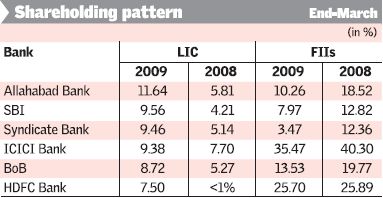
As foreign investors continue to pull out of Indian equities, the insurer has been increasing stakes in many bank stocks as shown by the chart below:

India Banks

Source: The Hindu Business Line, India

Note: FII denotes Foreign Institutional Investors

With a huge asset base, India’s largest insurer is a major investor in many banks and other domestic companies. As governments in many western countries continue to bailout many financial institutions, the government of India seems to have taken an indirect route to supporting the banks.The article quotes an analyst as saying “Some banks, especially those in the private sector, have grown by leaps and bounds in the last few years. They have now become systemically important. So, it makes eminent sense for the Government to have a foothold in the banks via the State-run insurance company,”

The above chart shows that the insurer has raised its holdings in HDFC Bank (HDB) much more than ICICI Bank (IBN) in 2009. ICICI and HDFC are the first and second largest private-sector banks in India and they are also constituents in the Sensex index.Currently IBN offers a 2.51% yield and has a market cap of $11.4B. On April 25th, the bank reported a 35% fall in profits in the fourth quarter over the same period last year. HDFC Bank (HDB) has a dividend yield of just 0.79%. The stock is expensive on a relative basis with a PE of 21.81. On April 31, the bank reported a 34% jump in fourth quarter profit. While the interest income, commissions and fees increased the bank’s provision for loan losses also increased indicating a deterioration in its loan portfolio.

Another Look at Latin American Economy

After five years of strong growth Latin American economies were severely impacted by the current credit crunch. However the region holds plenty of potential for the future growth. The following are some key points from a “Regional Overview: Latin America” report by Institute of International Finance (IIF).

  • “Most countries are better prepared to confront the global crisis having implemented structural reforms and enhanced the quality of their economic policies over the past decade.
  • Bank regulatory frameworks have been made more effective and in many countries banking systems have become much stronger.
  • There is increased recognition that stronger public finances will lower interest rates and enhance economic growth.
  • Most sovereign borrowers in the region that have been pursuing sound policies have manageable external debt servicing prospects for 2009; however,
    a number of corporate borrowers have large syndicated loans and bond maturities falling due and face significant rollover risk.
  • A few countries with substantial foreign exchange reserves, such as Brazil, are offering foreign exchange loans to domestic corporates to help them remain current in their external debt service payments.”

Select Country Stock Market Indices

1-latam.JPG

Despite the selloffs as shown in the above chart, the markets of Latin America are easily ahead of other emerging markets. The graph below shows that the European emerging markets are performing worse than the Asian and Latin American emerging markets.

LatinAmerican Stocks Performance Comparison 

2-latam.JPG

Knowledge is Power: Chrysler’s Surgical Bankruptcy Edition

1.Canada’s economy is in serious trouble, which means our future jobs and prosperity are in trouble.

Our economic problems run much deeper than the daily headlines on job losses at General Motors, bankruptcy protection at Nortel, and business failures in many small businesses, from retailers to restaurants.

For several decades we have failed – despite repeated initiatives – to build the kind of economy that can create and grow the innovative businesses that can survive and grow in the global marketplace. It’s these innovative companies that provide future jobs and replace the jobs we lose.Canada: Innovate or stagnate

2.Ignore that Chrysler LLC, smallest of the Detroit Three automakers, has filed for creditor protection in what the firm hopes will be a brief “surgical” bankruptcy from which it emerges a healthy firm in just one to two months.

Skipping along the rim of the abyss has been the Chrysler way since the 1970s. Chrysler should have replaced its pentagram logo with a phoenix decades ago. How many industry veterans, watching as Lee Iacocca drove North America’s first minivan off the assembly line at Windsor in the early 1980s, thought Chrysler was so well and truly saved it would never edge up to the precipice again? Saving jobs sole motive for alliance

3. United States central bankers may actually believe the assumptions behind their “stress tests” of commercial lenders. More likely, neither the Federal Reserve nor the Treasury has any will to paint a clear picture of the country’s financial turmoil. China’s purchase of gold, meanwhile, tells its own story. Stress tests flunk stress test

Related: Stress-Test Results Are Delayed by Fed as Examiners, Banks Debate Finding

4.Merchandise trade volumes of the Group of Seven (G7) took an unprecedented drop in the last quarter of 2008 compared with the previous quarter. However, provisional monthly data for January and February 2009 measured in value terms suggest a slowing down of the rate of decline. Trade flows collapse in Q4 2008 but signs of falls easing in early 2009

5.Speaking at the FinanceAsia and AsianInvestor distressed investing conference, the Patron Saint of Bankruptcy, Professor Ed Altman, believes that we are entering a golden age of corporate default. A vintage year for failures

6.With the Chinese government announcing that it wants to become the world’s largest producer of electric cars in the next three years, some of the smartest minds in business—including Warren Buffet, the management teams of global majors like BMW and Toyota, and leading Chinese auto manufacturers like Chery Automobile and Geely Automobile—believe that the market for electric vehicles in China is about to take off. Yet, most manufacturers chasing this market don’t fully understand who the customer really is.The Race for China’s Electric Car

7.Is history repeating itself? The current global downturn has many parallels to the Great Depression. And if the current massive bailout packages fail, the effect on the world’s economies could be similarly drastic.Current Crisis Shows Uncanny Parallels to Great Depression