New Listing: Commonwealth Bank of Australia

Effective March 30,2009, Commonwealth Bank of Australia’s American Depositary Receipt (ADR) stock started trading in the OTC market with the ticker CMWAY.

Each ADR represents one ordinary share. The depository bank is The Bank of New York Mellon.

commwealthaustralia-bank-logo.gifA profile of the bank from their corporate site:

“The Commonwealth Bank is one of Australia’s leading providers of integrated financial services including retail banking, premium banking, business banking, institutional banking, funds management, superannuation, insurance, and investment and sharebroking products and services. The Group is one of the largest listed companies on the Australian Stock Exchange.

The Group has A$487,572 million in assets held and funds under administration (as at 30 June 2008).”

With a staff of over 38,000 Commonwealth operates1009 branches nationally. It has international branches in the U.S., the U.K., Singapore, Hong Kong, Malta, New Zealand, Fiji, Indonesia, Vietnam, Japan, China and India.

CMWAY closed at $26.80 on May 6th. Since 2000, Commonwealth has maintained a full year dividend payout ratio of over 70%.

For more information, go to their Shareholder Centre site by clicking here.
Knowledge is Power: End of Stress Tests Edition

1.The power of the three big US rating agencies, Moody’s, Fitch and Standard & Poor’s, remains unbroken. By awarding high ratings to junk securities, they fueled financial market excesses. Now they are taking countermeasures by brutally downgrading securities. In doing so, they are making the crisis even worse.The Power of Rating Agencies

2. The U.S. government’s long-awaited “stress-test” results have found that 10 of the 19 largest U.S. banks need a total of about US$75 billion in new capital to withstand losses if the recession worsened.Stress tests find banks need US$75B more

3. Society at a Glance reveals evolving social trends in OECD countries -The French spend more time sleeping than anyone else in OECD countries. They also devote more time to eating than anyone else and nearly double that of Americans, Canadians or Mexicans. The Japanese sleep nearly an hour less every night than the French and also spend longer at work and commuting than they do indulging in leisure activities.

4.GRAEME Wood started hotel site Wotif.com just as the dotcom bubble burst, but that didn’t stop it becoming a success story. Making money while you sleep

5.US policymakers have already braced themselves for a bout of deflation, and many corporations are quaking at the prospect of price declines. Some are wondering, though, how bad can it really get? – FEAR FACTOR

Knowledge is Power: Nouriel Roubini on Insolvent Banks Edition

1.As I write this, the Federal Reserve has announced a huge new program to buy various kinds of debt designed to lower interest rates for home mortgages and other loans (such as securitized consumer loans). This action is another major step in the new era of the proactive Fed that puts large amounts of “Fed-created” money into the economy. The Fed money is intended to restart the seriously sick real economy by providing credit not available from the private sector.Will the Fed’s Medicine Work?

2.Despite America’s move to the left under Obama, it’s still assumed that Europe and America are fundamentally different—in their economies, societies and values. But this is a myth.A narrower atlantic

3.Moody’s discusses some of the characteristics of the world’s largest bank.The rise and rise of ICBC

4.Luxury carmaker Porsche agrees to merge with larger German manufacturer Volkswagen in a new car group. Carmakers Porsche and VW to merge 

5.Joseph Schumpeter famously argued that the essence of capitalism was creative destruction, by which new economic structures are born from the rubble of older ones. The government stress tests on the 19 largest US banks, the results of which are due be announced on Thursday, could have facilitated this process. The opportunity looks likely to be missed. -By Matthew Richardson and Nouriel Roubini Insolvent banks should feel market discipline

Canada: Latest Exports Data Shows Improvement

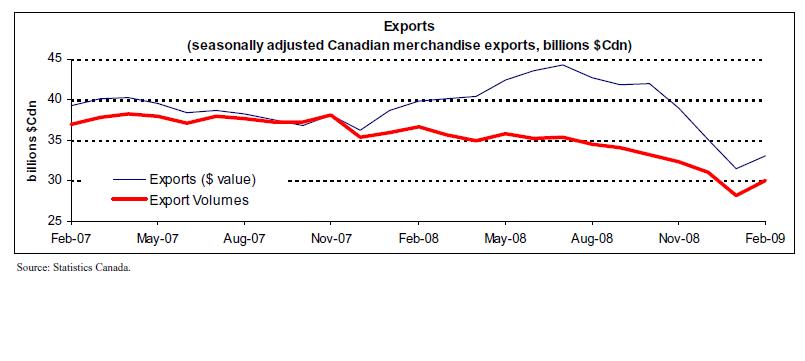
As a resource-rich country, the Canada is heavily dependent exports.Canada exports majority of its natural resources and finished products to USA, its major trading partner.In order to analyze the latest export figures, I reviewed the “Export Instant Insight” report published by Export Development Canada (EDC).

The following are some of the key points in the April,2009 report:

  • Canada’s merchandise trade balance stood at 5.2% in February of this year after falling for 6 consecutive months
  • Machinery and light equipment category was the top performing sector
  • The auto sector came in second with a growth of 20%  after production resumed in many plants
  • Too early to conclude that Canadian exports have seen the bottom in this recession
  • The Forestry products sector showed a growth of just 4.4% over the previous month indicating that the US housing market is still in doldrums
  • Despite this growth, exports volume is still 20% lower than last year levels

Chart #1: Exports (click to expand)

ca-exports.JPG

Chart #2: Export Growth Major Sector Comparison (click to expand)

ca-ex-sectors.JPG

Source: EDC

A simple and easy way to invest in Canada is via an ETF such as the ishares MSCI Canada Index Fund (EWC). As of the end of April the fund is up 9.66%.With $1.2B assets, the ETF offers an yield of 1.84%.Not surprisingly energy and materials comprise the most in the portfolio. Financials are next with about 30%.

Do The Rich Really Get Richer Overtime?

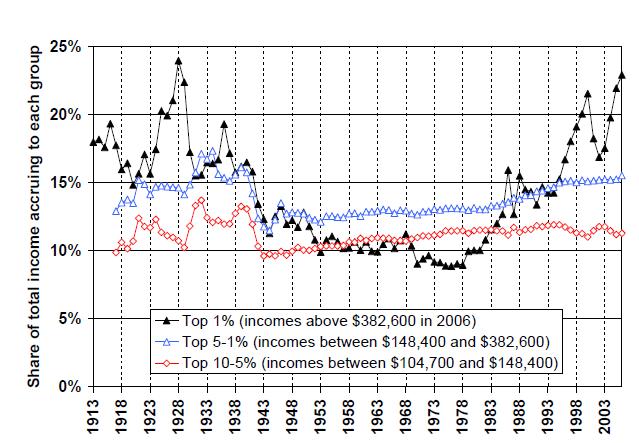
We all have heard that the rich get richer in the US and other parts of the world. But is it really true?. How high has the income inequality between the rich and poor grown in the US?.

According to a research paper titled “Striking it Richer: The Evolution of Top Incomes in the United States” by Emmanuel Saez from the Department of Economics, University of California, Berkeley the income of the top earners has increased dramatically since the 1980s as the chart (click to expand) shows below:

rich-richer.JPG

Source:  “Striking it Richer: The Evolution of Top Incomes in the United States” by Emmanuel Saez

To read more on this fascinating paper, click here (pdf)