US Financial Institutions No Longer On Top

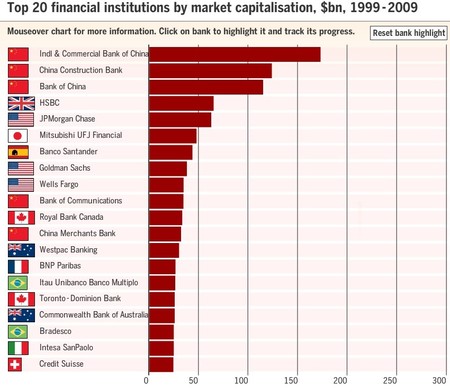
The following two charts show that US financial institutions are no longer the best in the world when compared to 1999.

Chart #1:
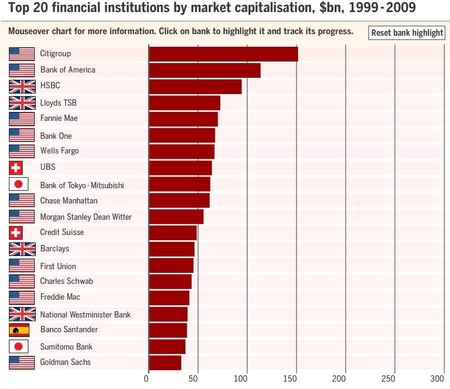
Top banks 1999

Chart #2:
Top banks 2009

Source: Financial Times

Though the above graphs were from March of this year it is worth reviewing. In 1999, out of the Top 20 financial institutions in the world, 11 were US-based.Some of the banks such a Bank One have disappeared in 2009 since it merged with Chase a few years ago.Interesting to see Citibank (C) at the top of the list at that time.Next in the ranking was Bank of America (BAC).

In 2009,  the top three spots have gone to Chinese banks. Citibank and Bank of America are not even in this list. Two Canadian banks – Royal Bank of Canada(RY) and Toronto-Dominion Bank(TD) have made it to the list.Australia also has two banks listed. In addition to Chinese banks, the importance of emerging markets is confirmed by the presence of Itau Unibanco Banco Multiplo (ITU) and Banco Bradesco(BBD).

Knowledge is Power: S&P 500 Earnings Collapse Edition

1.Subsidies to buyers are helping China auto sales soar, a move Washington might follow given personal income in the US fell as much as US$34.4 billion in March. Which doesn’t leave much cash to pay for ever-more expensive oil for those new vehicles US consumers might buy.Sinking incomes

2.With earnings season coming to an end, I wanted to find a way to depict the severity of the financial meltdown into the context of profits.S&P 500 Earnings Decline: 90%

3.AA. No, it’s not Alcoholics Anonymous, although investors could be forgiven for… Five steps to portfolio recovery

4.Investors continue to favour emerging markets despite fears that valuations may be running ahead of fundamentals.Emerging markets continue to take in new money

5.The Bombay Stock Exchange closes early after the Sensex soars 17.2% in reaction to Manmohan Singh’s re-election.Congress victory provokes frenzy in Indian markets

6.Norway voted winner of Eurovision Norway has emerged as the winner of the Eurovision Song Contest, held in the Russian capital, Moscow.Singer and violinist Alexander Rybak, 23, smashed the record for the most points awarded during the competition.

7.Photo – Romania’s glamourous popstar Elena

Source: Der Spiegel

Elena

US Ranks 3rd in Ease of Doing Business 2009

According to the latest Doing Business Report 2009 published by the World Bank, the USA ranks third in ease of doing business. This report is based on comparison of 181 economies from around the world.

The following regulations affecting 10 stages of a business’s life were measured : “starting a business, dealing with construction permits, employing workers, registering property, getting credit, protecting investors, paying taxes, trading across borders, enforcing contracts and closing a business. ” All data used were based on data collected upto June 1, 2008.

Chart #1: Ease of Doing Business

us-ranking-edb.JPG

Chart #2: US Ranking in various measures

2-us-edb-table.JPG Source: World Bank

The lower the number the better the rank.So the tiny city state of Singapore ranks 1st in ease of doing business.Doing business in China is much easier than in Brazil and India.This is interesting since Brazil and India follow democracy. Some of the factors which are take more time in the US are processes involved in calculating and paying taxes, dealing with construction permits. As the data in Chart #2 shows US ranks 5th in getting credit. In countries like Brazil, Mexico, China it is much harder to get loans for businesses. On protecting investors with strong regulations, New Zealand ranks 1st. While US takes the 5th spot, it is questionable as investors are finding out since the credit crisis began.It is widely accepted notion that the US has some of the strictest and wide array of regulations,they were not enforced properly by the government entities involved. For example, the SEC was asleep at the wheel all along when some financial institutions were going insolvent and reported rosy earnings to investors.

To download the full Doing Business 2009 Report – Country Profile for USA, click here.

Related ETFs:

iShares MSCI Singapore Index Fund  (EWS)
iShares S&P 500 Index Fund  (IVV)

Knowledge is Power: Banks of Brazil Ready to Bounce Edition

1.In more normal times, shareholder meetings were relatively genteel affairs. A smattering of people, many retired, would show up, ask a few questions and approve the various resolutions before demolishing the wine and sandwiches. A chief executive was more likely to be challenged over the quality of the biscuits than the finer details of the balance sheet. But now revolution is in the air as investors vent their fury over the huge destruction in shareholder value over the past couple of years. Eggs and shoes fly as investors vent their anger at directors

2. The hedge fund industry strikes back over the suggestion that exchange-traded funds are a possible substitute. Exchange-traded funds aren’t the best alternative

3.Kroll’s Tadashi Kageyama speaks about the dangers of fraud in a weak economic environment.The risks of fraud during an economic downturn

4.Strict regulation, high capital and reserve requirements, and low levels of debt mean Brazil’s banks are flourishing and in a good position to capitalise if their US and European competitors should pull back. Brazil’s giants stand ready to pounce

5. A half-century of Chrysler car sales ended when Eldon Howe received a delivery from United Parcel Service Inc.Chrysler Dealers Grope for Answers After Shutdown News Is Delivered by UPS

6. Almost ten years ago to the day, Alan Greenspan, the former chairman of the Federal Reserve delivered one of his first speeches on financial derivatives before the Futures Industry Association in Boca Raton, Florida on March 19, 1999. Given the role financial derivatives played in the meltdown..Financial derivatives

7.Moscow promised to host the most lavish Eurovision Song Contest ever. But as the weekend approaches, controversy may be brewing.The Eurovision Extravaganza Heats Up

8.The invasive dominance of monetarism in macroeconomics has been total ever since central bankers, led by Alan Greenspan, who from 1987 to 2006 was chairman of the Board of Governors of US Federal Reserve – the head of the global central banking snake by virtue of dollar hegemony – embraced the counterfactual conclusion of Milton Friedman that monetarist measures by the central bank can perpetuate the boom phase of the business cycle indefinitely, banishing the bust phase from finance capitalism altogether.Monetarism enters bankruptcy

IMF: European Economies To Contract Sharply This Year

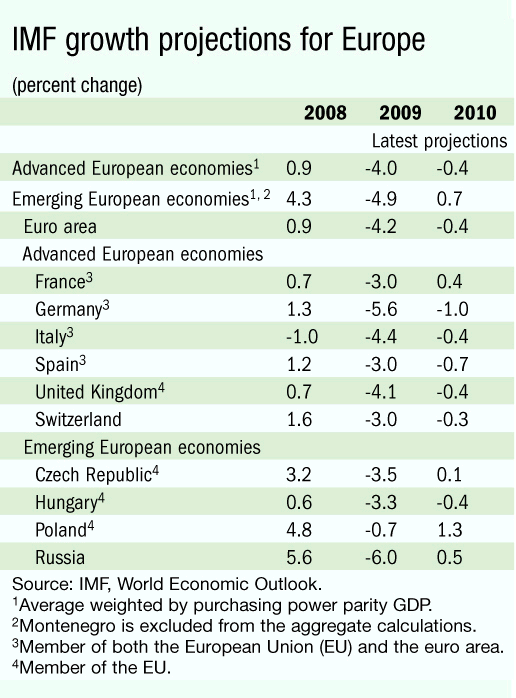
The IMF released it Regional Economic Outlook for Europe on May 12th. Some of the key takeaways from this release are:

IMF Economy Projections

Source: IMF

  • Europe’s current deep recession there is a risk that it could worsen further
  • Western Europe is projected to see their economies shrink by 4.0% in 2009
  • Output in Emerging European countries would fall by 4.9% in 2009
  • Modest decline for Western Europe and modest recovery for Emerging Europe in 2010
  • Demand for goods fell sharply in 4Q,2008 leading to 26% annual rate decline in trade
  • Domestic real estate crash has severely affected the Baltic economies, Ireland, Spain, and the United Kingdom
  • Large public debt and current account deficits have been the cause of collapse for some countries such as Hungary and Greece
  • IMF suggests more strong actions in the financial sector
  • Better policy co-ordination among countries and more support for emerging eastern Europe is needed