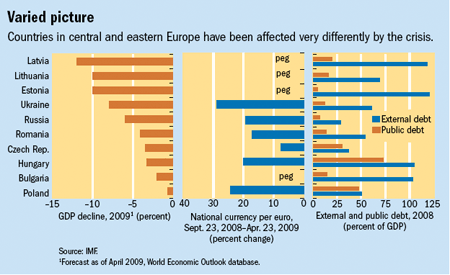
Source:Â IMF, Finance and Development
Source:Â IMF, Finance and Development

“The 12 Federal Reserve banks provide the financial means to operate the Federal Reserve System. Each reserve bank is organized much like a private corporation so that it can provide the necessary revenue to cover operational expenses and implement the demands of the board. Member banks are privately owned banks that must buy a certain amount of stock in the Reserve Bank within its region to be a member of the Federal Reserve System. This stock “may not be sold, traded, or pledged as security for a loan” and all member banks receive a 6% annual dividend.[41] No stock in any Federal Reserve Bank has ever been sold to the public, to foreigners, or to any non-bank U.S. firm.” Source: Wikipedia
 In an interview today with The Observer of London, Nobel Prize-winning economist Paul Krugman said:
“I think the UK economy looks the best in Europe at the moment. I have no position on all of the crazy stuff. But I think the policies are intelligent. The fact of the matter is that Britain did manage to stabilise the banking situation”.
Back in October last year British Prime minister Gordon Brown together with Chancellor of the Exchequer Alistair Darling announced a recapitalisation program that infused “£37 billion ($64 billion, €47 billion, equivalent to £617 per citizen of the UK) of new capital into Royal Bank of Scotland Group Plc, Lloyds TSB and HBOS Plc, to avert financial sector collapse (Source: Wikipedia)”. This dramatic action by the British government saved the British banking system. Basically the British part-nationalized these financial institutions with the tax-payer effectively taking a controlling interest to influence decision-making in the operations of the banks. For example, today the Royal Bank of Scotland (RBS) is majority owned by the British government with a total shareholding of 70.33%. The three banks and other British banks like Barclays also had successful rights issues raising billions of pounds in additional capital.
Unlike the strategy followed by the UK, the US took a different path. Due to the cultural and ideological differences the US government couldn’t part-nationalize the troubled US banks such as Citibank(C), Bank of America(BAC) and others. Instead here various bailout programs were implemented which went by abbreviations one of which is the TARP. Some of the banks that accepted TARP money were recently aprpoved to pay it back by the Treasury. However ever since this program was announced by the previous administration many details were not clear leading many to believe the need for this program. For example, Barry Riholtz of The Big Picture has questioned the rationale behind the TARP program in a piece titled “Was the TARP a Ruse?”. In addition to the billions in bailout, the government conducted the so-called stress tests on many large banks. The results of this stress test have been discredited as well by many as the criteria for the tests were kept secret. “The stress tests are, at best, a waste of time,†said Mike Holland, who heads the investment firm he founded. “At worst, they’re misleading and testing the wrong things. The idea of using some level of unemployment to say whether Citigroup is not as strong as JP Morgan to me is laughable. And therefore I will be glad when this process is over.”
Compared to the policies implemented by the US government, the British policies seemed have to made the desired effect faster and cheaper. After the collapse of Norther Rock in 2007, the British nationalized it completely. In 2008, they nationalized the Bradford and Bingley bank. This was followed by the forced takeover of HBOS, Britain’s largest mortgage lender by Llyods TBS in September.The British Treasury acted decisively in facilitating the merger since they feared a banking system meltdown.
Another factor that differentiated the British bank rescues was that the treasury there was able to push out incompetent and over-paid executive leadership and replace them with new leaders. Thru this process they were able to implement many of the structural changes needed in the system such as bankers pay. In the US, the treasury’s TARP program did not include such conditions such as management changes or addition of treasury nominated members in the boards.
Overall the British have saved their banking system from collapse. However in the US, many banks especially small and medium-sized banks are not out of the woods yet. So far this year 37 banks have failed in the US. Many more are expected to fail. Sheila Bair, chairman of the Federal Deposit Insurance Corporation cautioned this Friday that the banking crisis is not over.
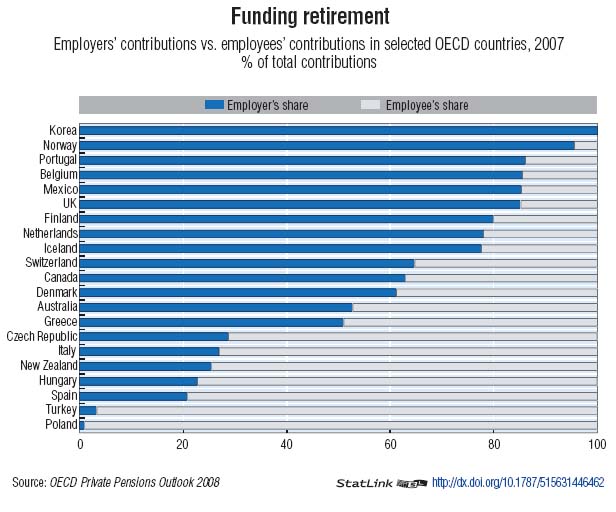
Interesting chart from OECD Observer on retirement contributions by employers Vs. employees in select OECD countries. Unfortunately USA was excluded in this chart.
Source: OECD Observer
Excerpts from the report:
“If you are a Polish worker, then you are probably paying 99% of total contributions, which is the highest in the OECD area. Turkey’s workers contribute a little less, with 97% of the total. In Portugal, on the other hand, employee contributions account for 14% of the total, while workers in Norway pay in just 4% to personal pension plans. In recent years, employers’ contributions to defined benefit plans-those pension plans that are linked to salaries-have grown, largely in an effort to reduce gaps in funding to cover growing benefit payments in light of population ageing.
Pension fund contributions by employees and employers combined grew substantially in 2007 in those countries with large defined benefit systems, such as Canada, the Netherlands, Switzerland and the UK. Australia, Iceland and Finland recorded the highest ratios of pension fund contributions-to-GDP. All three countries had ratios over 10%. “

China’s stocks have been enjoying a rally since mid-March and one of the reasons could be the leakage of stimulus funds into the stockmarkets. Stimulus money leaking into Chinese stocks
Nobel Prize-winning economist Paul Krugman says the UK economy is the best in Europe at the moment. UK’s economy is ‘best in Europe’
Two European nations are considering taking over public pension plans, converting their assets of approximately $34 billion into cash for general government use and turning the plans into pay-as-you-go systems.2 European countries turn plans into cash
Often after a sharp economic downturn we observe an equally dramatic recovery. But nobody can claim to be seeing that so far in the currently available data.Not a robust recovery
Recovery for resource-rich Russia is tied to the price of oil, natural gas, other commodities.EMERGING MARKETS – Russia: risk vs. reward