Norway: Attractive Investment Destination

Among the Nordic countries, Norway’s economy is strong and is well positioned for an economic recovery. In fact, Norway is one of the favorite investment destinations among European countries.

The Norwegian economy was able withstand the current economic crisis better than most other European countries since Norway’s financial institutions did not invest in risky sub-prime mortgage derivatives and other instruments. The country is blessed with oil resources which has become a boon during the past few years when oil prices soared. As a result of this Norway’s sovereign wealth fund is one of the largest in the world with assets of about £380B. As the fund has tremendous amount of cash reserves, the fund was able to pick high quality equities at dead cheap prices during the market crashes in the past few months.

In addition Norway has many advantages relative to other economies of the world. Some of the key points are:

  • Norway is a surplus country with NOK 76 billion in current account surplus as of 1Q,2009
  • GDP Growth rate for 1Q,2009 was the lowest at -0.4% seasonally adjusted when compared with other Scandinavian countries, UK, Europe and US
  • Gross national Savings remain high in Norway at NOK 757 B at the end of 2008
  • Households decreased their borrowing and increased savings in Q1,2009
  • Government wealth stood at 144% of GDP at the end of 2007, the highest among Nordic countries
  • In 2008, due to record high crude oil prices the trade surplus was the highest ever with a total of NOK 460.5 billion

Source: Statistics Norway
Note: 1 Norwegian Kroner = 0.15659 US Dollar

For US investors, there is not a single-country ETF for Norway. However there are a few stocks that trade in the US markets.

In the oil and gas sectors, there are four Norway ADRs:
Acergy – ACGY
Petroleum Geo-Services – OTC: PGSVY
StatoilHydro – STO
Teekay Petrojarl – OTC: TKPOY

Two other large Norwegian companies that trade in the OTC market are:
Telenor – OTC: TELNY (Mobile Telecom)
Yara International : OTC: YARIY (Chemicals)

Research Paper Review: Economic Outlook for India

The global economic recession is projected to impact the economy of India adversely taking down the GDP for this year according to paper titled “Indian Economic Outlook 2008-09 and 2009-10” from the Indian Council for Research on International Economic Relations (ICRIER). The authors also argue that “There is real downside risk that the growth rate could plummet to the pre-1980s levels if appropriate countercyclical measures are not taken immediately and are not urgently followed by necessary structural reforms”.

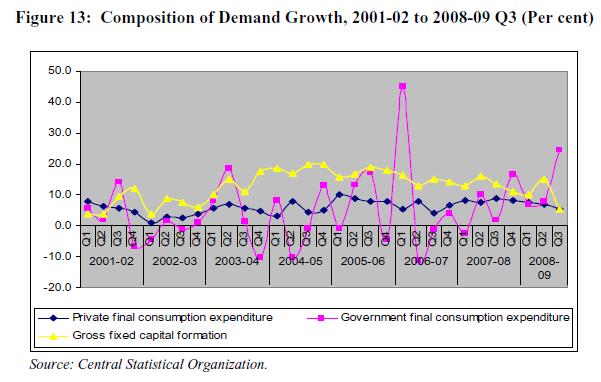
As the recession continues to slow consumer demand, governments across the world are stepping up their of goods and services. This is true in India as well as the chart shows below. The government consumption expenditures as a percentage of GDP is rising faster as the private final consumption expenditure is going down.

India-Economy-Growth-Government-Expenses

For more details on the Indian economy click Indian Economic Outlook 2008-09 and 2009-10

Spain has the Highest Unemployment Rate in EU at 18.7%

Yesterday the BLS released the unemployment data for the month of June. A total of 467,000 jobs were lost in June and the unemployment rate remained almost the same at 9.5%.

The Eurostat also released the unemployment report for the EU but for the month  of May. The unemployment rate in the Euro area stood at 9.5% seasonally-adjusted in May .In the expanded EU 27 states, the unemployment rate was 8.9% in May.An estimated 21.462 million in the EU27, of which 15.013 million were in the Euro area, were unemployed last month.

The lowest unemployment rates were in:
The Netherlands – 3.2%
Austria – 4.3%

The highest unemployment rates were in:
Spain – 18.7%
Latvia – 16.3%
Estonia – 15.6%

While the EU unemployment rate was 9.5% in May, the rate in the USA and Japan were 9.4% and 5.2% for the same month respectively.

EU-Unemployment-Rate-May-2009

Source: Eurostat

A Comparison of U.S. Health Care Spending with Other OECD Countries

The Organisation for Economic and Co-operation and Development (OECD) released the “OECD Health Data 2009” report which compares the health care statistics across OECD countries.

Some of the key points from this study comparing the U.S. health care system with other countries are listed below:

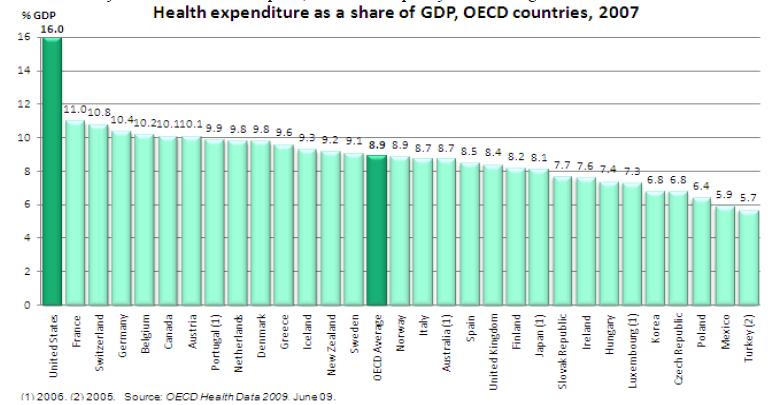
  • In 2007, the total spending for health care accounted for 16% of the country’s GDP, the highest share among the OECD and almost double the OECD average
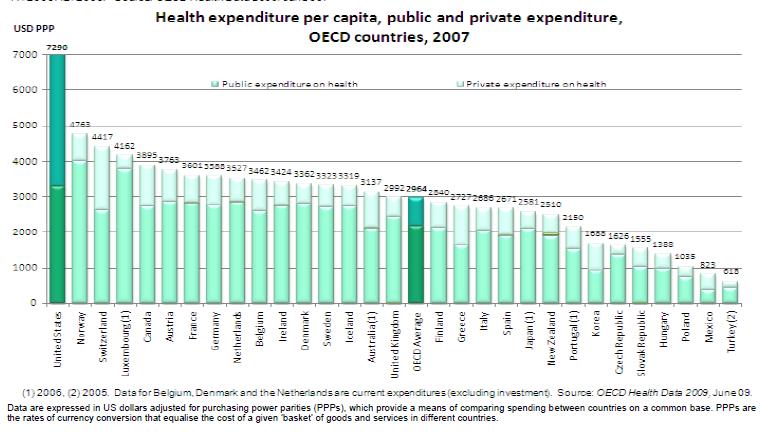
  • On a per capita basis also the U.S. spent the highest with a total of $7,290 which is two-and-half times the OECD average
  • The public share of health care expenditure in the USA (45%) is less than any other OECD country
  • Despite spending the most, the U.S. provides health care coverage for only the elderly, disabled and some of the poor people
  • In comparison, the same amount is enough to provide universal health care insurance by the government for all citizens in other OECD countries
  • 35% of total health care expenditures is done by private health insurance which is the highest In OCED
  • Despite the high medical expenditure,there are fewer doctors per capita in the U.S. than most other OECD countries
  • Life expectancy in the U.S. is lower when compared with Japan,Switzerland, Canada and Australia
  • Infant morality rates  in the U.S. is higher than most OECD countries. In 2006, it was 6.7 per live births relative to OECD average of 4.7
  • The proportion of daily smokers has fallen the most (> 50%) between 1980 and 2007 in the U.S. due to public awareness and high taxation
  • Obesity rate among adults is the highest in the U.S. in the OECD countries at 34.3% in 2006. Higher obesity rates leads to higher health care spending in the future

Charts:
Click to Enlarge

US-OECD-Healthcare

US-OECD-Healthcare-Spending

The above data lead me to do some research on the health care system. In 2007, we spent an astonishing $2.2 Trillion on health care expenses. The government social programs Medicare and Medicaid spending grew by 7.2% and 6.4% in 2007. On a long-term basis I observed that the price food has fallen continuously over the years but the cost of health care has gone up in the opposite direction.

One benefit of spending so much on health care is that it provides stable and well-paid employment opportunities for many people in that sector. In fact, it is one of the safest sector to be employed in now.

One reason for the fewer number of doctors per capita in the U.S. is  the total number of medical schools in the U.S.  is low.There are only 131 accredited M.D.-granting medical schools in the country. The total number of graduates coming out of these schools per year seem to be low as well. For example, last year just 16,167  students graduated to be physicians.

In his speech to the American Medical Association last month, even our President Obama highlighted the problems in the health care system. Some of the points mentioned by him match with the OECD’s findings as noted above. President Obama said:

“Today, we are spending over $2 trillion a year on health care — almost 50 percent more per person than the next most costly nation. And yet, as I think many of you are aware, for all of this spending, more of our citizens are uninsured, the quality of our care is often lower, and we aren’t any healthier. In fact, citizens in some countries that spend substantially less than we do are actually living longer than we do.

Make no mistake: The cost of our health care is a threat to our economy. It’s an escalating burden on our families and businesses. It’s a ticking time bomb for the federal budget. And it is unsustainable for the United States of America. ”

The current administration is planning to dramatically change the health care system in this country. The official site of the U.S. government healthreform.gov states:

“The President’s 2010 Budget lays the groundwork for reform of the American health care system, most notably by setting aside a deficit-neutral reserve fund of $635 billion over 10 years to help finance reform of our health care system to bring down costs, expand coverage, and improve quality.”

It remains to be seen if the reforms proposed will lead to reduced costs and improved efficiency in the system.  A few other interesting stats from the site include:

  • Employer-sponsored health insurance premiums have nearly doubled since 2000, a rate three times faster than wages.
  • In 2008, the average premium for a family plan purchased through an employer was $12,680, nearly the annual earnings of a full-time minimum wage job.
  • Americans pay more than ever for health insurance, but get less coverage.

Some of the other causes of issues  for the inefficient health care system are: malpractice suits, bureaucracy, monopoly pricing power of drug companies, lack of transparency of prices for various items such as medical procedures, surgeries, etc. preventing comparison shopping by patients, greedy doctors,  paperwork hell,  defensive treatments performed by doctors, inadequate medical facilities, growing number of retiring baby-boomers, increasing population, seeking medical care for unnecessary situations,etc. What are your thoughts on this issue?. Please feel free to share it in the comments section.