Democratic Vs. Non-Democratic Countries – Why Does Economic Growth Differ?

Democratic countries have higher economic growth than non-democratic countries. The following chart shows the difference in GDP growth per capita between Singapore and Jordan:

Singapore-Jordan-Per-Capita-GDP-Growth

Source: Democracy, diversification, and growth reversals by David Cuberes , Michal Jerzmanowski

The above chart shows the exponential growth enjoyed by the citizens of Singapore over the past few decades compared to Jordan which has stagnant growth. This is because Singapore is  a democracy while Jordan is not. Jordan is a a constitutional monarchy with a representative government. executive authority lies with the King King Abdullah II and his council of ministers.

Some of the reasons for the difference in economic growth between Jordan and Singapore are:

  • Openness to trade
  • Protection of property rights
  • High investment rates,  etc.

Singapore has the above factors in abundance while Jordan lacks.

To read more , go here.

Can China Convert to a Consumer-Based Economy Successfully?

Investors worldwide are focusing on China as it has become the top-performer among the emerging markets year-to-date. Media reports have even mentioned China as the country that will pull the world out of the current global recession.

Until last year  China was mainly an export-driven economy. Overseas demand for all kinds of consumer goods kept the Chinese economy growing strong.However since the credit crisis and the recession adversely affected exports,China implemented a 4 trillion yuan ($706 billion) stimulus plan that concentrates heavily on infrastructure spending and raising consumption levels by individuals by offering subsidies for goods. However moving forward will China be able to depend less on exports and convert the economy to be a consumer-based economy?. Nobody knows the answer for sure.

China is heavily dependent on exports as the chart shows below. During 2001-08 60% of the GDP growth was related to net exports and investment in sectors related to trade primarily manufacturing. This was increase from 40% in the 90s. The estimated contribution of exports to GDP growth as about 30% for 2001-08 up from 15% in the 90s. The tremendous growth in exports lead China to account for 9  1/3% of world’s export in 2008.

China

China has one of the highest investment rate in the world at about 40% of GDP. The majority of the investments go into manufacturing, infrastructure and real estate. Manufacturing accounts for 30% of investment since exports of finished products require large investment in factories.

China-Investment-Rate

Source: IMF Working Paper, Is China’s Export-Oriented Growth Sustainable? by Kai Guo and Papa N’Diaye

It will take a long time for China to retool the economy to stimulate domestic demand.As consumers in the developed world drastically cut down consumption of cheap imported goods, China’s exports would suffer more. China’s exports have been decreasing on an year-over-year basis for the past nine month.Compared to last year, exports was down 23% in July 2009.

The Chinese leadership is well aware of the task ahead of them in converting the economy to be consumer-based as opposed to export-driven.

“The biggest problem with China’s economy is that the growth is unstable, unbalanced, uncoordinated, and unsustainable.”
Premier Wen Jiabao, National People’s Congress Press Conference, March 2007.

Which Banks Are More Risky – The Largest EU or US Banks ?

The largest of the European Union (EU) banks fell more than their US peers in the recent credit crisis since their leverage ratio and the exposure to market risk was higher.Many European bank stocks such as ING Bank (ING), Royal Bank of Scotland (RBS), Societe Generale (SCGLY), Commerzbank(CRZBY), Lloyds Bank(LYG) fell sharply last year and thru March. For many investors this was a big shock since they assumed that European banks were not involved heavily in the sub-prime mess.

If banks have high leverage ratios then their capacity to absorb losses becomes less.The leverage ratio for the financial sector in the Euro area increased to about 70% of the GDP between 1999 and 2007. But in the U.S. this ratio grew to only 40% during the same period.

The chart below shows the Leverage and Exposure to Market Risk of the Largest EU and US banks between 1998-2008: 

Click to Expand

EU-US-Banks-Leverage-Market-Risk

Source: Leverage: total liabilities/net tangible equity. Exposure to market risk: total securities/net tangible equity. Data on 2008 are estimates. Source: R&S – Mediobanca 2009 

Simple explanations for global financial instability and the cure: Keep it simple by Jacopo Carmassi,   Daniel Gros, Stefano Micossi

The large  EU banks had an average leverage ratio higher than US banks (top section of chart).The average ratio for EU banks was about 35 but it reached to 70 or even 80 for some German, British and Swiss banks.

Compared to the US, Europe has tougher regulations for the banking sector. Despite this, European banks  not only over-leveraged but also exposed themselves to some of the riskiest assets out there similar to the large banks in the US. This situation occurred because of the lax oversight by the regulators in European countries. Besides European banks also wanted to boost their profits to high levels even if meant taking huge unnecessary risks.

Best Private Banks in Asia for 2009

The publishers of FinanceAsia magazine have released the Best Private Bank Country Awards for 2009.

From Wikipedia: ” Private banking is a term for banking, investment and other financial services provided by banks to private individuals investing sizable assets. The term “private” refers to the customer service being rendered on a more personal basis than in mass-market retail banking, usually via dedicated bank advisers. It should not be confused with a private bank, which is simply a non-incorporated banking institution.”
The Best Private Banks in Asia for 2009 are:

China – Bank of China
Hong Kong – HSBC Private Bank (HBC)
India – Kotak Mahindra Bank
Indonesia – Bank Mandiri
Malaysia – CIMB Private Bank
Philippines – BDO Private Bank
Singapore – DBS Private Bank (DBSDY)
South Korea – Samsung Securities Private Bank
Taiwan – Chinatrust Commercial Bank

Knowledge is Power:Shipping Industry Crisis Edition

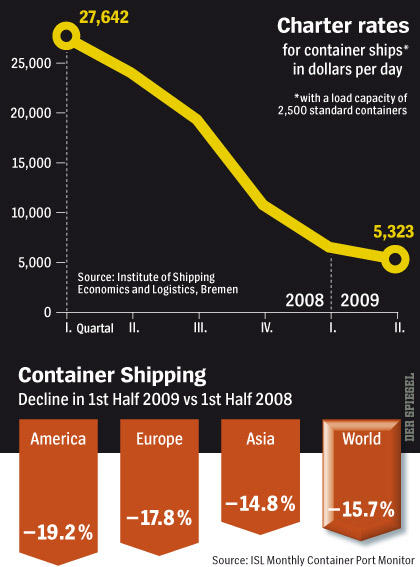
Shipping-Collapse

 Source: Der Spiegel

The global economic crisis is wreaking havoc on shipping: Demand and prices have collapsed and ports are filling up with fleets of empty freighters. The crisis has fueled cut-throat competition and not all companies will survive. Germany’s Hapag-Lloyd alone needs 1.75 billion euros to stay afloat.Shipping Industry Fights for Survival

The number of bankruptcies rose by a staggering 51.6 per cent in June compared to the year before, as more Canadian consumers and businesses were…Canadian bankruptcies skyrocket in June

Will the current crisis reverse the past two decades of democratisation and financial liberalisation? This column documents the complex, non-linear relationship between political and financial reform. Financial liberalisation often reverses as countries move from autocracy to democracy, as “partial democracies” are less liberalised, and there are big differences between de jure and de facto liberalisation.Financial liberalisation and “partial democracy”

Even some of our most sophisticated commentators doubt a link between consumer protection and any macroeconomic outcomes.  Consumer protection, in this view, is microeconomics and quite different from macroeconomic issues (such as the speed and nature of our economic recovery).Credit Conditions In The Absence Of Consumer Protection

The order in which the world will emerge, post-recession, is still unclear, but a long slog can be expected, after which there will still be few competitors to challenge the US dollar as the world’s predominant currency.How will the world look when the dust settles?

The balance of risks to Asian equities is to the downside over the next three months, says Macquarie.Macquarie bullish on Singapore and banks

Stronger high-street sales and optimism in housing market have boosted hopes of economic recovery. Spending and house prices pick up

Ships-Parked

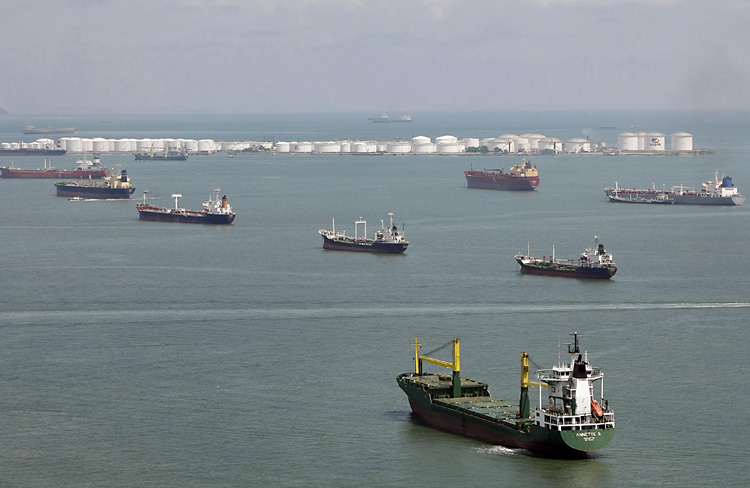
Container ships and bulk carriers parked off the coast of Singapore: Roughly 450 container ships are now idle worldwide as a result of the crisis — about 10 percent of the global fleet. Credit: Der Spiegel