Ten Stocks from the Dow Jones U.S. Select Dividend Index

The one hundred components in the Dow Jones U.S. Select Dividend Index are “selected to the index by dividend yield, subject to screens for dividend-per-share growth rate, dividend payout ratio and average daily dollar trading volume. Components are weighted by indicated annual dividend”. As of July 31,2009 the total return for the index was -4.03% and the yield is 4.39%. Utilities account for one fourth of the index.The following is a brief overview of the top ten stocks from this index:

1.CenturyTel Inc (CTL) is a telecom provider with operations rural and mid-size markets in 25 states. The majority of its business are in Missouri, Wisconsin, Alabama, Arkansas and Washington.The current dividend yield is 9.02% and the market cap is $9.2B. Last year the company had $2.6 in revenues.

2.New York Community Bancorp Inc.(NYB) has 214 branches in all five boroughs of New York City, Long Island, and Westchester County in New York, and Essex, Hudson, Mercer, Middlesex, Monmouth, Ocean, and Union counties in New Jersey. NYB pays a dividend of 9.31%.

3.Zenith National Insurance Corp. (ZNT) is a small-cap property and casualty insurance company offering worker’s compensation, reinsurance and investments. Dividend yield is 7.97% and the beta is 0.9. For the 2nd quarter, Zenith reported a net income of $1.8 million.

4.R.R. Donnelley & Sons Co.(RRD) is a printing services company. It pays a 6.16% dividend yield.
Donnelley earned $25.2 million, or 12 cents a share in the 2nd quarter and sales fell to $2.36B.

5.Altria Group Inc. (MO) is a fully owned subsidiary of Philip Morris USA Inc with a dividend yield of 7.26% which is comparable to the yield of its peer Reynolds America (RAI). MO has a profit margin of about 15%.

6.Based in Puerto Rico First Bancorp(FBP) is bank holding company with operations in Puerto Rico, the United States and the US and British Virgin Islands. In the past 52-weeks the stock is down nearly 67% due to loan losses.The current yield is 8.81%. On July 30th, First Bancorp announced the suspension of common and preferred dividends.

7.F.N.B. Corp.(FNB) is a bank holding company operating in Pennsylvania, Ohio, Tennessee, Pennsylvania and Florida.FNB pays a 6.85% dividend yield. The Tier 1 risk-based capital ratio was 13.22% on June 30, 2009.

8.NiSource(NI) is a utility that provides “natural gas, electricity, and other products and services to approximately 3.8 million customers located within a corridor that runs from the Gulf Coast through the Midwest to New England.” It pays a 7.10% yield.Revenue and earnings growth are down in the past few years and the stock is a poor performer.

9.Mercury General Corp.(MCY) is a California-based insurance company offering homeowners, mechanical breakdown, commercial and dwelling fire, and commercial property insurance. In 52 weeks MCY is down 28% and the dividend yield is 6.34%.

10.Arizona-based electric utility Pinnacle West Capital Corp. (PNW) has a market cap of $3.3B.The current dividend yield is 6.50%.

To download the complete list of Dow Jones U.S. Select Dividend Index components in Excel click here.
Note: The yield listed in the Excel file is as of July 27,2009

Three China Oil ADRs

In an article titled Shanghai Market Sees Red the Journal says:

“It is rich in irony. But preparing to celebrate the 60th anniversary of the People’s Republic of China, the Communist Party won’t want a plunging stock market to mar the festivities.

At least, this is the latest thinking among traders betting on an end to the slide in Chinese stocks.

It highlights the Shanghai market’s defining characteristic: Successful investing there requires sniffing the winds from Beijing.

The recent selloff — taking the Shanghai Composite down 16% from its Aug. 4 high — has been stoked by fear Beijing will tame its massive rate of bank-loan expansion.”

I would agree that successful investing in not just China, but many emerging markets requires following the government’s moves on a regular basis. Some of the money from the stimulus program is moving into the stock markets. China’s car sales is growing exponentially due to high demand created by tax breaks and other incentives.

After Coal, oil is the major source of energy for China. As the following charts show, China was the 3rd largest importer of oil in 2008 and majority of the imports come from the middle east.

Source: Energy Information Administration, US Department of Energy

As China’s economy grows demand for oil will continues to grow and the large Chinese oil companies would benefit. Already some of the Chinese oil producers are active globally. In July, “Crude imports jumped 18% from a month ago to 19.63 million metric tons last month, or about 4.64 million barrels a day, according to monthly data released by China’s General Administration of Customs.”

One easy way to invest in the oil companies are via the 3 Chinese oil ADRs listed in the NYSE. A brief summary of them follows:

1.China National Offshore Oil-CNOOC (CEO) is a producer of offshore crude oil and natural gas with operations in People’s Republic of China, Indonesia, Australia, Nigeria, Canada and Singapore. The current dividend yield is 3.91%. In 2008, total revenues was about $18B and the annual earnings growth is 28%. China National Petroleum Corp. and Cnooc Ltd. are trying to acquire to Repsol YPF’s stake in its Argentine unit YPF for $17 billion.

2.China Petroleum & Chemical Corporation (aka Sinopec Corp.) (SNP) is involved in integrated oil, gas and chemical operations in the People’s Republic of China. At the end of last year the company operated 16 oil and gas producing fields. The stock is up 41% YTD.

3.PetroChina Company Ltd (PTR) is another integrated oil and natural gas producer and distributor with a market cap of over $200B. Revenues grew consistently over the past 5 years and the yield is 4%. PTR has nearly doubled from the March lows.

Knowledge is Power: China’s Success, Spanish Housing Market Edition

Not to be flippant about a new stock-market plunge that’s doubtless causing heartburn in many offices and households, but is this really such a huge surprise? And just as important, is it really such a bad thing?.U.S. consumer weakness painful but needed

In the aftermath of Iceland’s financial collapse, many citizens are planning to leave the country to find work and a more secure future.Brain drain hits cash-strapped Iceland

Reykjavik

Reykjavik, Iceland

Twenty Percent of Spanish Mortgages Now Considered To Be High Risk.According to an article which appeared in the Spanish newspaper Expansion this morning, one in five Spanish mortgages is now considered as being high risk and liable to become “non performing”.

GDP in the OECD area stabilised in the second quarter of 2009.Gross domestic product (GDP) in the OECD area stabilised in the second quarter of 2009 (minus 0.002%), according to preliminary estimates, following a fall of 2.1% in the previous quarter.

The recovery has started. Sustaining it will require delicate rebalancing acts, both within and across  countries.Sustaining a Global Recovery

US President Barack Obama has lost his messianic status in the row over health care reform, say German media commentators. The debate reveals the downside of America’s ideological aversion towards government: Americans are ready to put up with an inferior health service in the name of freedom, it seems.Americans Want ‘Freedom to Pay Too Much for Inferior Health Care’

Five years ago today, Google sold shares to the public for the first time, amid lots of skepticism about how the offering was being handled and whether the Web search company was overhyped and overvalued.Google’s I.P.O., 5 Years Later

Nicholas Taleb attacked Barack Obama for increasing his tax bill as part of anti-recessionary measures.

China’s rapid growth is no accident: it has had the right policies both practically and from the viewpoint of economic theory.No secrets to China’s success

BB&T Corp. calls itself a “fast follower”—a player that doesn’t try to get there first with technology, but takes advantage of every smart play.Capitalizing on Opportunities

Poverty Rate and Income Distribution in the USA

The latest poverty data available from the Census Bureau is for the year 2007. The official poverty rate in the US was 12.5 % in 2007. Put another way, 37.3 million people were in poverty up from 36.5 million the previous year.

Click to Enlarge

Poverty-Rate-US-2007

Source: U.S. Census Bureau

The 37.3 millions does not include people in institutional group quarters (such as prisons or nursing homes), college dormitories,military barracks and living situations without conventional housing (and who are not in shelters). The poverty threshold in 2007 for a couple with two children was $21,027.

The above chart shows that number of people in poverty has been rising since 2000. The latest population of the US is 307 million. With unemployment rate at 9.4% in July and household debt at high levels, more people may be pushed into poverty.

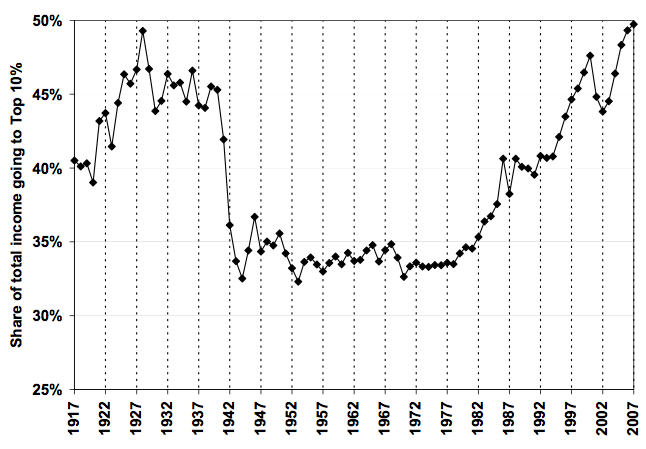
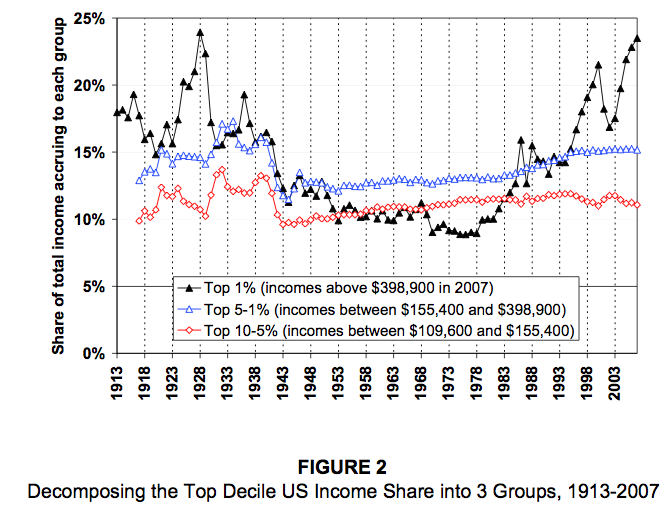
When we compare the rising poverty levels to the income distribution, the correlation is  interesting.As the charts below show clearly, the rich are getting richer and the poor are getting poorer.

Click to Enlarge

Rich-US

Income-Distribution-USA

Source:  Striking It Richer. The Evolution of Top Incomes in the United States, by Emmanuel Saez,
UC Berkeley

In the past few years, the wealth and income inequality in the US is rising to record high levels. During the 2000 presidential campaign in New York, gazing at the diamond-studded $800-a-plate crowd Presidential candidate George W. Bush commented:

“This is an impressive crowd – the haves and the have-mores,” quipped the GOP standard-bearer. “Some people call you the elites; I call you my base.”

Top 10 Canadian Dividend Stocks

The Dow Jones Canada Select Dividend Index represents 30 of the top dividend stocks in Canada. These stocks are selected to the index annually based on yield.

The index is up 29.04% year-to-date as of July 31,2009 with dividends reinvested. Last year the index was down about 31%.The 10-year annualized return is 10.62%. One of the interesting features of this DJ Canada Select Dividend Index is that about 73% of the index is made up of financials.Telecom, utilities and energy form about 7% each.

The Top 10 Components in the Index are:
National Bank of Canada
Bank of Montreal (BMO)
Canadian Imperial Bank of Commerce (CM)
Toronto-Dominion Bank (TD)
IGM Financial Inc.
Bank of Nova Scotia (BNS)
Royal Bank of Canada (RY)
Manitoba Telecom Services Inc.
TMX Group Inc.
Sun Life Financial Inc (SLF)

The only utility in the above list is telecom provider Manitoba Telecom Services Inc whose stock does not trade in the US markets. Among the financials all the large banks are in the list with one life insurance company. SunLife Financial (SLF) has a dividend of 4.43%.The five largest Canadian banks weathered the credit crisis well and have shown their strength with a strong rebound since the March lows. Their dividends range from 3.69% to 5.62%. One of the biggest advantage with holding the Canadian bank stocks is that due to strict regulation and highly conservative business practices, they produce consistent profits year after year. Some even call these banks the “cash cows” of Canadian stocks due to their dividend payments.

Another point is that these banks and insurance companies such as Manulife, Sun Life, etc. are in many of the mutual fund portfolios held by Canadian thru their 401-K equivalent for retirement savings called the RRSP account.

While its true that these banks took some unwanted risk thru the use of derivatives in recent years they have written most of the losses.Unlike the US, the housing market in Canada is relatively holding up well and consumer debts such as credit card debt is not a huge problem due to strict underwriting standards. None of the banks in Canada are in serious risk of collapse like some of the large US banks.

Disclosure: Long all five banks