The Best and Worst Performing Market Indices in Half Year 2008

The best performing market index in the first six months of 2008 was the IGBVL index of Lima Stock Exchange in Peru. This index grew by 85.3% in local currency. The second and third posts went to Shenzen and Shanghai stock exchanges in China which had growth of 73.9% and 62.5% respectively.

The worst performing stock markets were the indices of Bermuda, Iceland and Malta.

Click to expand

Best-Worst-Stocks-Markets-2008-first-half

Source: Market highlights for first half-year 2009, World Federation of Exchanges

This year it appears that emerging markets may handily beat the developed markets. Most of the best performing indices in the first half are from the developing world.

New Zealand ADRs List

The only New Zealand ADR listed in the NYSE is Telecom New Zealand (NZTCY). Currently NZTCY pays a dividend yield of 8.66%. For US investors, there is no country-specific ETF or other funds for investing there.New Zealand stocks generally have excellent yields and the country was not impacted adversely by the credit crisis.The average dividend yield of NZX 50 index is about 5%. In mid 2008 it averaged about 8%. The banking system is sound and there are many high quality companies that reward long-term investors handsomely.

Many of the companies of New Zealand recently listed their stocks in the OTC markets. Since these stocks are new to the US markets they are very thinly traded. The following is the complete list of all New Zealand ADRs traded in the OTC markets either in the sponsored or unsponsored category:

Air New Zealand ANZFY
Travel & Leisure

Auckland International Airport ACKDY
Travel & Leisure

Cavalier CVLRY
Construct.&Materials;

Contact Energy COENY
Electricity

Fisher & Paykel Appliances FPAHY
HouseGoods&HomeConst;

Fisher & Paykel Healthcare FSPKY
HealthCareEquip.&Ser;

Fletcher Building FRCEY
Construct.&Materials;

Freightways FTWYY
Support Services

GuocoLeisure GUORY
Travel & Leisure

Hallenstein Glasson HLSTY
General Retailers

Hellaby HLYHY
Financial Services

Mainfreight MFGHY
IndustrialTransport.

Methven MTHVY
HouseGoods&HomeConst;

Michael Hill International MXRHY
General Retailers

New Zealand Oil and Gas NZEOY
Oil & Gas Producers

Nuplex Industries NPXIY
Construct.&Materials;

NZ Farming Systems Uruguay NZFSY
Food Producers

PGG Wrightson PGWFY
Financial Services

Port of Tauranga PTAUY
IndustrialTransport.

Property for Industry PYIYY
RealEstateInv.Trust

Pumpkin Patch PUPKY
General Retailers

Rakon RAKNY
Mobile Telecom.

Sanford SARDY
Food Producers

Skellerup Holdings SKLUY
Construct.&Materials;

Sky City Entertainment Group SKYZY
Media

Sky Network Television SKKTY
Media

The New Zealand Refining NZRFY
Oil & Gas Producers

Windflow Technology WFLWY
Industrial Engineering

Some of the above stocks are part of NZX 50 Index, the main stock market index. For more details on this index, go here.

A Comparison of Economies: Canada Vs. Australia

Canada and Australia have  many similarities and some differences. Both countries are Federal parliamentary democracies and former British colonies. Canada has a population of 33 million while Australia has 21 million. The GDP per capita is also very similar. For example, in 2008 it was $39,183 for Canada and US$37,298 for Australia (Source: Wikipedia).

The following is a summary from a speech titled “Australia and Canada – Comparing Notes on Recent Experiences” given by Glenn Stevens, Governor, Reserve Bank of Australia, in Sydney on 19 May 2009. The table below shows the economic structures of the countries:

Click to enlarge

Canada-Australia-Economy

The production sectors are of similar size in the two countries. However Canada has more manufacturing than Australia. Canada has less mining than Australia. In mining, there are significant differences between the countries in terms of resources.

In 2008, exports of goods and services accounted for one third of the GDP in Canada compared to about one quarter in Australia. Commodities form a major portion of the exports in both countries. Commodity exports is important to Australia than Canada since machinery, automobiles and other equipments form a sizable portion of exports for Canada. The great white north exports more crude oil, natural gas and forestry products than Australia. Coal, iron ore, nickel, copper, precious metals form the major commodities of Australia.

Australia’s terms of trade grew much more faster than Canada’s after the 2001 recession. Between mid-2002 and 2008, Australia’s terms of trade grew by 60% compared to Canada’s 30%. The difference in growth is due to the differences in price increases of the commodities exported by the two countries. Coal, iron ore, aluminium and copper prices rose significantly in the time period mentioned relative to crude oil and natural gas prices.


Australia-Canada-Trade-Growth

Australia’s exports have not suffered as much as Canada’s exports since the main customers of Australian exports are in Asia. Demand from countries like China, Taiwan, Korea have stayed relatively strong. Canada on the other hand depends heavily on the US. As the US economy went into a tailspin last year Canada’s auto, machinery and forestry exports fell drastically.Compared to Canada, Australia has a diverse set of trading partners.

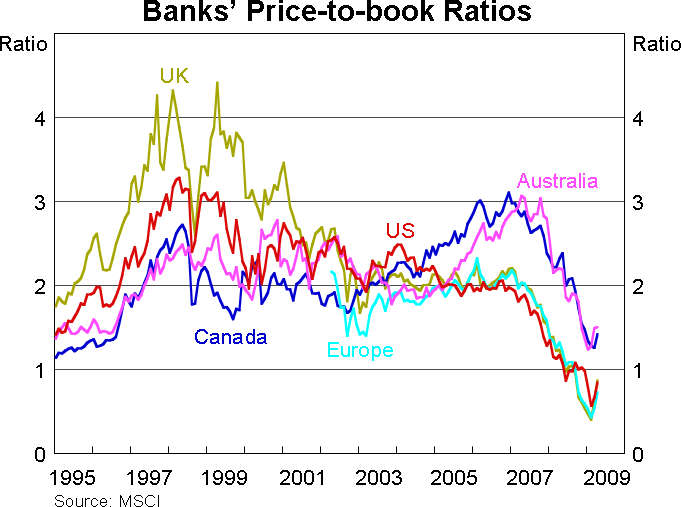
One of the key strengths of Canada and Australia have been their banking sectors. Unlike their peers in the developed world, Canadian and Australian banks came out of the credit crisis strong. Return On Equity stood at 17% and 14.5% for Aussie and Canadian banks in 2008. Due to their limited exposure to complex derivatives and the sub-prime mortgages losses have been much less severe than British and US banks.

Click to enlarge 

Canada-Australia-Banks

5-year performance comparison of country specific ETFs:

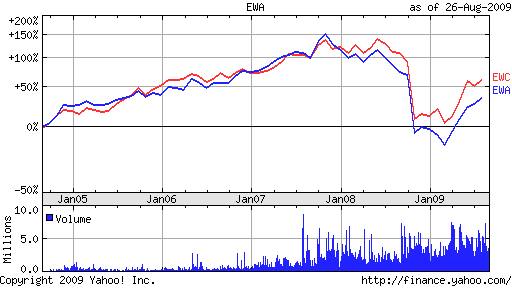
5-year-EWA-EWC

The iShares MSCI Australia Index (EWA) ETF has outperformed the iShares MSCI Canada Index (EWC) ETF in the past 5 years. EWC has more than $2 B in assets compared to EWA’s $1.19. But the dividend yield for the Australian ETF is much higher than the yield for the Canadian ETF. For the next few years, EWA is probably a better buy than EWC since China is growing due to the huge stimulus and other emerging in markets in Asia will follow the lead of China as well. As the US economy is projected to have slow and sluggish growth in the next few years, Canada might have to search for other overseas buyers  in order to diversify its export markets.

Update (2/27/17):

Also see: Philip Lowe: Australia and Canada – shared experiences, Speech by Mr Philip Lowe, Governor of the Reserve Bank of Australia

Nine Foreign Large Cap Dividend Stocks

To identify the large cap foreign stocks in NYSE with current dividend yields of 5% or higher, I ran the following screener:

Exchange: NYSE
Market Capitalization: ≥ $50.0B
Dividend Yield :≥ 5.00%

The screen resulted in 11 stocks out of which 9 were foreign ADR stocks.

1.Company: BP plc (BP)
Dividend Yield: 6.48%

2.Company: Deutsche Telekom AG  (DT)
Dividend Yield: 8.06%

3.Company: Eni S.p.A.(E)
Dividend Yield: 6.01%

4.Company: France Telecom SA (FTE)
Dividend Yield: 6.62%

5.Company: Telefonica S.A. (TEF)
Dividend Yield: 5.41%

6.Company: Deutsche TOTAL S.A.(TOT)
Dividend Yield: 5.66%

7.Company: Vodafone Group Plc (VOD)
Dividend Yield: 7.90%

8.Company: Royal Dutch Shell plc(RDS.A)
Dividend Yield: 6.12%

9.Company: Banco Santander, S.A(STD)
Dividend Yield: 5.19%

The common theme in the above list is that except Banco Santander of Spain all the others are either energy or telecom companies. Usually banks and utilities appear in high yield stock screens. But due to the credit crunch and the recession, most of the banks’  market caps fell heavily and dividend yields also decreased as most of them either cut or reduced them.

Among the large foreign banks, just Banco Santander, S.A(STD) currently has a market cap of about $125B and pays a dividend of 5% or more. Other Companies in the above list with market caps of $100B or more are BP, Telefonica, Total, Vodafone and Royal Dutch Shell.

Note: The above data is known to be accurate. Please do your own due diligence before making nay decisions.

Two Electric Utility ADRs of Chile

The country of Chile is a top copper producer in the world. While many banks have failed in the developed countries Chilean banks have remained stable. The economy has held up well. Recently an article in Business Week discussed about the growth of the IT industry in Chile. US companies are outsourcing their IT work to Chile since the cost of labor is cheap and the workforce is highly educated compared to other outsourcing destinations. In addition to banks and commodities, Chilean utilities hold good potential for future growth.

Two electric utilities of Chile trade in the New York Stock Exchange (NYSE). A brief overview of these two ADRs follows:

1.Enersis SA (ENI) is generates, transmits and distributes power in in Chile, Argentina, Brazil, Colombia and Peru. ENI is one of the largest private sector electricity companies in South America. Endesa of Spain is the largest shareholder in Enersis.”For the six months ended on June 30, 2009, Enersis’ Net Income was Ch$360.906 million, an increase of 46.0% with respect to the same period in 2008. This better outcome is mainly explained by the increase in energy sales and lower purchases of fuel and other operating expenses, which implied a 15.2% higher Gross Income.”

Enersis is also one of the top 10 largest traded stock in Santiago Stock Exchange in the first 6 months of this year. The current yield for ENI is 4.45%. From a low of about $10 the stock has rebounded to $18+ as of today’s close.

2.Chile-based Empresa Nacional de Electricidad SA (EOC) is another electric utility with operations in Argentina, Colombia and Peru as well. At the end of 2008, Empresa had 25 generation facilities outside of Chile.

Total revenue increased consistently for the past 5 years and the average annual dividend growth rate is 36.18%.The current dividend yield is 3.56%.