The Best Banks of India List

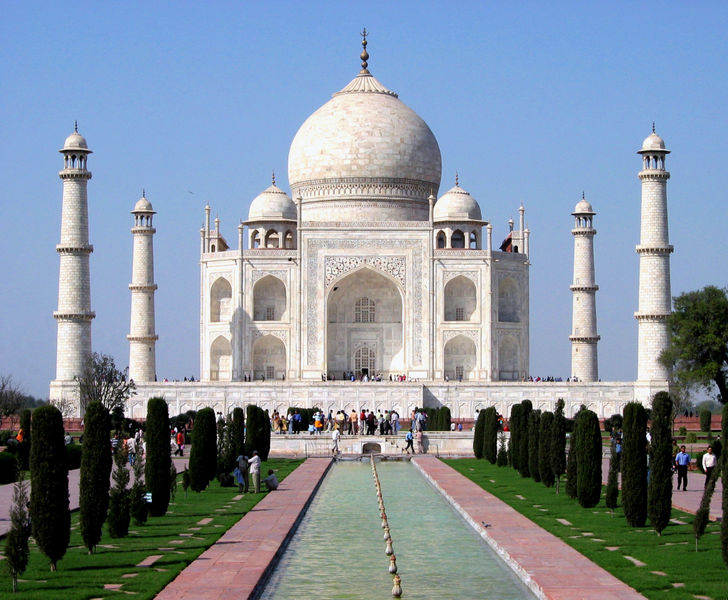
Taj-MahalIn July, the Financial Express newspaper presented its Tenth India’s Best Bank Awards in 12 categories. The banks are selected based on many factors such as growth, profitability, credit quality and strength in the past financial year.

The Best Bank awards were presented to the Top Two among each of the following categories:

Public Sector Bank -  Indian Bank and Bank of India

Old Private Sector Bank – South Indian Bank and Tamilnad Mercantile Bank

New Private Sector Bank – Axis Bank and HDFC Bank

Foreign Bank – Bank of America (BAC) and Citibank (C)

Growth – Deutsche Bank (DB)

Profitability – Standard Chartered Bank

Credit Quality – Union Bank

Soundness – HDFC Bank(HDB)

Efficiency – Bank of America (BAC)

The country’s top bankers were also presented awards this year.The Best Bankers
awards were given in three categories:

Lifetime Achievement Award – KV Kamat, MD & CEO, ICICI Bank(IBN)

Banker of the Year – OP Bhatt, Chairman, State Bank Of India

Most Innovative Banker – Aditya Puri, MD & CEO HDFC Bank (HDB)

In March, I wrote an article listing the Top Banks of India 2009 as selected by Dun&BradStreet.

The Bankex Index tracks some of the biggest bank stocks. To view the performance details of this index go here.
A Historical Perspective of U.S. Debt Growth

The White House projected that the sharply rising U.S. government deficit could reach $9.05 Trillion over the next decade. In February, after Mr.Obama became President, the projection was around $7 Trillion. Mr.Obama inherited a gaping budget deficit from the previous Bush administration due to tax cuts.

Still, the deficit, stemming mostly from aid to the financial system and fiscal stimulus to jolt the economy from recession, represents more than 11 per cent of gross domestic product (GDP), the largest as a share of the economy since World War II, analysts pointed out.

Under assumptions by both the White House and the CBO, the United States will consistently run up large deficits of around three to four per cent of GDP.”

In a New York Times Op-Ed, Professor Paul Krugman says “deficits saved the world.” He added:

“But what about all that debt we’re incurring? That’s a bad thing, but it’s important to have some perspective. Economists normally assess the sustainability of debt by looking at the ratio of debt to G.D.P. And while $9 trillion is a huge sum, we also have a huge economy, which means that things aren’t as scary as you might think.

Here’s one way to look at it: We’re looking at a rise in the debt/G.D.P. ratio of about 40 percentage points. The real interest on that additional debt (you want to subtract off inflation) will probably be around 1 percent of G.D.P., or 5 percent of federal revenue. That doesn’t sound like an overwhelming burden.

Now, this assumes that the U.S. government’s credit will remain good so that it’s able to borrow at relatively low interest rates. So far, that’s still true. Despite the prospect of big deficits, the government is able to borrow money long term at an interest rate of less than 3.5 percent, which is low by historical standards. People making bets with real money don’t seem to be worried about U.S. solvency.”

An article titled Paying the Piper by Carlo Cottarelli in the IMF’s “Finance and Development” magazine March edition mentioned that “the increase in government debt (as a share of GDP) in advanced economies is projected to be the largest and most pervasive since World War II” due to all the financial sector rescues. The rise in debt-to-GDP ratios is projected at 14.5% of GDP for the G-20 economies, half of which is  due to rescue packages offered to the financial sector.

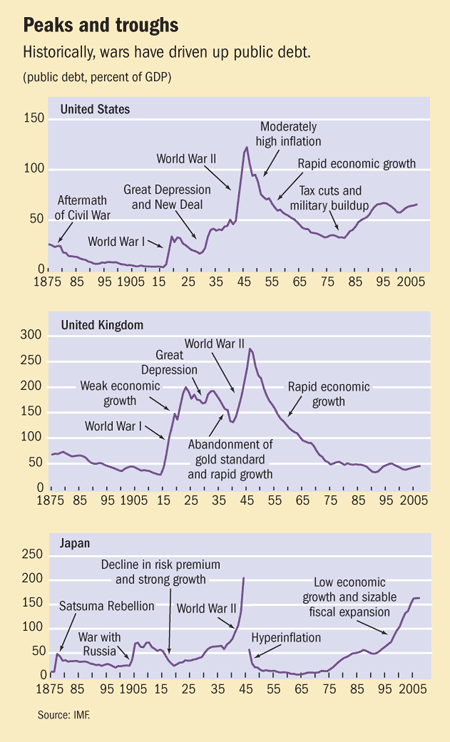
Though today’s debt-to-GDP ratios is high, even higher ratios were observed in the past especially during World Wars I and II. After the wars economic growth helped reduce the large debt accumulated to low levels. The chart below shows the growth of debt in the past for three major economies: the US, UK and Japan.

US-Debt-Growth-History

Strong economic recovery is critical to debt reductions.The IMF article noted:

“For example, rapid economic growth following World War II reduced the debt-to-GDP ratio in the United States from 121 percent in 1946 to 50 percent in 1965. In contrast, with overly prudent fiscal policies and continued compliance with the gold standard, sluggish economic growth in the 1920s and during the Great Depression led the debt-to-GDP ratio to rise in the United Kingdom from 130 percent in 1919 to 178 percent in 1933.”

Economists are projecting that the current US economic recovery will be sluggish and that private consumption will remain flat to down for  many years. In addition to the many bailouts of the financial sector which added billions to the nation debt, the U.S. is now engaged in two wars in Iraq and Afghanistan.If the US loses its AAA credit rating and the economy remains in stagflation mode for many years, then the huge U.S. debt would lead to many problems. Some consider the AAA rating of the U.S. is at risk already. However as long as the Chinese and other friendly governments are willing to “pay the piper” we are in good shape. Would you agree?

Related item: A Brief History of The U.S. Deficit (Time)

Knowledge is Power: Gold Illusion and Oil Empire Edition

THE FLIP SIDE OF GOLD –The illusion of gold mining profits. Like rabbits in strong headlights, equity investors with a gold bent continue to chase increasingly challenging cash margin compression.

A group of leading financial analysts quiz Britain’s top regulator on what went wrong and how to sort it out.How to tame global finance

The $19-billion merger of Calgary-based oil-industry pioneers Suncor and Petro-Canada creates a giant.  Oil industry: Empire of the sun

An accident shows how China treats consumers.On a cold January day in Pennsylvania, I arranged to meet a man who one day could be worth millions. The Italian restaurant he suggested in the town of New Castle was scruffy and a bit down at heel, but it served good old-fashioned food. That’s important, because Robert Silverman can’t splash money around – not yet, anyway.

Areas that tasted the excesses of the housing boom are suffering as the influx of people moving from the Rust Belt has slowed.Construction That Fueled Growth in the Sun Belt Slows

Key Points from the latest FDIC’s Quaterly Banking Profile

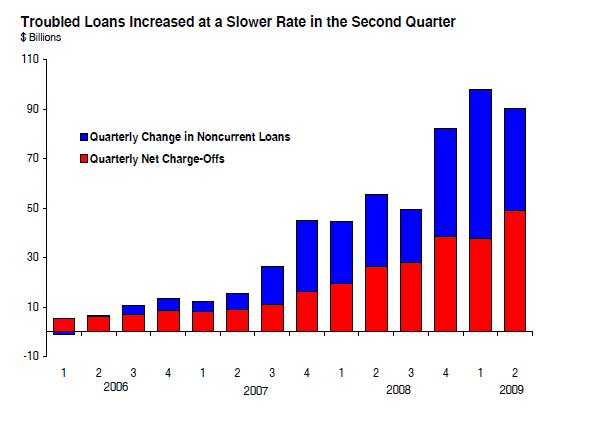
The FDIC released the Quarterly Banking Profile for second quarter,2009 yesterday. Some of the key points and charts from this report are presented below.

  • More Than One in Four Institutions Are Unprofitable
  • Charge-Offs and Noncurrent Loans Continue to Rise
  • Net Charge-offs:

“Net charge-offs of credit card loans were $4.6 billion (84.5 percent) higher than a year earlier, and the annualized net charge-off rate on credit card loans reached a record 9.95 percent in the second quarter. Net charge-offs of real estate construction and development loans were up by $4.2 billion (117.0 percent), and charge-offs of loans secured by 1-4 family residential properties were $4.0 billion (41.1 percent) higher than a year ago.”

Charts:

Problem-banks

Loan-losses

Download: FDIC’s Quarterly Banking Profile Second Quarter, 2009

Top Oil Producing Countries in 2008 and The World’s Largest Oil Fields

150 years ago this week Colonel Edwin Drake struck oil in Titusville, Pennsylvania. Ever since oil has become the most important commodity in the world.Despite the hype about green technologies and other alternative sources of energy, crude oil will continue to be the major source of energy for many years to come.

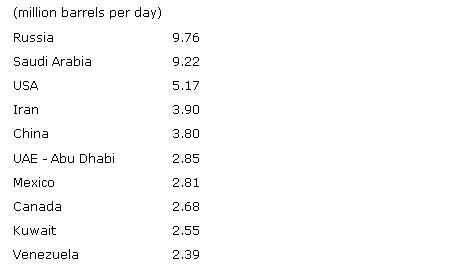
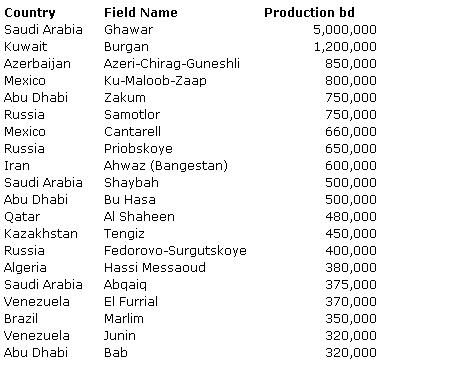
In this post lets take a quick review at the largest oil producers in 2008 and oil fields.

Top Oil Producing Countries 2008  (in million barrels per day)

Top-oil-producers-2008

World’s Largest Oil Fields

Top-oil-fields

Source: IHS CERA