Top 10 Reasons to Invest In Asia

Many stock market indices in Asia have performed very well this year compared to developed markets. For example, China’s Shanghai Composite Index is up 59%, India’s Sensex is up 76.5%, Taiwan’s Weighted Index is up 65.5%, Singapore’s Straits Times Index is up 52.2% YTD as of Oct 12th. European indices have risen about 20-30% this year. The S&P 500 has increased 21% YTD. As growth continues to be sluggish in the developed world investors are flocking to Asia for higher returns.

So should you invest in Asia?

The answer to the above question is a resounding Yes. The following 10 reasons were identified by CLSA Asia-Pacific Markets in the CLSA Quarterly, Autumn 2008 report on why one should invest in Asian markets.

1.Asia’s billion boomers – People, Money and Aspirations.

Asian countries are growing and creating middle-class and upper-middle class people with plenty of money and the willingness to spend. The growth in domestic consumption will much be much bigger than the post-World War II growth in the U.S. By 2020, more than 1.2 billion people are projected to have a per-capita GDP of more than $5,000 as the chart shows below:

Asians-GDP-per-capita

2. China’s consumers will lead Asian and possibly global recovery as the credit markets are loosened and consumer spending increases. The Chinese middle-class is already spending heavily to improve their standard of living.

3. Asia’s economic size relative to the US is growing fast. Since the 1990s low, its economic size has doubled relative to the US economy. As countries like China, India grow Asia’s economic power will rise.

4. Asia has the money – lots of it. Many Asian countries have current account surpluses while most developed countries have deficits. Countries such as USA, UK have high deficits.

5. Asians have plenty of money at the bank. Unlike American consumers who are deep in debt due to the credit bubble, Asian consumers have money to spend. The chart below shows the loan-deposit ratio of US and Asian banks:

Asia-US-Banks-Loan-to-Deposit-Ratio

6. Asia is at the start of a demographically driven boost to domestic investment. Hence Asians will take a large role in their own markets as opposed to foreign investors.

7. Countries in Asia are urbanizing rapidly. More and more people are moving from rural areas into urban cities and towns in search of better life. This urbanization process will lead to higher incomes, better educational opportunities and higher spending on the comforts of modern life.

8. Chindia will lead the way.In just 12 years, the combined economies of India and China will equal about 60% of the US economy. As of this result of this, the political and economic power will shift towards the East.

9. In addition to money, Asians are leading the way in the study of hard sciences which include math, engineering, etc. A country needs strong and bright thinkers in hard sciences in order to build a better future. More Asian students enroll in hard science programs in universities than American students.

10.Growing Prominence of Asian markets. In September, FTSE promoted South Korea to Developed Country status. China’s A shares and Taiwan may be added next. Also “Asia ex-Japan’s weight in the global MSCI has climbed from 3.7% to 6.8% during the past 12 years.”

With high savings rate and the strong confidence and eagerness to grow and prosper, Asia presents a multitude of opportunities for foreign investors seeking diversification and growth.

Top Foreign Dividend Stocks Traded in New York

In this post lets take a quick look at the Top Foreign Stocks Traded in the New York Stock Exchange. Last year when I wrote an article with the same title there were 21 foreign ADRs. Many of them were bank stocks such as Barclays (BCS) , ING (ING), etc. The world of banking looks a lot different now after the credit crunch.

Traditionally foreign stocks have paid higher dividends than their US peers despite taking into consideration factors such as taxes, foreign exchange, transaction costs, etc. To identify the top dividend ADR stocks, I ran the stock screener with the following criteria:

1. Stocks must trade on the NYSE
2. Market cap. >= $25B
3. Must have dividend yields of at least 5% now

The search resulted in 9 ADR stocks that met the above criteria. These nine stocks are:

Company: Bank of Montreal (BMO)
Dividend Yield: 5.29%
Country: Canada

Company: BP plc (BP)
Dividend Yield: 6.43%
Country: U.K.

Company: Deutsche Telekom AG (DT)
Dividend Yield: 7.69%
Country: Germany

Company: Eni S.p.A. (E)
Dividend Yield: 5.79%
Country: Italy

Company: France Telecom SA (FTE)
Dividend Yield: 6.42%
Country: France

Company: Repsol YPF, S.A (REP)
Dividend Yield: 5.36%
Country: Spain

Company: TOTAL S.A. (TOT)
Dividend Yield: 5.42%
Country: France

Company: Vodafone Group Plc (VOD)
Dividend Yield: 8.00%
Country: Canada

Company: Royal Dutch Shell plc (RDS.A)
Dividend Yield: 5.86%
Country: The Netherlands

Except Bank of Montreal, none of the financial institutions made it to this list. BP, Vodafone,France Telecom, Eni Spa, Deutsche Telecom AG and Repsol were in the last year’s list as well. The three giant oil multinationals BP, Shell and TotalFina are strong long-term consistent performers. Now they have attractive yield also. Overall, the above nine companies are world-class companies with strong leadership positions in their respective fields.

None of the emerging market companies pay dividends greater than or equal 5% and have a market cap of at least $25B. Except the lone Canadian bank in the list above, all the rest of them are European companies.

New Argentina ADR: Pampa Energia

Pampa Energia (PAM) is an electric utility from Argentina to list its ADR (American Depository Receipt) shares in the New York Stock Exchange on October 9, 2009. Each ADR represents 25 common shares of the Company.

Corporate Profile from Pampa’s Website:
“Pampa Energía S.A. is the largest fully integrated electricity company in Argentina. Through its subsidiaries, the Company is engaged in the generation, transmission and distribution of electricity in Argentina.

The Company’s generation business has an aggregate installed capacity of approximately 2,000 MW, representing about 8% of the installed capacity in Argentina. Its transmission business co-controls Transener, which operates the largest high voltage electricity transmission system in Argentina, covering around 10,155 km of lines, as well as 6,108 km of high tension lines from its subsidiary Transba. The distribution business comprises Edenor, the largest electricity distribution company in Argentina, with more than 2,500,000 customers and with a concession area that covers the northern part of the City of Buenos Aires and the northwestern zone of the Greater Buenos Aires.

The Company’s shares trade on the Buenos Aires Stock Exchange under the ticker “PAMP” and are part of the MERVAL Index with a participation of 10.21% . Pampa has an ADSs (American Depositary Shares) Level I‘s program, which represent 25 shares of common stock each. The Company will commence the trading of its ADSs in the NYSE (New York Stock Exchange) on October 9th, 2009.”

About 77% of the outstanding stock is free float with the rest under the control of management. Pampa is one of the most traded stock on the Buenos Aires Stock Exchange. PAM closed at $12.75 on the first day of trading in the NYSE. The other Argentina-based electric utility trading in the US markets is Edenor (EDN).

A complete listing of Argentina ADRs is available here.

For the latest earnings release,the Roadshow presentation and other information , go to Pampa’s IR site at: Investor Relations

Top 100 Consumer Brands in China

With a population of 1.3 billion, China is the fastest growing economy in the world especially for consumer goods. In China, the sales of all kinds of consumer goods are rising. For example, demand for household goods such as refrigerators, washing machines is increasing due to a subsidy program initiated by the government to help poor and middle-income families afford those goods.

Here are a few recent headlines on China’s consumer goods sales and the economy:

China Auto Sales Surge
Recovering Economy and Small-Car Push Lift Vehicle Demand

China Cosmetics & Toiletries Industry Continue to Flourish

Dell Says Strong Sales Growth to Drive China Share

Mobile phones ring in growth in emerging markets‎

To cash in on the explosive growth in the consumer goods sector, many foreign companies are investing heavily in China. Those companies that have established presence since as Coca Cola, Pepsi, Nestle, etc. are increasing their investments building new factories.

Which foreign companies will benefit from the growth of China’s economy?.

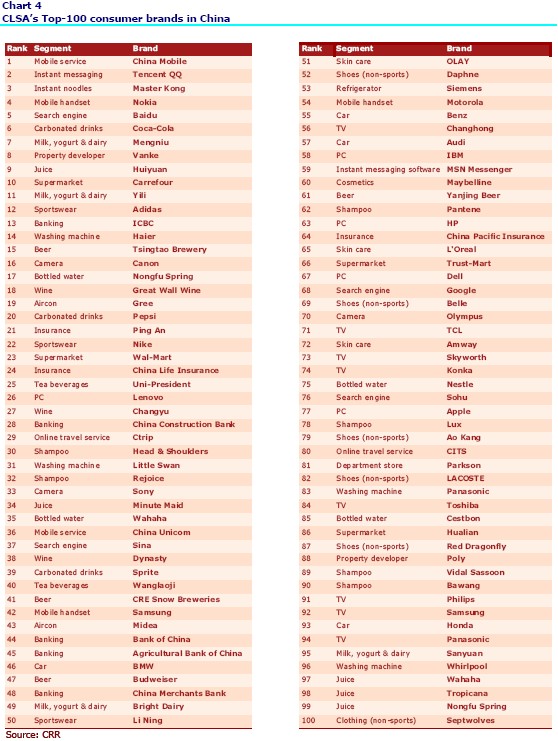
One way to identify the answer to the above question is to analyze the top consumer brands in China. Foreign companies that have strong brands in China will have higher sales growth as the domestic consumption increases.

The Top 100 Consumer Brands in China

Top-100-Brands-in-China

Source: CLSA launches inaugural China Brands Index and reveals China’s top 100 brands, CLSA Asia-Pacific Markets

CLSA compiled the above list based on a comprehensive survey of Chinese consumers. From the report:

“In terms of preference, domestic Chinese brands make up more than 50% of the Top-100 brands preferred by our respondents, with seven of the top ten being Chinese. First in terms of preference is China Mobile – mobile services (No.1); followed by Tencent QQ – mobile services (No.2); Master Kong – instant noodles (No.3); Nokia – mobile handset (No.4); Baidu – search engine (No.5); Coca-Cola – carbonated drinks (No.6); Mengniu – milk, yoghurt and dairy (No.7); Vanke – property developer (No.8); Huiyuan – juice (No.9) and Carrefour – supermarket (No. 10) (Appendix chart 4)

Domestic brands dominate the apparel, home appliances, food and beverage sectors where catering to local tastes is critical, and internet services, where regulators support easier to control home-grown providers. Domestic brands also feature overwhelmingly in the state-dominated industries of banking, insurance and telecoms. For example, seventy-six percent of respondents are current China Mobile subscribers and 92.5% said they would not consider switching to a different operator.

Domestic brands underperform in areas reliant on innovation and design, such as high-end consumer electronics and cosmetics and luxury fashion where R&D and technical know-how is critical. In these sectors, brand value as a share of the retail cost of the product is higher.”

Among the foreign brands in the top 100, American brands include Coca Cola (KO), Pepsi(PEP), IBM(IBM), Dell (DELL), Google (GOOG), Apple (APPL). Some of European brands in the list are Adidas(ADDYY), Siemens (SI), Nestle (NSRGY), Philips (PHI) etc. As the US consumer will no longer be the engine for global growth, these foreign companies would depend more on emerging markets particularly China and India to maintain their earnings growth.

While Google(GOOG) is the top search engine in the US, local firm Baidu (BIDU) is the most popular search engine in China. After its IPO on the Nasdaq in mid-2005, BIDU has become a traders dream stock and has had a wild run reaching over $400 in late-2007. After falling to nearly $100 last year the stock back over $400 again.