Bank Overdraft Fees: Another Example of Gotcha Capitalism

Overdraft fees charged by banks in the U.S. is another example of Gotcha Capitalism, a term coined by MSNBC’s Bob Sullivan who also wrote a book by the same name. The book shows how big businesses rip off billions of dollars from U.S. consumers in the form of hidden fees. Overdraft fees is an example of Gotcha Capitalism since consumers can be hit with fees as high as $39 when they over withdraw their account usually by just a few dollars such as $2 or $5.

Today’s journal has a story on new rules on bank overdraft programs. In Fed Curtails Banks’ Scope To Charge for Overdrafts, the article states:

“The Federal Reserve imposed rules Thursday making it harder for banks to hit customers with fees for overdrawing their accounts, in the latest government crackdown that could curtail a major revenue stream for financial firms.

The Fed’s policy requires customers to opt in to “overdraft protection” programs, meaning they would have to agree to pay a fee any time they overdraw their accounts at automated-teller machines or using a debit card. If they don’t agree, any effort to withdraw money would likely be rejected if it overdrew the account. Currently, banks can honor a withdrawal and levy a fee on the customer for becoming overdrawn.”

This new rule is too little too late for many consumers since many of the other strict regulations proposed were watered down or ignored completely. An example is how many times a consumer can be charged overdraft fees when they over-withdraw their account in a single day. According to the Fed, banks rake in between $25 billion and $38 billion in overdraft fees each year. For many banks, overdraft programs and service charges are huge money generators quarter after quarter. For the big four – Bank of America (BAC), Citibank (C), Wells Fargo (WFC) and JPMorgan Chase(JPM) – overdraft program fees are a significant portion of their non-interest income.

Last month the Center for Responsible Lending released a report titled Overdraft Explosion: Bank fees for overdrafts increase 35% in two years.The following are some of the key takeaways from this report:

“Finding 1: Over 50 million Americans overdrew their checking account at least once over a 12-month period, with 27 million account holders incurring five or more overdraft
or non-sufficient funds (NSF) fees.

Finding 2: Banks and credit unions collected nearly $24 billion in overdraft fees in 2008.

Finding 3: Overdraft fee income for banks and credit unions rose 35 percent from
2006 to 2008. ”

For U.S. banks, overdraft fee income is projected to increase this year as the chart shows below:

Overdraft-fee-growth

Source: Overdraft Explosion: Bank fees for overdrafts increase 35% in two years, Center for Responsible Lending

The study found that in 2008 consumers borrowed $21.3 B in short-term credit via overdrafts and were obligated to repay $45B.
The 10 Most Profitable Banks in India

Earlier today we looked at the The Top 10 Banks in India based on Assets. In this post, lets review the most profitable banks in India based on 2008 Net Income.

India’s 10 Most Profitable Banks/Financial Institutions based on Net Income in 2008:

[TABLE=229]

Source: BankScope

State-owned banking giant State Bank of India is the most profitable bank followed by ICICI Bank (IBN). State Bank of India generates more than three times the profits of ICICI.

It is interesting to see Citibank(C) in this list. While the Citibank in the U.S. has to be bailed out by US taxpayers from collapse, Citibank subsidiaries in other countries have been performing well such as the Citibank division in India. The other foreign bank in the list is the British-based Standard Chartered Bank. The presence of these two foreign banks in the ranking shows the success of their Indian operations in the difficult environment last year.

The Top 10 Banks in India Based on Assets

The Top 10 Indian Banks based on Assets held as of Dec 31,2008 are listed below. Similar to Brazil, China and other countries, there are both private and state-owned banks in India.

The Top 10 Indian Banks based on Assets

[TABLE=228]

Source: BankScope

The largest bank in India is the state-owned State Bank of India, which stood at 113 in world ranking of banks by assets. The two highly successful private sector banks in the list are ICICI Bank (IBN) and HDFC Bank (HDB). ICICI ranked second based on assets at the end of 2008. None of the other banks in the list trade in the US markets.

India-focused ETFs and ETNs:

Powershares India Portfolio (PIN)
WisdomTree India Earnings Fund (EPI)
iPath MSCI India Index ETN (INP)

Can Emerging Markets Replace USA as China’s Main Exports Destination?

After the credit crisis last year, China is increasingly focusing more on developing markets for growth. Chinese companies have been making large investments especially in developing resource-rich Middle East and Africa.

An interesting article in the Der Spiegel titled Reluctant Partners – Global Crisis Makes US More Dependent on China than Ever discusses the trade relationship between the USA and China and the rising power of China.

From the article:

When US President Barack Obama visits China this weekend, he will encounter a rival that sees the financial crisis as more of an opportunity than a threat. America, on the other hand, has been fundamentally weakened by the global crunch — and is more dependent on the goodwill of the rising superpower than ever.

The scientists at the National University of Defense Technology in Changsha, China, had plenty to celebrate: They had developed a supercomputer that could perform more than a quadrillion calculations per second.

The announcement, released just in time for US President Barack Obama’s visit to China this weekend, had symbolic value: With their new computer, dubbed “Tianhe” (“Milky Way”), the Chinese claim they will be the first country to become a direct rival to the superpower.

China is bursting with self-confidence. The new world power sees itself as a winner in the financial crisis, with its economy growing by an impressive 9 percent in the third quarter, while the economies of the West struggle to recover from a deep recession. And while the Americans are focused on their own problems, China is expanding its influence, both in Asia and among resource-rich African countries.”

Writing about the American consumption of Chinese goods the authors write:

“Suddenly the crisis hit China, whose economy had been oriented almost completely toward the United States. In Dongguan, home to one low-wage factory after the next, entire neighborhoods have died out. “We have lost a third of our orders,” says Li Zhaoyuan, who owns Dongguan Singyan, a company that makes metal parts. He has laid off 40 percent of his workforce.

The remaining workers sit at outdated machines on the two floors of the plant, punching and pressing pieces of metal into objects like fishhooks and housings for Motorola mobile phones. “We used to work 24 hours a day,” says Li, “but now one eight-hour shift is enough.” He doesn’t believe that American consumers will soon be buying Chinese products as enthusiastically as they did before the crisis. He prefers to follow the advice of the strategists in Beijing, namely to focus on new markets in Asia, the Middle East and Africa.”

I agree with Mr.Li 100%. The once free-spending American consumer will not be going back to old ways any time soon with real wages in the private sector going down and rising unemployment levels. The American consumer is in belt-tightening mode now. Most of the Chinese made cheap goods were bought with credit. As consumer shop less credit growth has slowed for many months consecutively. China’s strategists have clearly understood that they need to rely less on America as the main export destination and focus more on emerging markets.

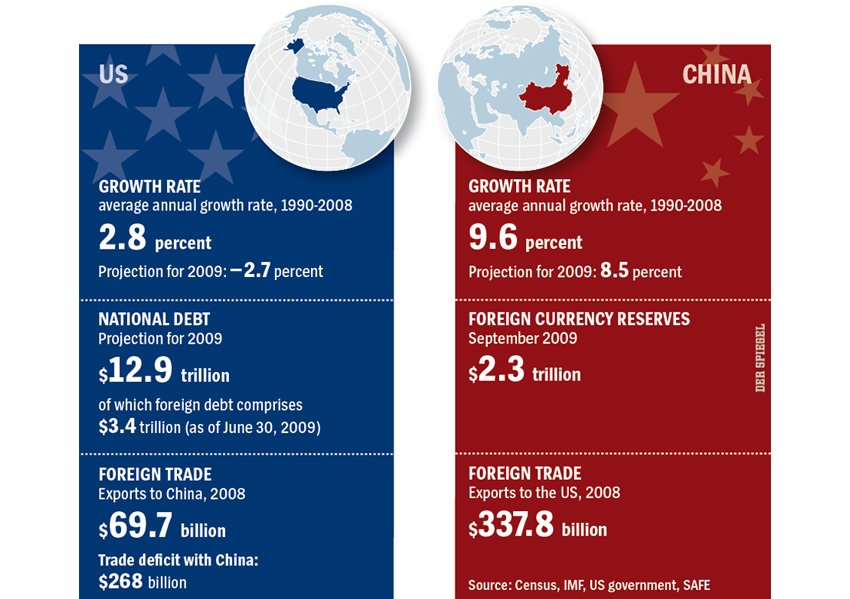
Chart – Key Economic Figures Comparison between China and USA

Click to Expand

China-USA-Economy-Compare

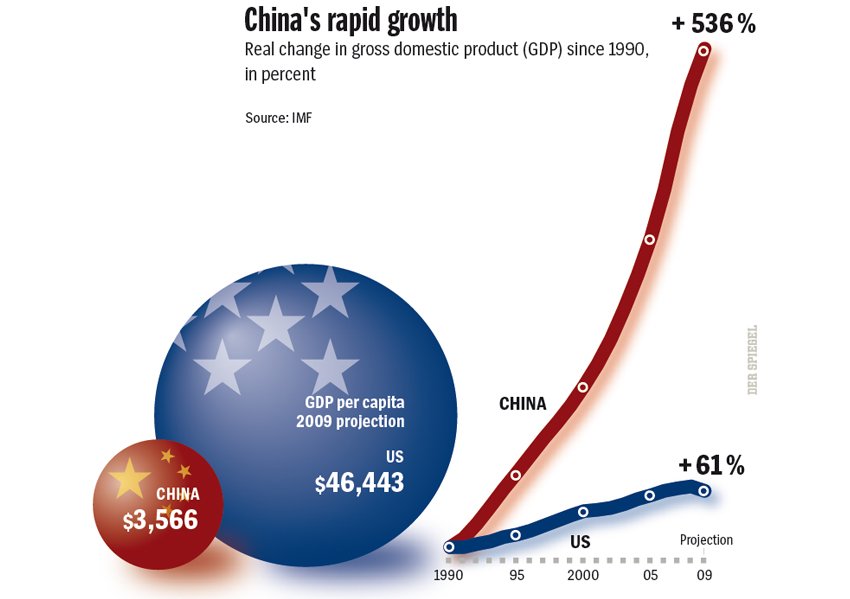
Chart – China and USA GDP Growth

China-USA-GDP-Growth

Source: Der Spiegel

While China’s economic growth since 1990 is astonishing, China has a long way to go before it can beat or overtake the US economy. Despite the strong growth the Chinese economy still is relatively small compared to the US economy. So in that sense it may be premature to call China as the rising superpower.

Emerging markets in Asia, Africa, etc. may not be able consume as much of the Chinese goods as the US did simple because consumers in those markets do not have the purchasing power as Americans do. For example, it would be wrong to assume that many Asians such as Indonesians, Indians, Vietnamese, etc. would spend as frivolously as Americans did in buying Chinese products. So the answer to my title question is that is too early to tell whether China will be able to successfully replace USA with new markets in Asia, Africa and the Middle East as its main exports destination.

Components of the AEX High Dividend Index

The AEX High Dividend Index (AEXHD) consists of 12 Dutch stocks with the highest dividend yields. The selection of stocks is based on the past calendar year dividends. The eligibility criteria is that all these stocks must be part of the AEX Index, the main blue chip index of the Dutch stock market.

The weighting is based on the dividend yield and is capped at 15%. This inception date of this index was 3/4/2008. Last year the index was down 46%.

In backtesting the index performed as follows:
2003 = 2.06%
2004 = 8.91%
2005 = 31.94%
2006 = 18.83%
2007 = 5.30%

The Components of the AEX High Dividend Index are:

1. Aegon (AEG)
Current Dividend Yield = No regular dividends paid

2. Air France – KLM (OTC: AFLYY)
Current Dividend Yield = 5.19%

3. BAM Groep KON
4. Corio
5. DSM KON

6. ING Groep (ING)
Current Dividend Yield = No regular dividends paid
7. KPN KON
8. Randstad

9. Royal Dutch Shell A (RDS.A)
Current Dividend Yield = 5.40%

10. TNT (OTC: TNTTY)
Current Dividend Yield = 1.76%

1. Unibail – Rodamco
12. Wereldhave

Many of the above stocks do not trade in the US markets. Some of them have suspended or reduced dividends due to the global economic downturn and government bailouts last year.