Top 15 Global Bank Stocks Ranked by Price-to-Book Value

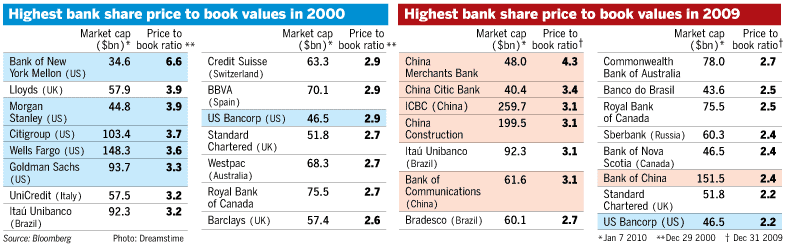
Emerging market banks occupy the top positions in a ranking of the world’s most valuable financial institutions based on their stock price to book values as of Dec 31,2009 according to a recent article in The Financial Times.

Click to Enlarge
top-Banks-2010

Chinese banks took the first four spots easily beating western banks which were highly valued back in 2000.

From the article:

China Merchants Bank, China Citic, ICBC and China Construction Bank lead the table, followed by Itaú Unibanco of Brazil, all with a price-to-book multiple of more than three.

Over the past six years, the average price-to-book value of the biggest 50 banks has halved from two to one.

This means that investors believe the average bank is worth no more than the value of its balance sheet. Most western banks are trading at well below their book value.

But investors are attaching a growing premium to emerging markets banks, led by China Merchants, the most highly rated of the biggest 50 banks by market capitalisation, on a multiple of 4.3, according to Bloomberg data.

At the start of the last decade, the US dominated the rankings. The top five were Bank of New York Mellon , Lloyds of the UK, Morgan Stanley, Citigroup and Wells Fargo.

Only last year US Bancorp topped the table and Wells Fargo was in the top 10. ”

Canadian banks Bank of Novo Scotia (BNS) and Royal Bank of Canada(RY) have climbed in this price-to-book ranking. Australian bank Commonwealth Bank of Australia(OTC: CMWAY) is ranked number eight in this list. Similar to Chinese banks, Brazilian banks Banco Do Brasil(OTC: BDORY), Itau Unibanco(ITUB) and Banco Bradesco(BBD) also rebounded sharply after the credit crisis since their exposure to sub-prime loans were negligible.

Four Construction and Materials Sector ADRs

The table below lists four ADR stocks from the construction and materials industry:

[TABLE=288]

Cemex of Mexico is engaged in the production of and marketing of cement.Empresas ICA operates in the construction sector as well as maintenance and operation of highways and tunnels in Mexico. Ireland-based CRH is another building materials production and distribution company.James Hardie Industries of Australia is a manufacturer of fiber cement products and markets them in United States, Australia, New Zealand, and the Philippines.

A Review of Luxottica and Wacoal

Luxottica Group (LUX) and Wacoal (WACLY) operate in the personal goods sector.

1. Luxottica Group(LUX):

Milan, Italy-based Luxottica is the maker of prescription frames and sunglasses. From the corporate site:

“With net sales of euro €5.2 billion, 61,000 employees and a solid global presence, Luxottica leads the world in premium, luxury and sports eyewear.”

Retail sales acocunt for 60% and wholesale for 40%. Net sales in North America amounts to 59% with the rest in parts of the world.Some of the brands owned and licensed by the company include Ray-Ban, the world’s best known sun brand, Oakley, Vogue, Persol, Oliver Peoples, Arnette and REVO, Bvlgari, Burberry, Chanel, Dolce & Gabbana, Donna Karan, Polo Ralph Lauren, Prada, Salvatore Ferragamo, Tiffany and Versace. In North America the company owns over 900 LensCrafters stores.

In third quarter 2009, the net income was $118.9M from a revenue of $1.75B.

 2. Wacoal Holdings (WACLY):

Japanese company Wacoal Holdings through its “subsidiaries and affiliated companies, is engaged in the manufacture, wholesale and direct sales to consumers (for some products) of intimate apparel (mainly women’s foundation garments, lingerie, nightwear and children’s underwear), outerwear, sportswear, and other textile products and accessories.”

Six ADRs with the Largest Market Cap Gains in 2009

Last month I wrote an article titled Five Companies with the Largest Market Cap Gains in this Decade. Three of the companies in that list were BHP Billiton, Vale and Petrobras.

In the Year-End Review of Markets & Finance, The Wall Street Journal listed the biggest gainers in market value in 2009. Only stocks which had a market value of at least $5B at the start of the year were considered in this ranking.

The six ADRs with the largest market cap gains in 2009 were:

1. Petrobras (PBR)
Change in Market Cap = $114.92B

2. BHP Billiton(BHP, BBL)
Change in Market Cap = $85.65B

3. Rio Tinto (RTP)
Change in Market Cap = $84.40B

4. Vale(VALE)
Change in Market Cap = $84.34B

5. HSBC Holdings (HBC)
Change in Market Cap = $83.07B

6. Banco Santander (SAN)
Change in Market Cap = $61.85B

As noted above, BHP Billiton, Vale and Petrobras appeared in the top market cap gainers in the last decade also. Out of the 10 market cap gainers in 2009, six were foreign companies.

Are Canadian Energy Stocks a Good Buy Now?

Crude oil futures closed at $82.75 per barrel on the New York Mercantile Exchange last Friday. Energy prices have been rising in recent weeks due to the perception that global economy is in recovery mode and that the demand from China and other emerging markets is picking up.

It must noted that despite the rise in gas prices at the pump in the U.S., demand is still flat to down as people are driving less. Just last week the labor department reported that 15.3 million Americans are unemployed. Unemployment is expected to remain high thru the rest of this year. While it is true that China surpassed U.S. last year as the world’s largest market for cars, it is still arguable if the rise in crude oil prices is really due to the demand for crude oil led by China. Last year 10.3 million passenger cars were sold in China due to various government incentive programs that benefited car buyers.

Given the context above, is it a good time to invest in Canadian energy companies?

Canada is one of the most important sources for US energy imports. In fact, most of Canada’s electricity, oil and natural gas exports go the U.S. and Canada is also consistently the top supplier of oil to the US. Close proximity to the U.S. and a stable political system are two distinct advantages that Canada has over other crude oil suppliers to the US. The EIA projected that Canada may produce 3.48 million bbl/d this year in the Short-Term Energy Outlook report published in July, 2009.

From the EIA site:
“Large oil producers in the country include Imperial Oil, EnCana, Talisman Energy, Suncor, EOG Resources, Husky Energy, and Apache Canada. In 2009, Suncor and Petro-Canada announced that they would merge, creating the largest oil producer in the country, as well as one of the largest producers of natural gas.”

Some of the Canadian energy companies are Encana(ECA), Suncor Energy(SU), Canadian Natural Resources Ltd(CNQ), Imperial Oil Ltd (IMO), Talisman Energy Inc(TLM) and Nexen Inc(NXY). Enbridge(ENB) and TransCanada(TRP) are major pipeline operators. Imperial Oil is the subsidiary of the U.S. oil giant ExxonMobil.

In summary, since over 99% of oil Canadian exports go the U.S., it is obvious that Canadian oil export growth is closely tied to the health of the US economy. As most economists have projected a jobless recovery this year, investors can wait for a better opportunity to get into Canadian energy stocks.