Canadian Banks’ Equity Third Worst in the World

An interesting article by Peter Boone and Simon Johnson of The Baseline Scenario blog discussed about the effects of regulatory constraints on Canadian banks.

From The Canadian Banking Fallacy article:

“Despite supposedly tougher regulation and similar leverage limits on paper, Canadian banks were actually significantly more leveraged – and therefore more risky – than well-run American commercial banks.  For example JP Morgan was 13 times leveraged at the end of 2008, and Wells Fargo was 11 times leveraged.  Canada’s five largest banks averaged 19 times leveraged, with the largest bank, Royal Bank of Canada, 23 times leveraged.   It is a similar story for tier one capital (with a higher number being safer):  JP Morgan had 10.9% percent at end 2008 while Royal Bank of Canada had just 9% percent.  JP Morgan and other US banks also typically had more tangible common equity – another measure of the buffer against losses – than did Canadian Banks. ”

A January report from McKinsey Global Institute shows that, based on assets to equity ratio Canadian banks are not in great shape. In fact, globally they are the third worst after Switzerland and Japan.

Banks-Leverage-Comapre-Countries

Before the financial crisis, Canadian banks ranked 4th in terms of leverage ratio.

Banks-Leverage-Before-Crisis

Source:  Debt and Deleveraging: The global credit bubble and its economic consequences, McKinsey Global Institute

The five Canadian banks trading in the US markets are Royal Bank of Canada(RY), Toronto-Dominion Bank (TD), Bank of Montreal(BMO), Bank of Novo Scotia (BNS) and Canadian Imperial Bank of Commerce (CM).


Knowledge is Power: Roubini, China Edition

10 Signs of Speculative Mania in China

If China melts down ….
It’s the country with the world’s largest foreign exchange reserves, built out of a gigantic and
dynamic export machine. Yet, in recent weeks, it’s being called …

nouriel_roubini.jpgNouriel Roubini Interview:

‘US-China trade war can shake up markets’

From the interview:

“You’re quite bearish about the prospects of advanced economies in the second half of this year…

Yes, in my view, the growth is going to look better in the US and also in the advanced economies in the first half because of a number of temporary factors. The fiscal stimulus, restocking of inventories, base effects in the US, the government temporarily hiring a million workers to do essentials — something they do every 10 years — a series of tax policies that sold the man the future like the cash for clunkers on cars and tax credit for house buyers and so on. Those are all effects that are going to fizzle out by the second half of the year. And I see the weakness of the US household sector keeping the consumption growth weak over time, given that income growth is anaemic and wealth income is low compared to the past. And that implies, private demand is not going to recover fast enough when the policy effects phase out. Then you could have growth falling back towards 1.5-2%. That is well below a potential 3%.  ”

Chinese demand for gold could double by 2020

China won’t repeat Japan asset bubble crash – BOJ

50 Blue Chips of the Euro Zone

The Dow Jones EURO STOXX 50 Index covers the 50 leading blue-chip stocks in the Euro Zone.

The SPDR DJ EURO STOXX 50 ETF(FEZ) tracks the performance of the above index. The fund has an asset base of $155M and the dividend yield is 3.33%. French and German equities account for about 63% of the holdings. One-third of the portfolio is allocated to financials.

The Components of the DJ Euro Stoxx ETF are listed below:

[TABLE=424]

Which is Better for Investment: Chile or Brazil ?

Chile and Brazil are two of the hottest destinations for foreign investors in Latin America. Though Chile has had tremendous economic growth over the last 20 years, Brazil beats Chile in terms of attracting foreign capital. Chile’s economy growth has slowed in recent years.

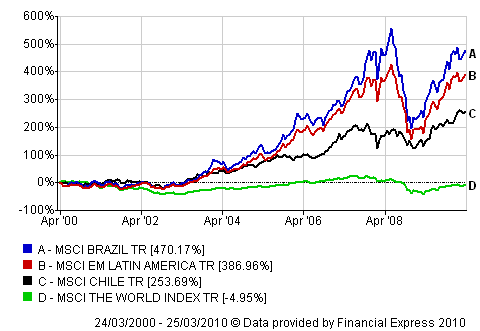
The chart below shows the performance of Chile Vs. Brazil over the last 10 years:

Chile-Brazil-Compare-10-Years

Source: Trustnet

In the last 10 years, the MSCI Brazil index has grown by 470% while the MSCI Chile index has increased by only 270%. Both the countries performed very well when compared to the MSCI World index which fell by about 5% during the same period.

Despite the strong performance of the Brazilian market, some investors prefer Chile over Brazil. In 2008, during the global financial crisis the MSCI Brazil index crashed over 60% whereas the MSCI Chile index fell only 20%. In addition, the annualized volatility rates for the past 10 years for Chile and Brazil are 16.3% and 25.4% respectively.

However it must be noted that unlike Brazil, Chile is heavily dependent on commodity exports particularly copper. The Brazilian economy is much more diversified compared to the Chilean economy. With a larger population and rising income levels among the middle class, Brazil offers a wide range of opportunities for investors. But since a huge amount of foreign investment dollars is flowing into the country, Brazil is prone to higher volatility. Overall as emerging economies both Brazil and Chile have strong potential for growth but they must be evaluated based on the economic factors unique to each of them.

The iShares MSCI Brazil ETF (EWZ) offers exposure to the Brazilian market. The fund has an asset base of $10.4B and 76 holdings in the portfolio. Investors can access Chilean equities via the iShares MSCI Chile Investable Market ETF (ECH) . This ETF has an asset base of $365.0M and 32 holdings in the portfolio.The difference in net assets between the two ETFs is huge since more investors choose Brazil over Chile.