One Effect of U.S. Trade with China: 2.4 Million Jobs Lost

The U.S. unemployment rate held steady at 9.7% in March. The number of unemployed persons remained little unchanged at 15.0 million.

Last month employers added 162,000 jobs but 48,000 of them were temporary workers hired for the 2010 census. In the manufacturing  sector, 2.1 million jobs have been lost since December 2007. 17,000 jobs were created in this sector in March. Many of the manufacturing jobs lost over the past couple of decades may never return to the U.S. The free trade agreements signed by the U.S. over the years such as NAFTA and WTO policies have not only eliminated millions of jobs in the U.S. but also have helped drive down the wages for workers. In order to understand the loss of manufacturing jobs, we have to look at the impact of U.S. trade with China since China is the largest exporter of goods to this country.

A recent report titled “Unfair China Trade Costs Local Jobs” by By Robert E. Scott for the Alliance for American Manufacturing analyzes the impact on U.S. jobs due to rising trade with China. The following are some of the key takeaways from this paper:

  • Since the entry of China into the WTO in 2001, 2.4 million jobs have been lost in the U.S. between 2001 and 2008
  • The dramatic rise in trade with China has a created a growing trade deficit and is the primary reason for the loss of manufacturing capacity and jobs in the U.S.
  • 100 million workers have been affected by falling wages due to competition from low-wage countries like China and others
  • China accounted for over 40% of all non-oil imports into the U.S.
  • The hardest hit areas include the Silicon Valley in California proving that not only low-tech manufacturing jobs moved to China but also high-tech manufacturing jobs
  • One of the major reasons for U.S. trade deficit with China is China’s manipulation of its Yuan by pegging it to the dollar at a rate that undervalues the Yuan
  • The Chinese government policy encourages export while maintaining stiff trade barriers on imports and entry restrictions on many domestic industries such as banking, insurance, etc.

After China’s entry into the WTO in 2001, President Bill Clinton claimed that the agreement “creates a win-win result for both countries” (Clinton 2000, 9). He argued that exports to China “now support hundreds of thousands of American jobs” and that “these figures can grow substantially with the new access to the Chinese market the WTO agreement creates” (Clinton 2000, 10)”. However nine years later we now know that this was not the case. U.S. exports to China is lesser than imports from China. Hence the number of jobs created in the U.S. due to exports to China is always lower than the number of jobs lost or displaced due to imports from China. For example, “U.S. exports to China in 2001 supported 166,200 jobs, but U.S. imports displaced production that would have supported 1,188,200 jobs.” Thus overall from a jobs growth perspective, China benefited greatly from growing trade with U.S.

Knowledge is Power:Dividend Investing,Dividend Aristocrats & Achievers Edition

dollar-sign.jpgWhy dividends matter to investors: Seed

The ‘Four Percent Rule’ for Dividend Investing in Retirement

MoneySense magazine: Canada’s Top 100 Income Trusts and 100 Dividend Yielding Stocks

Dividend sustainability more important than high yield, argue equity income managers

Two great high-yield stocks that now look even better

Want Income? Catch These Dividends Now

Download in Excel: Mergent’s 2010 Dividend Achievers Lists

S&P Dividend Aristocrats:

S&P 500 Dividend Aristocrats

S&P High Yield Dividend Aristocrats

S&P/TSX Canadian Dividend Aristocrats

S&P Pan Asia Dividend Aristocrats

S&P Europe 350 Dividend Aristocrats

Emerging Vs. Developed Markets: Decoupling is Still Dead

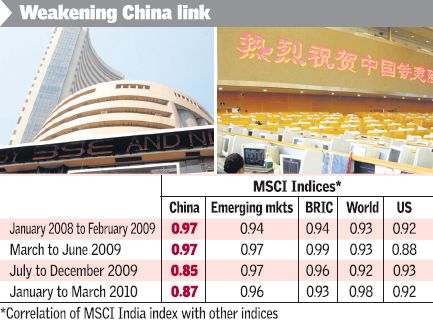
The theory that emerging, frontier markets are decoupled from developed markets in terms of performance is still dead. The chart below proves this point:


Souce: The Hindu Business Line

During the past couple of years investors worldwide learned that emerging markets and developed markets are not decoupled from each other. In fact, emerging markets went down more than markets in the developed world during the credit crisis. The notion that somehow emerging markets follow different dynamics and are not dependent on the U.S. economy was put to the test and it failed. This logic appears to be the case even now as the chart above shows.

Stocks in India re moving in lock step with global markets.In the past 3 months however they have started to decouple a bit from the performance of Chinese markets. India, BRIC and emerging markets are still closely related to the US markets based on the data for the first three months of this year.However Chinese equities are showing some variance from global markets primarily due to the Chinese government’s policies to cool down the over-heated economy and rein in liquidity.

Related ETFs:
MSCI Emerging Markets Index Fund
(EEM)
iShares MSCI EAFE Index(EFA)

Four Closed-End Funds for Current Income and Capital Growth

Closed-End funds can be used as one type of vehicle for earning current income and capital growth. Similar to ETFs, mutual funds, Closed-End funds can also be used to gain exposure to overseas markets which are difficult to access for foreign investors.

The following are some of the advantages of Closed-End funds:

  • Opportunity to buy at a discount
  • Efficient portfolio management
  • Ability to control market price and timing
  • Leverage potential
  • Lower expense ratios
  • Clear Commissions
  • No minimums

Source: Closed-End Fund Association 

Along with the usual risks associated with investment in equity markets such as market risk, inflation risk, political risk, etc. Closed-End funds can also be highly volatile during adverse market conditions due to their structure.

The following four Closed-End funds that offer potential for Income and Capital Appreciation:

1. ING Global Equity Dividend and Premium Opportunity Fund (IGD)
This fund pays dividend monthly and invests about 41% of portfolio in the US markets and the rest in foreign equities. The annual distribution yield is 11.79%.  Financials form about 20% of the portfolio. The fund also uses call and put options to manage risk and enhance returns. The net asset base is $1.1B and the fund is currently trading at a  premium of 8.35% to NAV.

2. ING International High Dividend Equity Income Fund(IID)
This CEF also pays dividend monthly. The current annual distribution yield is 10.76%. The fund invests in high-dividend-yield stocks or derivatives with 50% of portfolio in European securities, 40% in Asian Pacific equities and the rest in other equities. The net assets of the fund is $86M and the fund is now trading at a premium of 17%.

3.ING Asia Pacific High Dividend Equity Income Fund(IAE)
This fund invests in 75-100 high-yielding Asia-Pacific stocks. To enhance returns the fund also sells call options on select Asian-Pacific equities or indices. The fund has net assets assets of $208M and the annual distribution yield is 9.58%. In 2009, the fund’s market return was about 87%. Currently the fund is trading at a 4.58% premium. Australia, Hong Kong and South Korea have the highest weightings in the portfolio. Dividends are paid quarterly.

4. ING Global Advantage & Premium Opportunity Fund(IGA)
This CEF has an asset base of $242 M and the annual distribution yield is 10.42%. This fund invests 60% of portfolio in US equities and the remaining in foreign equities. The fund also uses call options to enhance returns. Because this fund is heavily concentrated in the US markets, the fund’s market return in 2009 was 41%. Dividends are paid quarterly.

Review: Singapore and Hong Kong Bank ADRs

Asian banks emerged strong from the credit crisis and are now growing again. Most Asian banks follow conservative policies and have low NPAs. In addition, they tend to concentrate on traditional banking services as opposed to investment banking and trading securities.

Two banks each from Singapore and Hong Kong trading on the OTC markets in the US are listed below:

1.Hang Seng Bank Ltd (OTC:HSNGY)
Hong Kong
Current Dividend Yield: 6.99%

2.Bank of East Asia (OTC: BKEAY)
Hong Kong
Current Dividend Yield: 3.39%

3. United Overseas Bank Ltd (OTC: UOVEY)
Singapore
Current Dividend Yield: 1.96%

4. DBS Bank Ltd (OTC: DBSDY)
Singapore
Current Dividend Yield: 3.84%

Besides having a presence in many international markets, Bank of East Asia operates 70 outlets in China. During the credit crisis, there was a scare that this bank may fail. But that did not materialize and the bank survived. Hang Seng is one of the large banks in Hong Kong with a rich history. Unike many developed countries, Singapore did not have to inject capital into any banks during the crisis and Singaporean banks are some of the strongest financial institutions in the world.United Overseas Bank and DBS are two of the large banks in Singapore. Both are well-capitalized and have operations in many of the emerging markets in Asia. For example, the Tier 1 ratio of DBS Bank is a healthy 13.1%. Investors hunting for growth and yield in Asian bank stocks, may consider the above mentioned four banks.