Euro crisis ‘spells end of the welfare state’
Crisis Hits Greek Tourism as Cancellations Soar
String of Suicides Continues at Electronics Supplier in China
Why Europe’s banks could be the next flash point for markets
Asia: Lessons in crisis recovery
The Shanghai Composite index is down over 21% as of last Friday and continues to fall further. An article titled “Chinese Savers Turn to Their Stockbrokers” in the latest edition of Bloomberg BusinessWeek suggests that equities are now preferred over savings and real estate.
From the article:
“Ordinary Chinese investors are looking to stocks for a lift. If they’re not careful, they may get the opposite.
Although the Shanghai Stock Exchange Composite Index is down more than 21 percent this year, Pan Weiting sees no better place to put her money. The 27-year-old Shanghai accountant recently shelved plans to buy an apartment after real estate prices reached record highs. The 2.25 percent interest she earns on the 400,000 yuan ($59,000) she has in her bank account is being nibbled away by rising inflation, which hit 2.8 percent in April.
If Pan were an American, she might switch to international stocks, gold, or municipal bonds. China’s financial regulations, however, limit her investment choices to property or domestic equities. It’s no contest. “The stock market is the best choice for the moment,” says Pan. “Even the bank staff advised me against depositing more money.”
Millions of other Chinese, who on average save half their income, share Pan’s dilemma. Property prices are often out of their reach. If they do buy real estate, they risk seeing their investment wiped out should the government’s recent curbs on mortgage loans finally chill the market. Inflation is forecast to climb 3.4 percent this year, according to the median estimate of 18 economists surveyed by Bloomberg on May 11. That will put more pressure on low-yielding savings accounts. “It becomes a question of who’s the least ugly girl at the fair,” says Victoria Mio, a Hong Kong-based senior fund manager at Robeco, whose firm manages $194 billion worldwide. “There is migration [to stocks] occurring, and the shift will accelerate with a few months of negative interest rates.”” (emphasis added)
Chinese households have very low debt levels.The household debt as a percentage of GDP is about 10% .In general, Chinese households save over 25% of their disposable income.Savings by businesses and households push the gross domestic savings as a percentage of GDP to exceed 50%.The combined personal and corporate savings in China equals $7.2 Trillion.
Some of the reasons mentioned in the article for anticipated the flow of funds into equities include:
Despite all the reasons mentioned above, I believe Chinese savers are not going to rush into equities. Many global issues such as the European debt crisis, the chances of the global economy going into a double-dip recession, the Korean issue, etc. may affect the Chinese economy leading to accelerated decline in share prices. In addition, culturally the majority of the Chinese are very conservative and prefer property investments and savings to stocks.
The 10 most profitable publicly-listed Indian companies that appear in the Forbes Global 2000 list for 2010 are listed below:
[TABLE=504]
Except IT outsourcing firm Infosys Technologies (INFY), none of the other companies trade on the US markets. The most profitable company in India is the state-owned Oil & Natural Gas Corp. which made$3.86B last year. State Bank of India, India’s largest bank is also state-owned and was ranked at number three. It must be noted that Indian banks such as State Bank of India and ICICI Bank(IBN) have a long way to go before they can become global players. For example, though banks in India operate in different dynamics than their western counterparts, profits earned by Indian banks are low compared to international banks. For example, State Bank of India’s profit of $2.13B for the full year pales in comparison to Bank of America’s profit of $4.2B just in the first quarter of 2009.
ETFs to invest in India:
iShares S&P India Index Fund (INDY)
PowerShares India Portfolio (PIN)
WisdomTree India Earnings Fund (EPI)
The four largest “Too Big To Fail(TBTF)” U.S. banks Bank of America (BAC), JPMorgan Chase(JPM), Citigroup (C) and Wells Fargo(WFC) continue to remain as the largest banks in the country. These TBTF banks are also known as the superbanks.
From a November, 2009 article titled Too-Big-To-Fail and the Theory of Large Numbers by Henry C.K. Liu:
“JP Morgan Chase is reportedly holding more than $1 of every $10 on deposit in the US. The four biggest super banks (JP Morgan Chase, Bank of America, Wells Fargo and Citibank) now issue one of every two mortgages and about two of every three credit cards in the
Sheila C. Bair, chairman of the Federal Deposit Insurance Corp, described the TBTF problem as: “It fed the crisis, and it has gotten worse because of the crisis.”
The
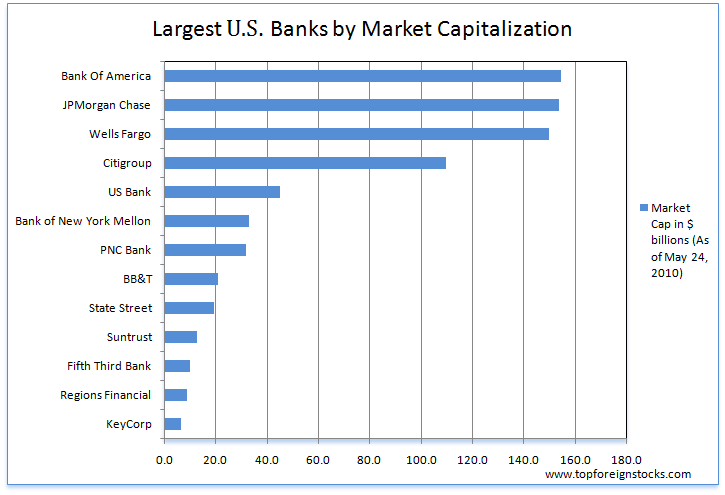
The chart below shows the 13 Largest 13 U.S. Banks by Market Capitalization:
Click to Enlarge
The largest four also hold the largest bank deposits. The market cap of US bank (USB) is less than half of Citigroup, the fourth largest bank. The market cap of Bank of America is higher than all the non superbanks except U.S. Bank.
U.S. stocks generally have lower dividend yields than foreign stocks. For example, the current yield of the S&P 500 is 2.14%. Compared to this many foreign markets have much higher yields. In 2009, U.S. stocks paid 1.93%. Among the large 20 countries by market capitalization only Russia, India and Korea had lower yields than the US. Australian stocks on the other hand paid 3.73%. Despite taking into consideration factors such as foreign taxes, currency exchange fluctuations, etc. one can earn higher yields going overseas.
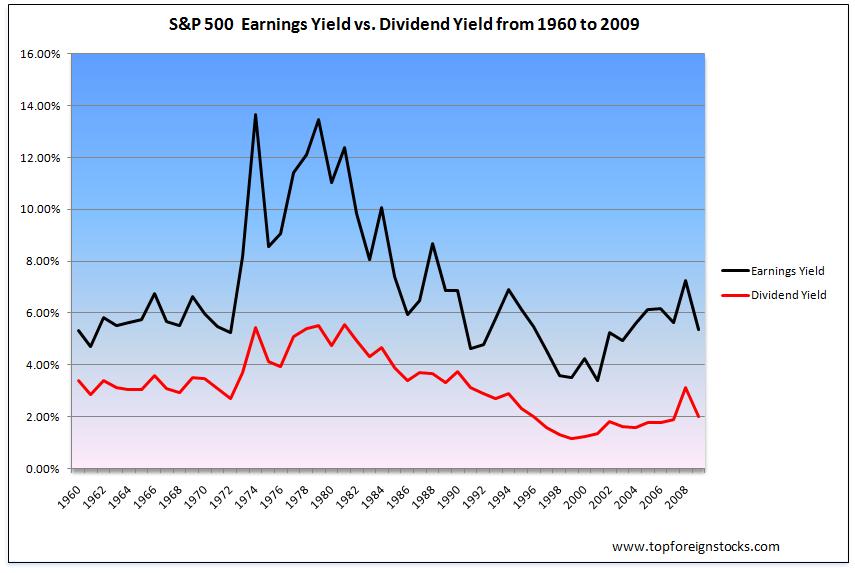
Historically the last time the dividend yield of the S&P 500 exceeded 3% was in 1991. Since 1991,the dividend yield of the S&P 500 remained under 2% with the lowest yield of 1.14% reached during the dot com bubble in 1999. The 2008 yield was 3.11% due to fall in share prices and not due to increase in dividend payments.Last year the yield was 2%.
The following chart shows the historical comparison of the Earnings Yield and Dividend Yield of the S&P 500 Index:
Click to Enlarge
For U.S. investors looking for high yields, foreign stocks that trade on the U.S. markets offer great opportunities to earn dividends in excess of 2%. I ran the stock screener to identify large cap foreign stocks having market caps of over $10BÂ and dividend yields of over 5%. Thirty two stocks that met the condition are listed below:
[TABLE=503]
Note: Data shown is known to be accurate from sources used. Please do your own research before making any investment decisions.
Canadian companies included in this list are Sun Life Financial Inc(SLF), Telus Corporation (TU) and BCE Inc(BCE).