The Different Phases of a Bubble

I came across this interesting graph that shows the different phases of a bubble:

Asset-Bubble-Chart

Source Video: http://www.youtube.com/user/ancientsong#p/u/18/PHo1bqIp71E

On a related note, Bloomberg BusinessWeek published an article on the real estate bubble in Vancouver, Canada.

Click to Enlarge

Vancouver-Bubble-Homes

From the article:

“The Olympics are over, and the Village is for sale. The complex in Vancouver, British Columbia, that housed the athletes during the 2010 Winter Olympics has been converted into 1,100 luxury condos. About 450 have been pre-sold, and the sales of the remainder may well render a verdict on a mystery that looms over this city like Grouse Mountain: Did Canada prudently steer its way clear of the worst of the financial crisis only to be rewarded with a massive housing bubble of its own?

On a bright, warm Saturday in late June, couples and families wandered through the empty village, which has been renamed Millenium Water. It opened for public tours last month and draws about 100 people a day. Millenium Water is a city of the future, built with enviro-touches like green roofs and automatic shades that moderate the temperature inside the apartments. An 815-square-foot, one-bedroom apartment is on sale for C$879,000, which works out to C$1,078 per square foot, or $12 higher than the average price in Manhattan, according to The Corcoran Report. (A Canadian dollar is currently worth about U.S. 96 cents.)

Millenium Water isn’t in downtown Manhattan, of course. It’s not even in downtown Vancouver, which is across an inlet known as False Creek. It isn’t really even in a neighborhood; the nearest establishment is the sales office for another condo development. If all this is starting to sound a little irrationally exuberant, especially given the shaky international outlook, well, that’s Vancouver for you.”

The Vancouver real estate market is currently in the Mania Phase. It is not just Vancouver where prices have reached the bubble stage. Across Canada home prices have soared and continue to defy gravity. It remains to be seen how long the mania phase can last in Canada.

Brazil’s Export Product Groups and Destinations

Some investors have the misconception that Brazil is a commodity-based economy. However this is not true. Though natural resources form a major portion of the economy, the manufacturing sector is growing rapidly.

The chart below shows the different types of products that are exported from the country:

Click to Enlarge

brazil-exports.PNG

Manufactured goods such as planes, cars, vehicle components, etc. accounted for about 45% of all exports for the 12 months thru March this year. Primary products which include minerals, food products such as coffee, soy, meat, etc. amounted to about 42% of exports. Semi-manufactured products include raw sugar cane, wood chemical moisture, etc.

Brazil has also increased its exports to China, Asia (excl. Middle East and China), other countries and has reduced its exports to the U.S. and EU. Exports of Brazilian products to China has more than doubled when compared to 2006. As the economies of the EU and U.S. remain sluggish, Brazil’s increasing dependence on emerging markets for exports will benefit the country as there is potential for more growth in these markets.

braizil-export-products.PNG

Source:  Banco Central Do Brasil

Knowledge is Power: Double-dip, Eurozone, Safety Net Edition

The US housing horror story is about to get even worse

In graphics: Eurozone in crisis

Six dividend-stock myths

Nobel Economist Krugman Slams German Austerity

Double-dip recession unlikely, Europe worries overblown: Economist

Ten Signs There’s No Adult in This Economic Room: William Pesek 

High-Quality Stocks Poised for Gains

Carrigan: BP may be cheap, but investors should beware

‘Fig leaf’ reform bill let’s US banks off lightly

Falling through the safety net

rocky-mountains-Canada

Rocky Mountains, Canada

Top 10 Components of the S&P Global Agribusiness Index

The S&P Global Agribusiness Index is composed of 24 of the largest publicly-traded global agribusiness companies. The companies in this index include a diversified mix of Producers, Distributors & Processors and Equipment & Materials Suppliers in this sector.

The Top 10 Constituents of this index are:

1. Archer-Daniels-Midland Co (ADM )
Current Dividend Yield: 2.21%
USA

2. Potash Corp. (POT)
Current Dividend Yield:  0.41%
Canada

3. Wilmar International(OTC: WILMY)
Current Dividend Yield:  1.63%
Singapore

4. Monsanto Co(MON)
Current Dividend Yield: 2.12%
USA

5. Associated British Foods (OTC: ASBFY)
Current Dividend Yield: 3.03%
U.K.

6. BRF – Brasil Foods SA (BRFS)
Current Dividend Yield: N/A
Brazil

7. Deere & Co(DE)
Current Dividend Yield: 1.99%
USA

8. Syngenta AG(SYT)
Current Dividend Yield: 2.27%
Switzerland

9. Mosaic Co(MOS)
Current Dividend Yield: 0.46%
USA

10. Bunge Ltd(BG)
Current Dividend Yield: 1.59%
USA

Lower Corporate Tax Payments Do Not Necessarily Benefit Shareholders

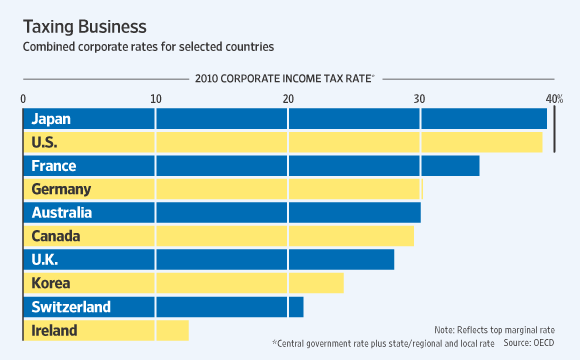
Japan’s corporate income tax rate of 40% is the highest among major developed countries according to the OECD. Surprisingly the U.S. has the next highest rate at 39%.

2010 Corporate Income Taxes of Select Countries:

Global-Corporate-Tax-Rates-Comparison

Source: Kan Seeks Cuts in Japan’s 40% Corporate Tax Rate, The Wall Street Journal

The corporate rates in the Asian countries of Singapore and South Korea is much lower than the U.S. at 17% and 24% respectively.

The journal articled noted that “different rules on depreciation and other areas make the total tax burden generally lighter in the U.S., experts say.”

Experts are correct in this case. Most major U.S. corporations do not pay the top marginal rate of 39% in income taxes to Uncle Sam. In fact a few of them pay no taxes. General Electric (GE) is the most interesting example of a U.S. company when it comes to avoiding taxes. GE generated $10.3 in pretax income in 2009, but paid no taxes to the US government. In fact, it recorded a tax benefit of $1.1B for last year.GE’s tax return is the largest the IRS deals with each year running at almost 24,000 pages if printed out.

From an article in Forbes magazine titled  “In Pictures: What The 25 Top U.S. Companies Pay In Taxes“, the top five tax paying companies were:

Wal-Mart – 2009 Tax Rate: 34.2%
Exxon Mobil – 2009 Tax Rate: 47.0%
Chevron – 2009 Tax Rate: 43.0%
Chevron – 2009 Tax Rate:  N/A
ConocoPhillips – 2009 Tax Rate: 51%

Some companies also evade taxes legally by establishing foreign subsidiaries and using a strategy called “Transfer Pricing”. Tax economist Martin Sullivan believes that companies are keeping some $28 billion a year out of the clutches of the U.S. Treasury using this method.

Another article in BusinessWeek last year discussed tax payments by U.S. companies. From the article:

“FPL Group (FPL), owner of Florida Power & Light, understands the value of alternative energy. By setting up everything from 1,500 acres of solar electric systems in California to wind farms across the U.S., the Juno Beach (Fla.) utility has avoided the need to build 12 new power plants. And those investments create another green benefit: tax breaks. Over the past four years, FPL has paid just $88 million in taxes on earnings of nearly $7 billion. FPL spokeswoman Jackie Anderson says the company is merely taking advantage of incentives to develop renewable resources.”

What do U.S. companies do with excess cash ?

They simply hoard them at least in the current economy. According to a report in The Wall Street Journal earlier this month, U.S. “nonfinancial companies had socked away $1.84 trillion in cash and other liquid assets as of the end of March, up 26% from a year earlier and the largest-ever increase in records going back to 1952. Cash made up about 7% of all company assets, including factories and financial investments, the highest level since 1963.”

Companies also do not pay the excess cash as higher dividend payouts to shareholders. In fact the dividend yield of the S&P 500 Index, which includes the largest 500 American companies, is about 2%.

A research study by Credit Suisse showed that U.S. companies had high dividend payouts from 1871 to 1945. The focus of companies during this period was on the payout ratio. After 1945 companies started to focus on managing the amount of dividends paid and they were also slow to increase dividends when earnings increased, thus reducing the payout ratio. The dividend payout ratio declined from about 70% till 1945 to about 50% from 1946 thru 2005.

US-Historical-Dividend-Payout-Chart

Source: Credit Suisse, Quantitative Research -High Yield, Low Payout,  August 2006

Hence it can be argued that many American companies with huge cash-piles can raise dividends but they chose not to. Instead these companies hope to use the cash for future expansion either by investing in new equipments, factories, etc (or) grow by acquiring other companies. In the past few decades, management of companies have also paid themselves lavishly before paying or raising dividends to shareholders. Even during the global financial crisis, some financial firms that were bailed out by Uncle Sam paid their executives huge bonuses and compensation from profits before resuming suspended dividend payments to shareholders.