Study: Growth Stocks Don’t Grow

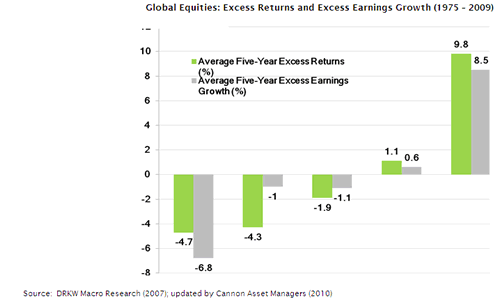
Growth stocks which have high price-earnings (P/E) ratios don’t grow their earnings faster the market, according to a new research study by Cannon Asset Managers. The study was based on 10,000 global stocks over a 35 year period. The study analyzed two aspects of investment results namely the relationship between price-earnings ratios and investment returns; and the relationship between investment returns and earnings growth.

During the dot-com bubble times of the 1990s, investors bid up hi-tech stocks in the expectation that they will grow faster than the market. However that did not happen. Instead investors lost out big when the hi-tech bubble popped and tech stocks crashed wiping out billions in wealth.

Growth-Value-Stocks-Return

The results of study contradict conventional wisdom on growth and value stocks. The two  the main takeaways from this study:

  • Growth stocks with high P/E ratios under-perform the market
  • Growth stocks have earnings growth that are slower than the market but unloved value stocks deliver faster-than-market earnings growth

In the above chart, the left most Quintile 1 represents the basket of stocks with the highest P/E ratio while the right most Quintile 5 represents the stocks with the lowest P/E ratios. The green bar shows the average annual investment return, measured over five years, relative to the global equity market. Hence the expensive growth stocks in the Quintile 1 underperformed the market by an average of 4.7% per year. Similarly modestly expensive stocks underperformed by 4.3% per year. On the other hand, deep-value stocks in the Quintile 5 outperformed the market by an average of 9.8% per annum.

The grey bar measures the earnings growth relative to the market for each Quintile over five years. Value stocks have higher than the market average five year earnings than growth stocks.

Value shares outperform because of stronger-than-market earnings growth and growth shares under-perform because of poorer-than-market earnings growth.

This study conclusively proves that investors will be richly rewarded with value stocks as opposed to growth stocks. That does not mean investors ought to avoid all growth stocks. Some of them experience phenomenal growth and deliver awesome returns to investors. However such stocks are very few among the large pool of growth stocks and most investors fail to identify these winners.

Some examples of growth stocks are: Chinese internet search provider Baidu (BIDU) with a P/E of 97, online travel company Priceline (PCLN) with a P/E of 21,  internet search giant Google (GOOG) with a P/E of about 20.

Service Sector Can Help Asia Achieve Higher Growth

Unlike Western economies, most of the Asian economies are overly dependent on manufacturing for growth. As the demand for cheap products declines in the West,  Asian countries can reduce their dependency on exports and instead grow their service sectors to boost growth according to an article by Olaf Unteroberdoerster in the latest edition of IMF’s Finance and Development(F&D) magazine.

Chart:

Asia-Economy-Service-Industry-Split

Industry’s contribution to China’s GDP is about 50%. This is much higher than the average for OECD countries and about 10% higher than the figure for low and middle-income countries. As the chart above shows, other countries such as Malaysia, Indonesia, Japan, Korea, etc. are also heavily reliant on industry. Similar to China, the industrial  sector contribution to the GDP of these economies are also high by 5 to 10 percentage points of peer countries.

From the article:

“Given Asia’s dependence on exports, it is no surprise that services’ share in GDP is generally low by international standards. For example, in 2008 China’s service sector GDP share was nearly 13 percentage points below the low- and middle-income
country average. The same holds true even for Singapore, which as a financial center is a service-based economy. Employment patterns—the distribution of the labor force across agriculture, industry, and the service sector—confirm Asian economies’ overexposure to industry and underexposure to services.

The dominance of industry has been an important factor in Asian economies’ strong growth performance and rapid rise in living standards. Rapid industrialization allowed hundreds of millions of workers to move out of low-paying jobs, particularly in agriculture, where Asian productivity levels have remained very low (see Chart 2). But future growth will depend on the service sector. As Asian economies, starting with Japan and Korea, move into a postindustrial world, the service sector must create jobs and catch up with productivity levels in advanced economies. Until now, productivity growth in Asia’s service sector has stagnated compared with that of the United States in recent years.”

The author notes that the service sector is a major component of India’s economy and has been leading India’s GDP growth for the past two decades. India’s service sector productivity is much higher than other countries due to the following reasons:

  • Advances in communications technology, which gave India’s ample supply of trained, English-speaking workers access to growing domestic and global markets
  • Successful deregulation of services
  • Privatization
  • Foreign direct investment
  • Financial sector reforms

Converting an economy from manufacturing-based to service sector-led will be a tough challenge to Asian countries. Malaysia tried to grow its service sector especially in the IT field but was unsuccessful. Malaysia then focused on manufacturing on the mass production electronic goods and components, the traditional industries of palm oil and rubber plantations. However it was an easy process to accomplish in the West especially in the U.S. when factories were moved overseas to low-cost locations and American workers ended up taking employment in the service sector.

Public debt in 2020: Emerging Vs. Developed Markets

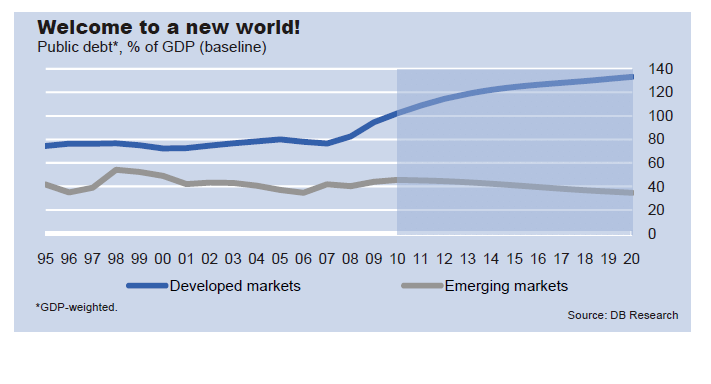
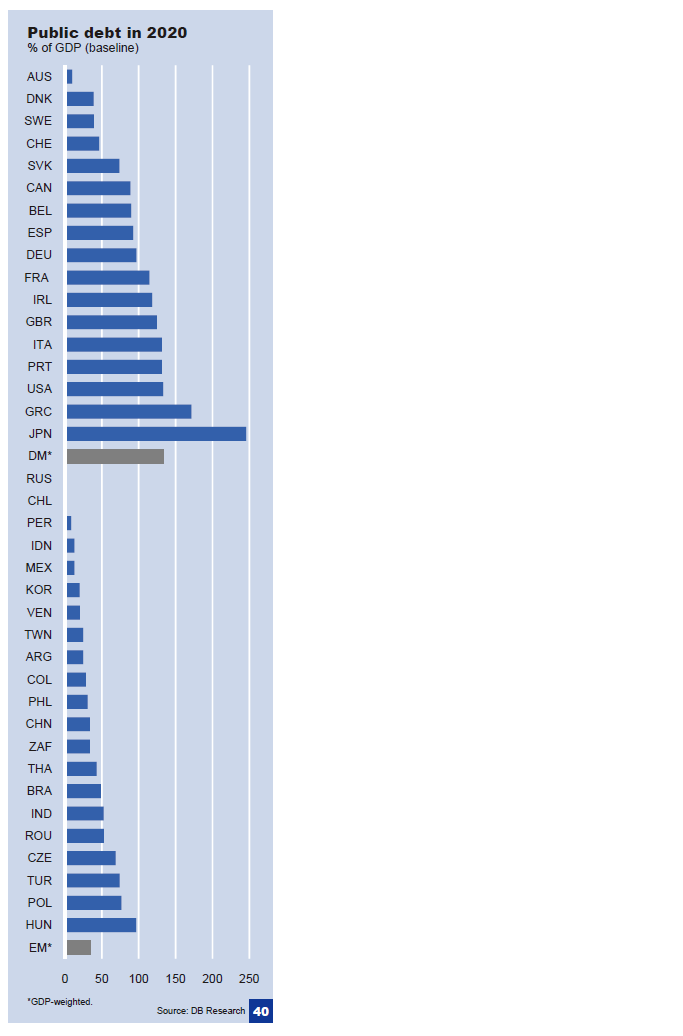
In a study titled “Public debt in 2020”, Deutsche Bank  analyzed public debt sustainability in both developed and emerging markets using data for 21 emerging markets(EMs) and 17 developed markets(DMs). The results show that the public-debt-to-GDP ratio is projected to soar from just over 100% this year to 133% in developed markets.

Charts:

Public-Debt-GDP

publid-bet-bar.png

The authors of this report conclude:

“Although there is a strong need for medium-term fiscal consolidation in many DMs and a few EMs, one should not forget that expansionary policies mitigated the adverse effects of the global crisis and very likely prevented a collapse of the global financial system and the world economy. At the moment, it appears that a fiscal exit can take place only gradually. Our 2020 scenarios as well as our debt target analysis highlight that public debt has become, or is at least at the risk of becoming, unsustainable in many DMs but only in a few EMs. At least in theory, most EMs could afford to run looser fiscal policies, for instance by extending counter-cyclical fiscal policies in order to smooth the fall-out from the global crisis. Moreover, moderate initial debt levels put them in a relatively
comfortable position to stabilise or even outgrow their debt-to-GDP ratios.”

Nestle Tops Global Dairy Top 20 Rankings

Switzerland-based food and nutrition company Nestle SA(OTC: NSRGY) is the world’s top dairy company based on sales. In the “Global Dairy Top-20” list published by the Dutch financial services provider Rabobank Group, European and US players dominate the top 10 ranks.

Global Dairy Top-20

[TABLE=518]

Source: Rabobank

From the research report:

“Changing diets and strength in numbers are key to understanding the growth of demand in the Asian markets, according to Mark Voorbergen of Rabobank’s Food & Agribusiness Research and Advisory. “The Chinese government is helping create a whole new generation of dairy consumers by promoting a school milk programme. So Chinese dairy companies will have ample opportunity to increase sales simply by keeping up with domestic market growth.”

Supply and demand
Putting consumption into perspective, Mark contrasts the 300 litres of dairy products consumed per person per year in the Netherlands with the current 20 litres per person per year in China. “We expect the Chinese market to grow along the same lines as Japan or South Korea, from zero levels five years ago to a maximum of 50 litres per person per year.”

But volume growth is only happening in developing regions like China, South East Asia and selected markets in the Middle East, Africa and Latin America. For the developed markets of Europe, the USA and New Zealand, the main growth challenge is to introduce new characteristics – often related to health and convenience – to standard dairy products that the consumer is willing to pay for.”

It is interesting to note that emerging markets are represented by just two companies from China. As the report notes above, focusing on health benefits of dairy products is a major selling point in developed countries. For example, French company Danone(OTC: DANOY) is the world’s leading producer of fresh dairy products accounting for about 28% of the world market share. Growth of Danone’s products is mainly driven by innovation and the marketing of dairy products emphasizing the health benefits to consumers. The success of Activia brand of yogurts in the U.S. and other developed markets is a proof of this strategy.