How to Profit from China’s Growing Retail Industry?

One of the fastest growing sectors in the emerging markets of Asia and Latin America is the retail sector. Consumers spending is increasing due to rising income levels. According to HSBC estimates, consumer spending in developing countries is expected to grow by about 6% this year and next compared to just 1.4% in developed countries. Hence companies that are well positioned to take advantage of this consumer-driven growth are sure to perform well.

The U.S. restaurant chain Yum Brands (YUM), which owns KFC, Pizza Hut and Taco Bell, reported strong earnings today due to growth in international markets especially China. Same-store sales grew 6% in China compared to just 1% in the U.S. and international division. “We continue to make progress at all three divisions and are especially pleased with the continued strong results from our China business,” Chief Executive David Novak said in the earnings report. “The combination of high-return, new-unit development, same-store-sales growth and increasing margins drove operating profit growth of 23% in China for the quarter.” Last year China accounted for 34% of Yum’s total revenue. To further raise its market share, the company opened 90 restaurants across the country last quarter.

In the retail industry, three western companies are well established in China and appear in the ranking of the top retailers.

The Top 10 Retail Companies in China 2010:

[TABLE=582]

Source: Euromonitor International and Retail Asia

The three international companies in the above are list are Wal-Mart (WMT) of U.S. and Auchan and Carrefour(CRERY) of France. Wal-Mart’s total sales in 2009 reached $7.5B from 279 outlets. In 2008, the company had 240 stores and sales totaled $6.1B. Wal-Mart first entered China in 1996. From Wal-Mart China website: “Walmart China firmly believes in local sourcing. We have established partnerships with nearly 20,000 suppliers in China. Over 95% of the merchandise in our stores in China is sourced locally.”

Carrefour’s total sales last year was $5.3B from its 156 stores in China. Carrefour is the world’s second-largest retailer and the largest in Europe. The group currently operates over 15,000 stores worldwide in four main grocery store formats: hypermarkets, supermarkets, hard discount and convenience stores. For the first six months of this year, sales rose 5.9% to EUR 43.7 billion boosted by strong growth in new markets like China and resilience in the home territory of France. Carrefour’s ADR (CRERY) closed at $10.88, just shy of the 52-week high.

Auchan(China) is part of the Auchan Groupe SA, another global French retail group. The company is private and operates 114 hypermarkets in China under the Auchan and RT Mart brands.

Carrefour and Wal-Mart offer a convenient way to gain exposure to the growing Chinese retail sector. The common equities of Chinese domestic retailers Gome Electrical Appliances Holding(GMELY), China Resources Enterprise (CRHKY) and Belle International Holdings (BELLY) trade on the OTC markets and have daily low trading volumes. China’s top retailer, Gome had sales of over $10B last year.
The 10 Largest ETFs by Asset Size

The three largest ETF providers in the U.S. are Blackrock Inc’s iShares, State Street Corp’s State Street Global Advisors and Vanguard Group. These three companies account for 85% of the total ETF assets.

Hundreds of ETFs are now listed on the market. For example, iShares alone offers 215 ETFs which hold over $368B in assets. Not all of the ETFs attract sizable assets. Some of the ETFs that failed to attract investors’ interest have been closed by providers. In 2008, sponsors closed 50 ETFs and last year they closed another 51 funds. Despite the availability of many ETFs, new ETFs continue to hit the market. Among the new ETFs launched this year,the ETFS Physical Platinum Shares(PPLT)  has already collected $491 million in assets as of September 27th.

The 10 Largest ETFs ranked by Asset Size are listed below:

[TABLE=581]

Source: The Wall Street Journal

Two emerging market ETFs in the top five confirm the attraction of emerging markets to investors. The streetTRACKS Gold ETF (GLD) takes the number two spot as the flight to safety into gold continues.

Historical Perspective on the Relationship between Stock Yields and Bond Yields

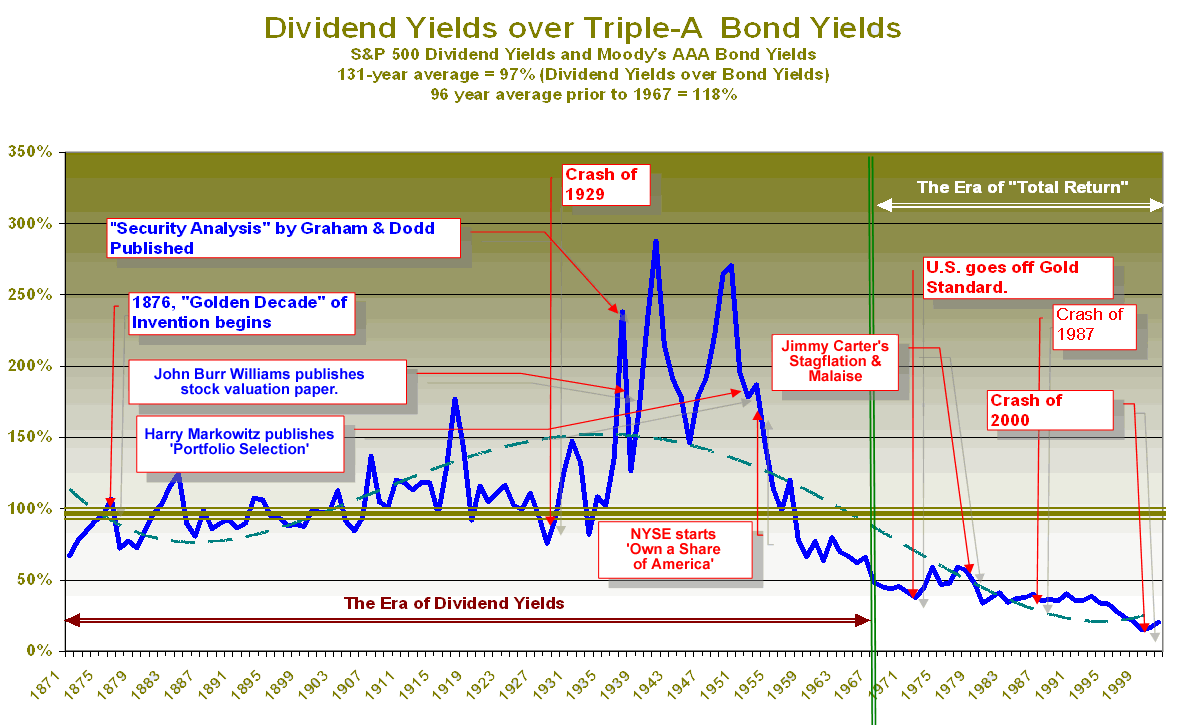
Last month fellow blogger and financial advisor Roger Nusbaum wrote an excellent article on stock yields vs. bond yields. While doing research on stock and bond yields, I came across the following chart which shows the relationship between equity and bond yields over 131 years:

Click to Enlarge

Source: Capital Flow Analysis

“Until the 1970s, stock yields averaged between ten and twenty percent higher than the yields of investment grade bonds.

By the end of the century, dividend yields were eighty percent below bond yields – a historic low.”

In 1956 when stock yield equaled bond yield for the last time, famed value investor Benjamin Graham closed his investment management business and retired to teach at UCLA. By 1968, the era of dividends was over.

American firms have long paid high dividends and investors bought stocks for income more than price appreciation. The average annual cash returns on a portfolio of stocks owned by John Perkins Cushing, a Boston capitalist from 1836 to 1851 when there were no income taxes were:

Bank Stocks:  6.6%
Manufacturing Stocks: 8.1%
Railroad and Canal Stocks: 8.5%
Insurance Stocks: 12.1%

Source: Casebook in American Business History’,N.S.B. Gras and Henrietta M. Larson, F.S. Crofts & Co. 1939, New York

Four hundred years ago The East India Company, the world’s first multinational company, paid its investors dividends ranging from 95% to 234% after its first nine voyages.

New Brazilian ADR: WEG

On September 28, 2010 the ADRs for WEG S.A., a Brazilian industrial equipments maker, started trading on the OTC market with the ticker WEGZY.

The ADR program is a sponsored Level 1 program offering international investors access to this highly successful Brazilian multinational. WEG was founded in in 1961, in Jaraguá do Sul, the state of Santa Catarina, Brazil by German immigrants Werner Ricardo Voigt, Eggon João da Silva and Geraldo Werninghaus. They named the company WEG formed by the first letters of their names. WEG in German means “way”.

“As Latin America’s largest electric motor manufacturer and one of the world’s largest, WEG specializes in branches such as command and protection, speed variation, industrial process automation, power generation and distribution and industrial paints and varnishes.

Production is concentrated in 8 production sites located in Brazil (Guaramirim, Blumenau, São Bernardo, Manaus, Gravataí, Hortolândia and two in Jaraguá do Sul, the company’s headquarters), three in Argentina, two in Mexico, one in China and in Portugal.

The company is listed on the BM&F; Bovespa São Paulo stock exchange (stock exchange symbol WEGE3). In 2009, the Group employed a workforce of more than 21,000 people worldwide; gross revenues totaled R$ 5.1 Billion (US$ 2.6 Billion).”

Ten Reasons to Invest in Emerging Markets

Emerging markets have been growing at an incredible pace in the past few years. Some of these markets have performed well this year also compared to the US. For example, the year-to-date returns of Brazil, India and Mexico are 4.3%, 17.1 % and 5.3% respectively. Despite the strong growth in recent years, emerging markets continue to exhibit potential for further growth. Hence investors might want to diversify their portfolios with some exposure to emerging market equities.

Some of the reasons to invest in emerging markets are discussed below:

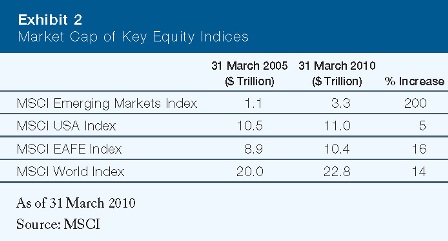
1. The market cap of the MSCI Emerging Market Index has grown 200% in the last 5 years beating all other broad indices as shown in the graphic below:

Source: Lazard via Trustnet

Currently emerging markets trade at 11 times forward earnings compared to 12.5 times for the MSCI World.

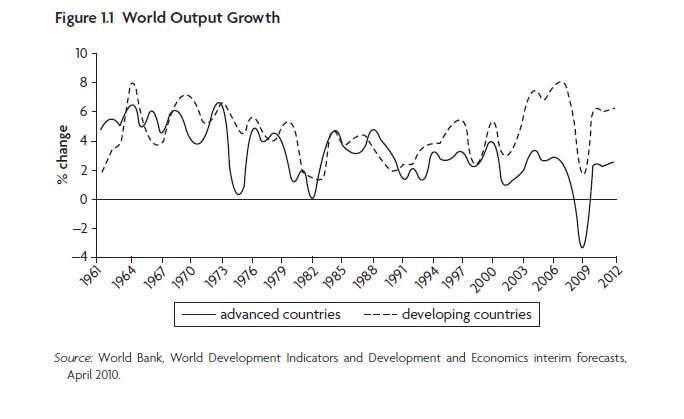
2. Almost half of the global GDP growth comes from developing countries.

3. According to The World Bank estimates, developing countries are projected to grow by 6.1% in 2010, 5.9% in 2011, and 6.1% in 2012, while the corresponding figures for the developed countries are just 2.3%, 2.4% and 2.6%.

4. Developed countries are facing a much stronger headwind compared to emerging countries.Recessions due to a combination of credit crunch, a housing bust, and an equity bust tend to be deeper and longer than usual. OECD data shows that just 4 out of 122 recessions in the post-war period have had all these three factors.Hence emerging countries are in better shape than developed economies since they suffered less from the effects of the credit crisis.

5. Public debt in the advanced G-20 economies is expected to reach 118% of GDP by 2014 whereas developing countries’ debt is projected to decline further.

6. Consumption spending by consumers in developed countries will be weak despite the balance-sheet de-leveraging by households due to the jobless recovery and collpased housing prices.

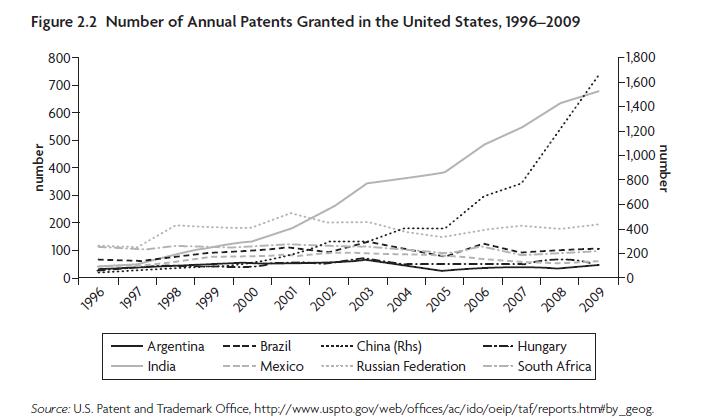
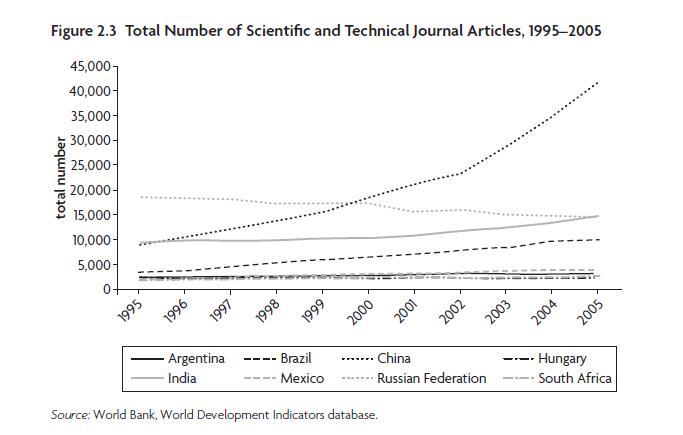
7. Among emerging countries, some countries such as Brazil, China, India are showing an increase in measures of innovation such as number of patents granted and scientific and technical journals published.

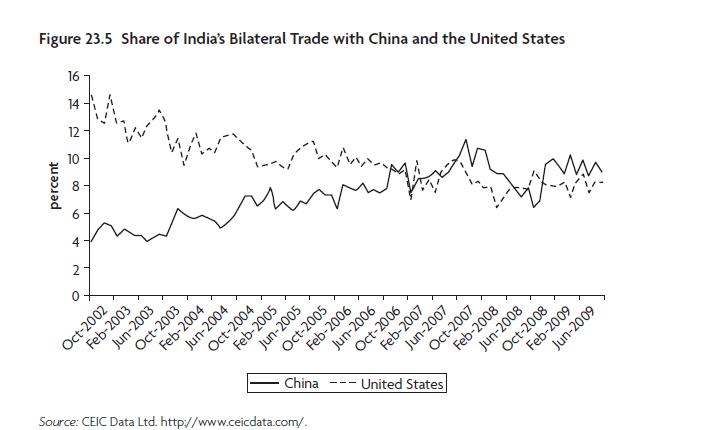
8. Trade among developing countries is increasing significantly. Trade among the developing countries now accounts for about 39% of their total trade. For example, bilateral trade between India and China has been increasing since 2008 and has exceeded the bilateral trade between India and the United States. Furthermore, trade between India and China remained constant during the credit crisis, while trade between India and the United States declined as the chart shows below:


9. As developing countries move up the value chain, they are less dependent on primary commodity exports than before.For example the share of commodity exports has fallen from 50% in 1990s to 40% during 2005-2007.

10. Factors such as infrastructure spending, urbanization, healthcare investments, etc. will lead to higher economic growth in emerging markets relative to developed markets.

Source: The Day After Tomorrow – A Handbook on the Future of Economic Policy in the Developing World by Otaviano Canuto and Marcelo Giugale, The World Bank

Related ETFs:
iShares MSCI Emerging Markets Index Fund (EEM)
SPDR S&P Emerging Markets ETF (GMM)
Vanguard Emerging Markets ETF (VWO)

Many other emerging market ETFs based on a variety of strategies are available for investors.This ETF list can be accessed at the Seeking Alpha site here.