America’s Growing Debt is Worse Than Europe’s Debt Levels

When the global financial crisis began much of the world’s attention was directed towards the U.S. since the country was the main source of triggering the worldwide crisis in financial markets. However recently Europe has been attracting the focus of investors worldwide due to the Euro debt crisis. First it was the tiny economy of Iceland whose banking system collapsed. Then it was followed by Greece, the sick man of Europe, which was bailed out as well. Now Ireland has become the latest European country to be rescued by the EU and IMF.

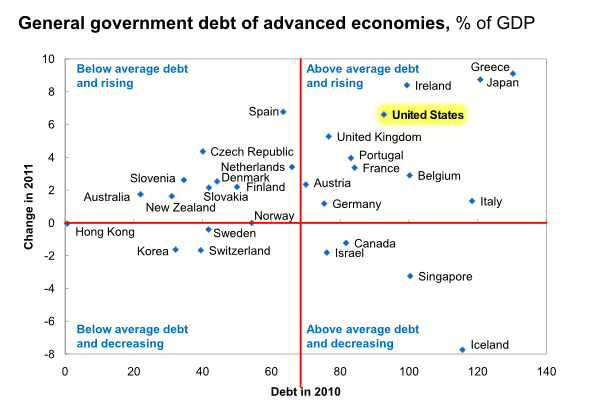
Despite the high government debt levels in Europe, investors should be more worried about the U.S. debt which stands at $13.8 Trillion and is set to rise further according to IMF graphs shown below. About $9.2 Trillion of this debt is held by the public and the rest is intragovernmental holdings. China is the largest foreign holder of U.S. debt. As of September 2010, China holds $883.0 billion of U.S. Treasury securities.

Click to enlarge

1)
1-em-dev-debt-growth.gif

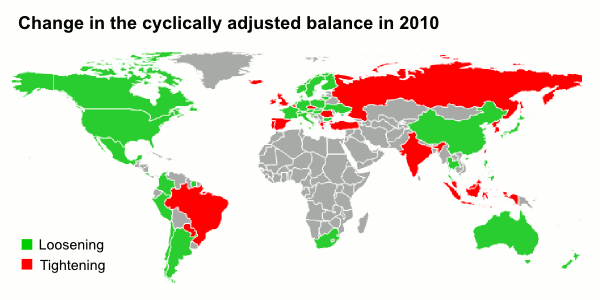
This year many emerging markets tightened their economic stimulus programs. But in the U.S. more funds is being spent with the Fed’s QE2 and on welfare programs.

2)
2-hi-low-debt-country.gif

U.S. debt is higher than Ireland and Greece and will continue to rise in 2011 when it will exceed 99% of GDP. A general rule is that debt over 90% of GDP will suppress growth.

3)
3-maturity-of-debt.gif

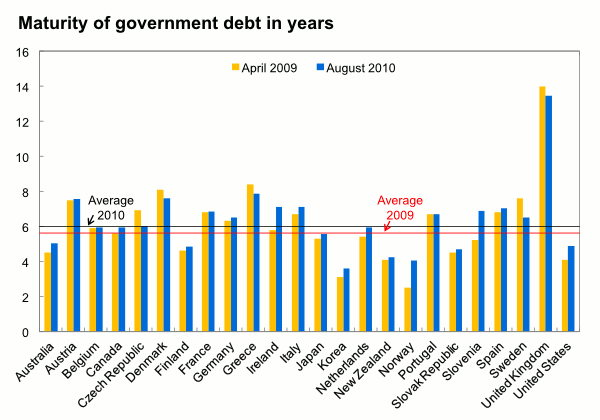
One of the factors noted by IMF that makes countries vulnerable is that how soon their debt becomes due. The chart above shows the average length of US debt is shorter than most European countries such as UK, Norway, Germany, etc.

4)
4-govt-debt-holding-by-residence.gif

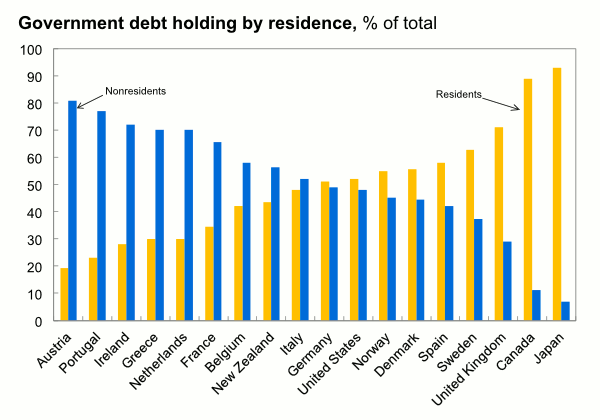
The blue and yellow bars indicate that about an equal number of Americans and foreigners (non-residents) have loaned money to the U.S. government. This makes the U.S. more vulnerable to crisis since it can be assumed that unlike domestic investors who will be patriotic, foreigners may demand their principal and interest at any time. If the Chinese pull their US investments it will have unimaginable consequences on the US economy. Some countries have low debt ownership by nonresidents. For example, foreign ownership of Canadian government debt is very small compared to the debt owned by Canadians.

5)
5-healthcare-spending.jpg

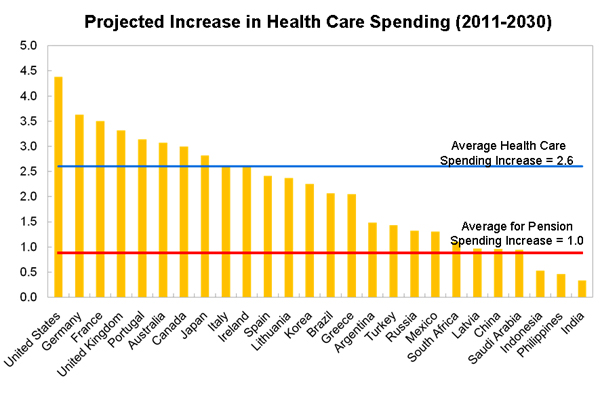
An ageing population means the US government spending on pension and healthcare is set to rise further from current levels.Until now no formal plans have been made on the funding sources for many of the expensive entitlement programs.

6)
6-impact-of-debt-on-growth.gif

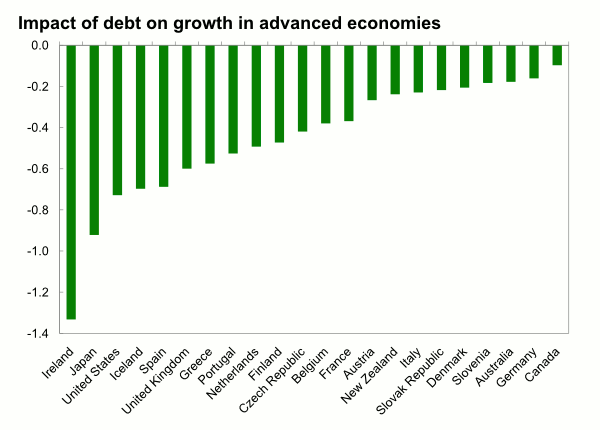
According to Carlo Cottarelli, director of the IMF’s fiscal affairs department, investors are unlike to get worried about America’s ability to repay its debt because of its long-standing credibility. But he mentioned that backing for such high levels of debt could have a negative impact on the long-term growth of the US economy.Currently the US has the AAA credit rating.

Source: via CityWire

One Disadvantage of Investing in the SPDR Gold Shares ETF

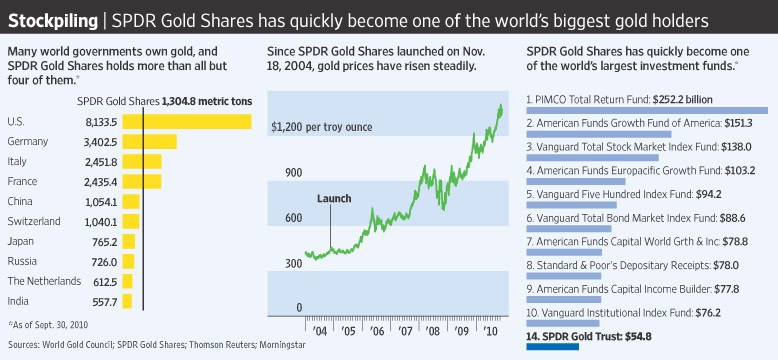
gold-bars.jpgIndividual small investors have traditionally avoided investing in commodities since they are extremely volatile. However in recent years Wall Street has made investing them pretty easy via ETFs and other products. Heavy marketing and the crash of equities in the past few years have only attracted more ordinary investors into this sector.One of the commodities that has gone up incredibly in the last few years is gold. From under $500 in 2004 the price of an ounce has gold soared to over $1,300 now. One of the ways investors are playing the gold run is with the SPDR Gold Shares ETF (GLD). The launch of this ETF made gold investing extremely easy for ordinary investors. While this fund continues to attract more funds, some worry that the fund has become too big and that any fall in gold prices may lead to a sharp fall of this ETF.

The following  are some key points about this gold ETF from an article in The Wall Street Journal:

  • Lauched in November 2004, the SPDR Gold Shares ETF (GLD) has grown into a $56.7 billion fund in a short span of time.
  • Currently this ETF is one of the world’s largest investment funds.

Click to enlarge

Gold-ETF-GLD-Growth

Source: Behind Gold’s New Glister: Miners’ Big Bet on a Fund, The Wall Street Journal

  • GLD is one of the fastest-growing fund ever and is one of the most active gold traders in the market.
  • The fund is buying about $30 million of gold daily for storage in its London vault.
  • GLD’s London vault holds about six months’ worth of the world’s entire gold-mining production.
  • As a result of buying of gold by this ETF and other gold ETFs some estimate that about $100-$150 has been added to the price of gold.
  • This gold-backed ETF holds more gold more than many countries as shown in the chart above.

Despite the tremendous growth of this ETF, ordinary investors may want to be cautious before investing in it at current levels. Speculators are driving the price of gold higher and higher since there is no way to determine the value of this commodity using metrics such as P/E. Despite talks of currency wars and the Fed printing paper money with almost no end in sight, the dollar will remain as currency of choice for the foreseeable future. There are many risks involved with investing in gold in general and especially investing them via ETFs. One of the major disadvantages of investing in the SPDR Gold Shares ETF (GLD) is the treatment of taxes. The I.R.S. levies a long-term capital gains rate of 28% on any gains realized. This rate is much higher than the long-term tax rates on equities which is now set at a maximum of 15%. The long-term capital gains tax rate is applicable to investments held for over one year. The 28% tax rate applies to the sale of arts and other collectibles as well.

From the ETF provider’s website:

“How is GLD treated from a tax standpoint?

The United States Internal Revenue Service (IRS) treats gold as a collectible for long-term capital gains tax purposes. As such, gains recognized by individuals from the sale of SPDR Gold Shares are subject to a capital gains rate of 28% if held for more than one year. This rule extends to all gold held by the Trust. Although there are some restrictions applicable to retirement plans such as IRAs and 401ks investing in collectibles, SPDR Gold Shares received a private letter ruling permitting investment by such retirement plans.”

Top 4 Industrial Gas Stocks To Consider

430.jpgOne of the sectors that is often overlooked by investors is the industrial gases sector. Industrial gases are a group of gases that are used in many industries such as metal, polymer, food, medical, oil refining industries. Like utilities and consumer staples, this sector can be considered as a stable and relatively safe industry to invest in during all market conditions.

Some of the industrial gases are Acetylene, Hydrogen, Oxygen, Nitrogen, Carbon dioxide and Argon. These gases can be transported in either compressed, liquid, or solid forms. Acetylene is used for cutting steel and for welding. Hydrogen is used in the edible fat and oil industries where it is used to hydrogenate vegetable oils to make margarine. Carbon dioxide is used to carbonate soft drinks, beers, etc. It is also used to remove caffeine from coffee beans to make decaffeinated coffee. Nitrogen is used for cooling many mechanical equipments that needs to be extremely cold in the food industry.In addition to the medical industry, Oxygen is used in the steel industry to remove impurities in the steel. Since Argon is highly unreactive it is used to protect very hot metal such as molten metal.

A comparison of the four major players in the industrial gases industry is shown below:

[TABLE=754]

1. Radnor,PA-based Airgas(ARG) is the largest distributor of industrial, medical, and specialty gases and hardgoods, such as welding equipment and supplies in the U.S. It is also one of the largest U.S. distributors of safety products, the largest U.S. producer of nitrous oxide and dry ice and a leading distributor of process chemicals, refrigerants and ammonia products. Over the years Airgas has built the largest national distribution network in the packaged gas industry with about 1,100 locations. As the economy recovered from the recession, Airgas saw strong performance in the second quarter. Second quarter sales came in at $1.06 billion and the company raised full-year EPS guidance to $3.22 to $3.32 from $3.15 to $3.30. Currently rival Air Products is involved in a hostile bid to acquire Airgas. The latest offer of $65.50 a share has been dismissed by Airgas a “grossly inadequate”. This week Airgas gained a small victory against Air Products when a court rejected Air Product’s attempt to force it to hold its next shareholder meeting early. Airgas investors have done very well in the long term. A $1,000 investment in 1986 when the company went public would be worth $61,209.19 with dividends reinvested for a return over 6,020%. Airgas’s stock closed at $61.52 today.

2. Air Products and Chemicals (APD) is also based in Pennsylvania. Air Products pioneered the concept of “on-site” producing and selling industrial gases, primarily oxygen which involved building oxygen producing facilities closer to large-volume customers and piping them directly to the point of use thereby reducing distribution costs significantly. Today the company operates in over 40 countries and had a fiscal 2010 sales of $9.0 billion. In the healthcare segment, Air Products is a market leader in Spain, Portugal, the United Kingdom and Mexico.

3. Founded in 1907, Danbury,CT-based Praxair (PX) has operations in more than 30 countries. In 2009 sales totaled  $9.0 billion. Praxair’s primary products are atmospheric gases such as oxygen, nitrogen, argon and rare gases & specialty gases such as carbon dioxide, helium, hydrogen, semiconductor process gases, and acetylene.The company’s name is derived from the Greek word “praxis”, or practical application, and “air”, its primary raw material. In 3Q, 2010, total sales were $2.5 billion, 11% above prior-year quarter. Sales in Asia and Latin America grew 24% and 16% from the prior-year quarter respectively. A $10K investment in PX on Jan 1, 2000 would have now grown to $36,615 for a return of 266% with dividends reinvested.

4. Air Liquide (AIQUY) is a Paris, France-based firm with operations in over 75 countries. Air Liquide is a member of the CAC 40 and the Euro STOXX 50 indices. Oxygen, nitrogen, hydrogen and rare gases are at the core of the company’s activities since its founding in 1902. In 2009, the company’s revenues amounted to €12 billion, of which almost 80% were earned outside of France.Q3, 2010 sales were €3.4 billion up 15% from the same quarter last year.

U.S. Corporate Profits Rising With No Job Growth

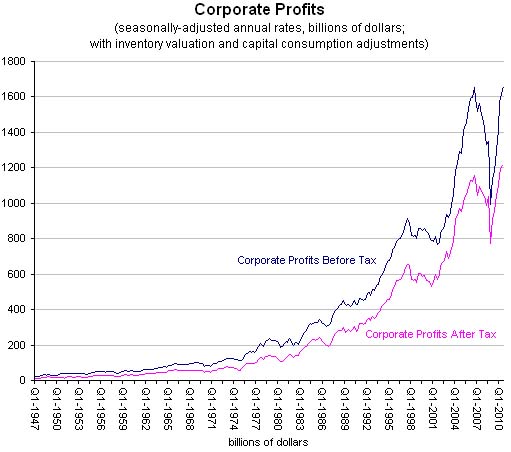
U.S. companies earned profits at an annual rate of $1.659 trillion in the third quarter, according to a Commerce Department report released Tuesday. In non-inflation adjusted terms, this is the highest figure since the government started keeping track over 60 years ago. Since the credit crisis ended, many businesses have resumed growing profits but not with creating more jobs.

The unemployment rate remained unchanged at 9.6% in October with 14.8 million persons unemployed according to official figures.

U.S. firms slashed 8.5 million jobs during the last recession. Millions of these workers still remain unemployed. However corporate profits are soaring to pre-crisis levels. This is because American businesses are able to increase profits by rising productivity, increasing exports, cutting costs and in some cases raising prices. Productivity simply means extracting more or the same amount of work using fewer number of numbers.Globally U.S. companies are leaders in productivity due to the corporate culture prevalent in the U.S. and the fierce competition in many industries. Hence in the current situation they are wringing out more profits with fewer workers. This concept was illustrated in a recent Bloomberg article:

“Campbell, the world’s largest soup maker, DuPont Co., the third-biggest U.S. chemical maker, and United Parcel Service Inc., the world’s largest package-delivery business, are asking workers to help save cash by working smarter with existing technology. A potential cost: Efficiency gains reduce the chances recession-casualty jobs will come back.

“When the productivity growth comes, then watch out because that is when companies start not needing so much labor,” Edmund Phelps, a Columbia University economist and Nobel laureate, said in an interview.

Some 142 non-financial companies in the S&P 500 had improvements in operating margins of three percentage points or more from the final three months of 2007, when the previous expansion peaked, compared with the most recent quarter, according to data compiled by Bloomberg as of yesterday.”

The chart below shows the annualized corporate profits, both before and after taxes since 1947:

Us-profit-growth-corp

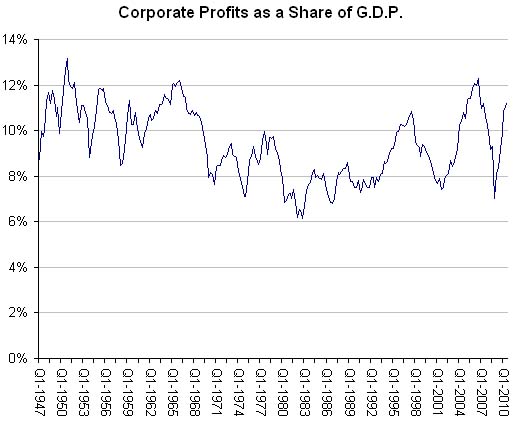
The chart below shows the corporate profit growth in terms of GDP:

Us-profit-corp-GDP

It represented 11.2% of G.D.P. last quarter, a figure that has also been growing for seven consecutive quarters. So for the past seven quarters companies have been earning higher profits with almost no hiring of workers since the unemployment remains stubbornly high at around 10%.

Source: The New York Times

The Economist magazine wrote about this dichotomy in the U.S. economy back in August in an article titled “Profits, but no jobs“. From the article:

“AMERICANS used to love to hear tales of success in business. One of the many oddities of the current joyless economic recovery is that this traditional enthusiasm is strikingly lacking. Corporate America has bounced back impressively. The quarterly results season that is now nearly over has revealed that profits are back within a whisker of the all-time highs achieved before the downturn in late 2008. By some calculations, the rate of recovery of profits from their trough is the strongest since the end of the Great Depression.

Yet nobody seems pleased. Not investors, who have failed to push up share prices in the way this sort of earnings growth would have caused them to do at this stage of previous economic cycles. Certainly not politicians, who complain that firms are “hoarding” cash and creating hardly any new jobs. As Robert Reich, an economist at Berkeley and former labour secretary under Bill Clinton, puts it: “Bottom line: higher corporate profits no longer lead to higher employment. We’re witnessing a great decoupling of company profits from jobs.”

Corporate America is reaping the rewards for tough actions taken after the financial markets collapsed in September 2008.” (emphasis added)

Yes indeed. There is a huge disconnect between rising corporate earnings and job growth. This recovery is not only a “jobless recovery” but also a “joyless recovery”. According to S&P, non-financial companies in the S&P 500 held over $1 Trillions in cash at the end of first quarter. Much of this cash is not getting paid out as higher dividends to investors or being spent on capital investments.

It remains to be unseen how longer this phenomenon of rising corporate profits with no increase in employment numbers can continue.

Some Facts About Ireland and The Largest 10 Companies

Ireland is relatively a little country with a population of about 4.5 million.Until the late 80s the country was a poor performer in terms of growth and prosperity. However Ireland was erroneously dubbed as a “Celtic Tiger” owing to the staggering economic growth achieved until 2007. This Celtic Tiger name was modeled after the “Asian Tigers” – the countries of Singapore, Taiwan, South Korea and Thailand that gained real exponential growth during the 1980s and 90s. However unlike the Asian Tigers, the Irish miracle was built on the boom in real estate market, financial services, low corporate taxes and a free flow of credit. In other words, Ireland did not turn into an economy built on solid foundations almost overnight like South Korea producing high quality products and exporting them. At its peak, Ireland was home to over 1,100 multinational companies that exported billions of dollars worth of goods and services. In fact, Ireland became the world’s largest exporter of software and produced a large portion of drugs for the European market.


dublin-castle.jpg

Dublin Castle, Ireland

Some interesting facts about Ireland:

  • Ireland’s GDP grew on an average 5% to 10% from 1995 to 2007.
  • The average Irish family owes an estimated 132,000 to the banks according to David McWilliams, a former Central Bank of Ireland economist.
  • Housing prices have fallen 36% since the 2006 peak.
  • Unemployment rate has jumped to 14% from a low of 4% during the boom years.
  • Ireland’s GDP soared from about $25 billion in the 1980s to $267 billion in 2008.
  • 33% of first-time home buyers in 2006 bought them with no money down.
  • As many as 29 Irishmen involved in real estate have committed suicide since the crash began.

Source: The Reckoning, Bloomberg BusinessWeek

The 10  Largest Irish companies based on market capitalization as of November 24, 2010 are:

1. CRH (CRH)
Market Cap: $8.70B
Sector: Construction – Raw Materials

2. Ryanair Holdings (RYAAY)
Market Cap: $4.86B
Sector: Airlines

3. Kerry Group
Market Cap: $3.81B
Sector:Food Processing

4.Dargson Oil
Market Cap: $2.27B
Sector: Oil & Gas – Integrated

5.Aryzta AG
Market Cap: $2.19B
Sector:Food Processing

6.Elan Corp
Market Cap: $2.0B
Sector: Biotechnology & Drugs

7. DCC Plc
Market Cap: $1.43B
Sector: Oil & Gas Operations

8.Bank of Ireland (IRE)
Market Cap: $1.37B
Sector: Banking

9. Smurfit Kappa Group Public Ltd
Market Cap: $1.37B
Sector: Containers & Packaging

10.Paddy Power PLC
Market Cap: $1.22 B
Sector: Casinos & Gaming