One of the key strategies for success with investing in equities is diversification. Following this strategy not only allows an investor reduce risk but also generate higher returns. Diversification can take many forms The easiest way to achieve diversification is to spread one’s investment across many times of asset classes.
The following chart shows the benefits of diversification from a Canadian perspective:
Click to enlarge
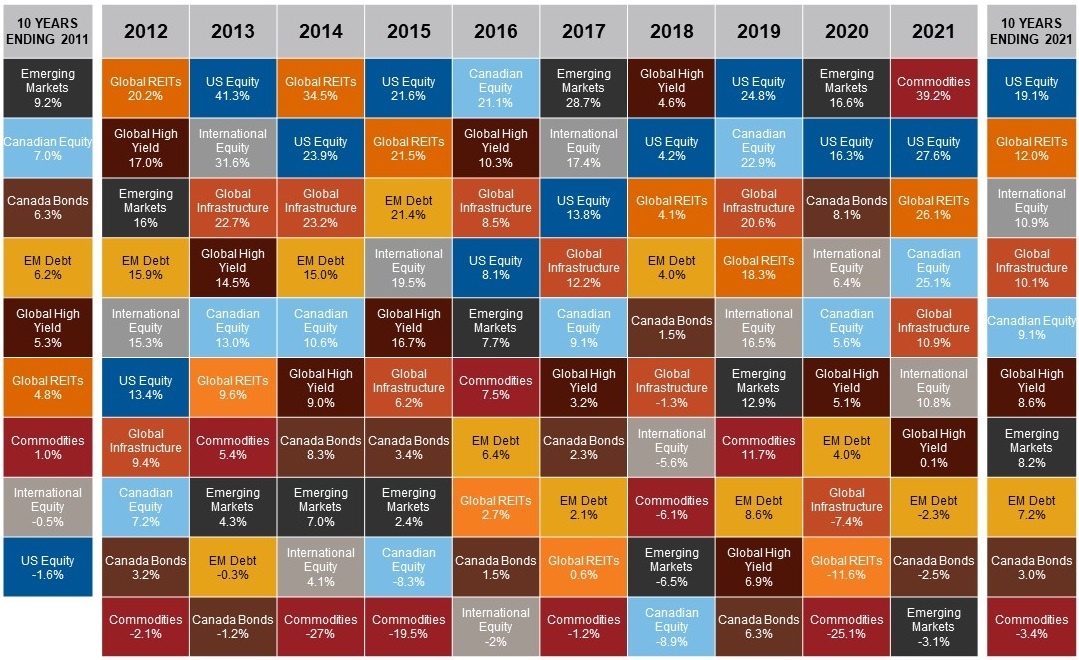
Source: Morningstar Direct, Russell Investments. Annualized return in CAD. Canadian equity=S&P/TSX Composite Index, US Equity=S&P 500 Index, International Equity=MSCI EAFE Index, Emerging Markets=MSCI Emerging Markets Index, Canada Bonds=S&P Canada Aggregate Bond Index, Emerging Markets Debt= JP Morgan Emerging Market Bond Index, Global High Yield=Bloomberg Global High Yield Index, Global Infrastructure=S&P Global Infrastructure Index, Global Real Estate Investment Trusts (REITs)=FTSE EPRA NAREIT Developed REITS Index, Commodities= S&P Goldman Sachs Commodities Index, Indexes are unmanaged and cannot be invested in directly. Past performance is not indicative of future results. Index performance does not include fees and expenses an investor would normally incur when investing in a mutual fund. Diversification and strategic asset allocation do not assure profit or protect against loss in declining markets.
Note: Returns shown above are in C$
Source: Going Global: Finding Opportunities in a World of Uncertainty, Russell Investments
A few observations:
Since 2021, Canadian stocks were the top among the asset classes shown only once in 2016.
Canadian equities have underperformed their American peers by a wide margin of 10% in the past 10 years ending in 2021.
Commodities have yielded average to mostly negative annual total returns in most the past decade.
Related ETFs:
iShares MSCI Canada Index Fund (EWC)
SPDR S&P 500 ETF Trust (SPY)
Disclosure: No positions