Six Foreign Stock Splits

Despite the volatility in equity markets for a few months now, some foreign companies are implementing stock splits to increase liquidity. The following are some of the foreign stocks that recently had stock splits:

1.Telefonica SA (TEF)
Sector: Telecom
Country: Spain
Split Ratio: 3:1
Split Date: 1/21/11
Current Dividend Yield: 7.17%
Current Stock Price: $25.10

2.Potash Corp Of Saskatchewan Inc (POT)
Sector: Non-Metallic Mining
Country: Canada
Split Ratio: 3:1
Split Date: 2/25/11
Current Dividend Yield: 0.49%
Current Stock Price: $57.23

3.Ultrapar Participacoes SA(UGP)
Sector: Oil & Gas Operations
Country: Brazil
Split Ratio: 4:1
Split Date: 2/25/11
Current Dividend Yield: 3.34%
Current Stock Price: $16.69

4.Technip SA (TKPPY)
Sector: Oil Well Services & Equipment
Country: France
Split Ratio: 4:1
Split Date: 3/22/11
Current Dividend Yield: 1.66%
Current Stock Price: $25.75

5.Cemex SAB De CV (CX)
Sector: Construction – Raw Materials
Country: Mexico
Split Ratio: 1.040:1
Split Date: 3/25/11
Current Dividend Yield: N/A
Current Stock Price: $8.81

Update:

7. Nedbank Group Ltd (NDBKY)
Sector: Banking
Country: South Africa
Split Ratio: 2:1
Split Date: 1/31/11
Current Dividend Yield: 3.74%
Current Stock Price: $19.93

8. CorpBanca (BCA)
Sector: Banking
Country: Chile
Split Ratio: 3.3333:1
Split Date: 2/23/11
Current Dividend Yield: 7.85%
Current Stock Price: $21.10

NedBank changed the ratio on the Depositary Receipt program from 1 Depositary Share  representing 2 Ordinary shares to 1 DS representing 1 Ordinary share. Hence all ADR holders received an additional DR share.

Canada-based oil services provider Enbridge Inc (ENB) has proposed a 2-for-1 split with a split date of 5/25/11.The current yield of ENB is 3.26% and the stock price is $60.89.

Disclosure: No Positions

Note: Stock price and dividend yield noted above are as of Mar 25, 2011.
A Look At China’s Dazzling Economic Growth

China has become the driver of global economic growth for many years now. As a communist country following a “Market Socialism” philosophy China continues to grow despite slowdown in developed economies and other emerging markets.

The following is brief overview of few of the statistics on China’s incredible growth. From a recent OECD report:

Ten years ago, on the eve of the 2001 slowdown, the world economy was expanding at a rate of close to 5% and China accounted for just over one tenth of that growth. Last year, as the world bounced back from the worst recession since the Great Depression, and growth was once again close to 5%, China contributed almost one third of global growth. In the meantime, it had become the world’s second-largest economy.

Ten years ago, China’s current account surplus stood at less than 2% of GDP, and its foreign exchange reserves at $166 billion, or 14% of GDP. Last year, China’s current account surplus exceeded 5% of GDP, down sharply from its 2007 double-digit peak, but still too high for comfort, while foreign exchange reserves towered at $2.85 trillion, or half of China’s GDP.

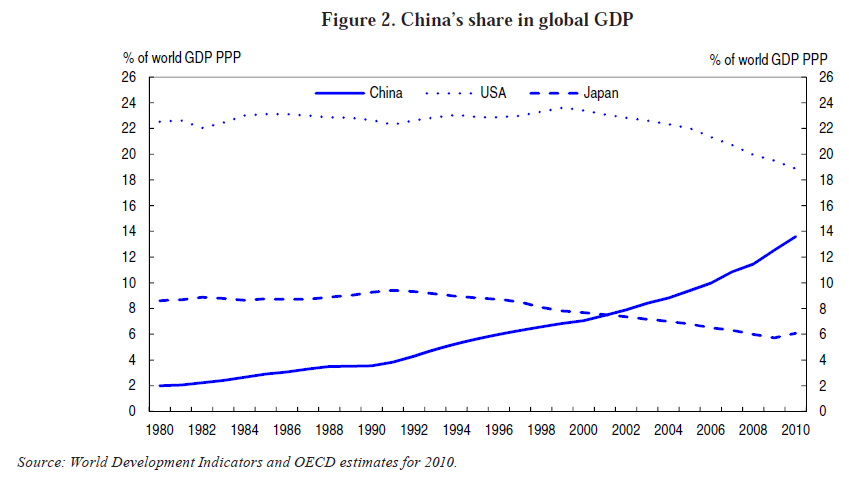
Two decades ago China accounted for less than 4% of global GDP at PPP exchange rates. Since then China’s sustained and rapid economic growth has pushed the share to 13% by 2010 as shown in the graph below. Meanwhile from 2000, the U.S. share of global GDP has decreased at a consistent pace.

china-share-of-global-gdp.png

China’s 12th Five Year Plan runs from 2011 to 2015. This plan outlines policies to changing the country from being the factor-floor of the world to more of a technology-based economic power. A an example of China’s successful transformation to a high-tech economy is the buildup of high-speed rail lines across the country.The stark contrast between this initiative and that of the situation in the U.S. couldn’t be more shocking.

From an article in Yale Environment 360:

China has committed to investing $360 billion to vastly expand its showcase network of high-speed trains, which already carry passengers at more than 200 miles per hour between some of the country’s largest cities.

Spain, despite its economic woes, is investing $170 billion to extend its acclaimed high-speed rail system, which now makes the 386-mile Madrid-Barcelona run in just 2 hours, 38 minutes — compared to six hours by car. A similar boom in high-speed rail construction is taking place throughout Europe, from the boot of Italy to the Baltic Sea.

Worldwide, nations not normally associated with the bullet train revolution — India, Brazil, Argentina, and Morocco, among others — are making plans to build high-speed rail networks. They understand that rapid, inter-city rail systems will be essential to developing competitive 21st-century economies as oil supplies dwindle, highways and airports face increasing congestion, and pressure to reduce carbon emissions rises.

And the United States? For the past several months the news on the high-speed rail front has been dominated by several governors, swept into power by the Tea Party movement, proudly proclaiming that they will have nothing to do with high-speed rail projects, which they contend are boondoggles. Indeed, the governors of Florida, Wisconsin, and Ohio have collectively rejected $3.6 billion in federal funds that would have covered nearly all of the cost of building rail lines on such routes as Orlando to Tampa, Milwaukee to Madison, and Cleveland to Columbus.

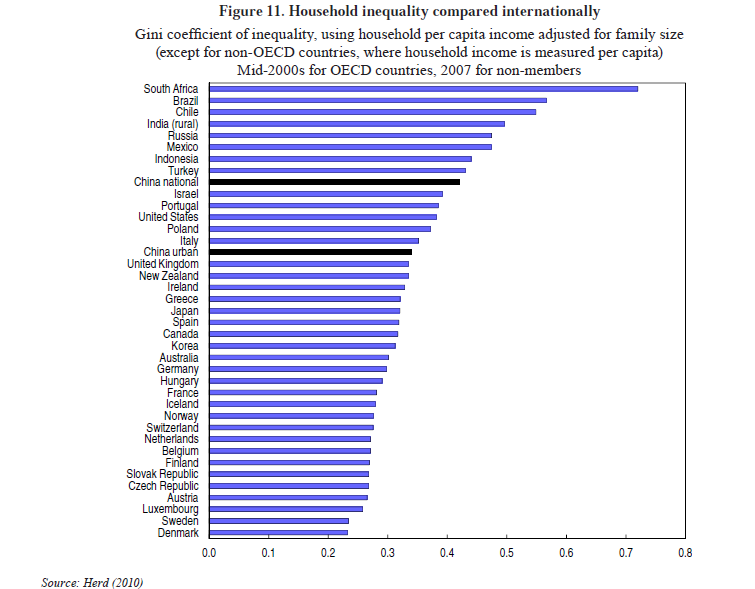
Unlike other emerging countries China’s economic growth does not seem to benefit only a small section of the population. Income inequality as measured by the Gini coefficient is not very high relative to other countries such as Brazil, India and Russia.

china-world-gini-coefficient.png

Source: China’s Emergence as a Market Economy: Achievements and Challenges, OECD contribution to the China Development Forum, 20-21 March 2011, Beijing.

The World’s Best Emerging Market Banks in Latin America 2011

The Global Finance magazine has published the list of Best Banks in Latin America for 2011. The winners were selected based on factors such as growth in assets, profitability, strategic relationships, customer service, competitive pricing, innovative products, etc.

The World’s Best Emerging Market Banks in Latin America 2011

[TABLE=886]

Source: Global Finance

Canadian banking group Bank of NovoScotia’s(BNS) subsidiaries are the winners in five Latin American countries including Costa Rica. Chile’s Banco Santander Chile (SAN) currently has a 3.17% dividend yield. The Bank proposes to payout 60% of its 2010 earnings as dividends to shareholders. Some of the notable winners of large Latin American economies include Itau-Unibanco(ITUB) of Brazil, Banamex of Mexico and Banco Santander Rio of Aregentina. Banamex is the Mexican unit of Citigroup(C).

Disclosure: Long BNS, ITUB

A Review of 11 Brazilian Electric Utility Stocks

Brazilian stocks have been not performed well in recent months. The Bovespa is down 3.5% so far this year compared to a rise of 1.7% for the S&P 500. However Brazil’s economy continues to grow, though at a lower pace than last year. The economy is projected to grow by 5.5% this year.Currently plenty of opportunities abound at attractive prices for long-term and yield-hungry investors. Those looking to gain some exposure to Brazilian equities can consider the fast-growing electric utility sector as this sector benefits strongly from economic growth.

Brazil has the third largest electricity sector in the western hemisphere after the U.S. and Canada.The majority of electricity generated in Brazil comes from hydro-power and the country is a net exporter of electricity. Despite privatization efforts launched in 1996, the bulk of the electricity sector remains under the control of the government. Eletrobras, the state-owned power company is still the dominant player in the market. The Brazilian government also owns almost the entire electricity transmission network. (Source: Energy Information Administration)

Eleven Brazilian utilities trading on the U.S. markets are listed below their current dividend yields and prices:

1. Companhia Energetica de Minas Gerais – CEMIG (CIG)
Current Stock Price: $17.62
Current Dividend Yield: 6.83%
Current value of $10,000 invested five years ago: $20,728
In addition to electricity generation and distribution, Cemig is also engaged in natural gas distribution and telecom services.

2. COPEL – Companhia Paranaense de Energia(ELP)
Current Stock Price: $26.14
Current Dividend Yield: 1.09%
Current value of $10,000 invested five years ago: $31,358
COPEL operates 18 power plants, 17 of which are hydroelectric plants and is a major supplier of power in the state of Parana.

3. CPFL Energia SA (CPL)
Current Stock Price: $79.24
Current Dividend Yield: 7.14%
Current value of $10,000 invested five years ago: $28,238
CPFL Energia served about 6.6 million consumers at the end of 2009.

4.Aes Tiete SA (OTC:AESAY)
Current Stock Price: $13.41
Current Dividend Yield: 9.59%
AES operates owns and operates ten hydro power plants in the state of Sao Paulo.

5. Centrais Eletricas de Santa Catarina SA (OTC:CEDWY)
Current Stock Price: $24.15
Current Dividend Yield: 2.23%
The company operates 12 power plants in the state of Catarina.It is also engaged in the distribution of natural gas and drinking water.

6. CTEEP Companhia de Transmissao de Energia Eletrica Paulista (OTC: CTPTY)
Current Stock Price: $26.44
Current Dividend Yield: Not Available
CTEEP’s principal customers are other electric utilities such as CPFL, Elektro, Bandeirante, Grupo Rede, Duke-Paranapanema, AES Tietê and CESP. And through the National Interconnected System it is linked to Furnas, CEMIG, Eletrosul, Copel, ETEO and Light.

7.Companhia Energetica De Sao Paulo (Cesp) (OTC:CSQSY)
Current Stock Price: $12.97
Current Dividend Yield: 0.46%

8.COPEL – Companhia Paranaense de Energia (OTC:ELPVY)
Current Stock Price: $22.10
Current Dividend Yield: 1.56%

9.Light SA (OTC:LGSXY)
Current Stock Price: $16.49
Current Dividend Yield: 6.39%

10.MPX Energia SA (OTC:MPXEY)
Current Stock Price: $23.90
Current Dividend Yield: Not Available

11.Tractebel Energia SA (OTC: TBLEY)
Current Stock Price: $15.38
Current Dividend Yield: 3.16%

Note: Stock price and dividend data noted above are as of Mar 18, 2011

Data source: S&P and others

Disclosure: No Positions

The World’s Most Ethical Companies 2011

The New York-based think-tank The Ethisphere Institute has published its fifth annual list of the World’s Most Ethical companies. About 3,000 companies from more than 100 countries were evaluated and the winners were selected.

From the think-tank’s site:

The World’s Most Ethical Companies designation recognizes companies that truly go beyond making statements about doing business “ethically” and translate those words into action. WME honorees demonstrate real and sustained ethical leadership within their industries, putting into real business practice the Institute’s credo of “Good. Smart. Business. Profit.”

There is no set number of companies that make the list each year. Rather, the World’s Most Ethical Company designation is awarded to those companies that have leading ethics and compliance programs, particularly as compared to their industry peers.

1) Foreign Companies in The World’s Most Ethical Companies list:

Housing Development Finance Corp (HDB)
Kesko
The Co-Operative Group
Natura Cosmeticos
Solae
The Rezidor Hotel Group
Svenska Cellulosa (SVNCY)
Schneider Electric (SBGSY)
Sompo Japan Insurance
Swiss Re (SWCEY)
Thomson Reuters (TRI)
Becton Dickinson
Royal Phillips (PHG)
Umicore
British Land plc (BTLCY)
Unibail-Rodamco
Hennes & Mauritz
Sonae
Singapore Telecom
Swisscom
Autoridad del Canal de Panama
East Japan Railway Company
Nippon Yusen Kabushi Kaisha
Stora Enso Oyj (SEOAY)
Svenska Cellulosa
Henkel AG(HENKY)

2) U.S. Companies in The World’s Most Ethical Companies list:

Rockwell Collins Inc. (COL)
Juniper Networks (JNPR)
The Aerospace Corporation
Gap (GAP)
Xerox (XRX)
Kimpton Hotels
Texas Instruments (TXN)
International Paper (IP)
Kimpton Hotels
Patagonia
Timberland (TBL)
eBay (EBAY)
Cummins (CMI)
Ford Motor Company (F)
Johnson Controls (JCI)
Dun & Bradstreet (DB)
Noblis
Ecolab (ECL)
JM Huber
Hitachi Data Systems
Adobe Systems (ADBE)
Microsoft (MSFT)
Salesforce.com (CRM)
Symantec Corporation (SYMC)
Teradata Corporation (TDC)
Granite Construction(GVN)
Parsons Corporation
Colgate-Palmolive Company (CL)
General Electric Co. (GE)
Freescale Semiconductor (FCS)
NextEra Energy, Inc.(NEE)
Wisconsin Energy Corporation (WEC)
AECOM Technology Corporation
CH2M Hill
Fluor Corporation (FLR)
Waste Management (WM)
American Express (AXP)
NYSE Euronext (NYX)
The Hartford Financial Services Group (HFG)
General Mills (GIS)
PepsiCo (PEP)
Stonyfield Farm
Wegmans
Whole Food Market (WFMI)
Baptist Health South Florida
Hospital Corporation of America (HCA)
Wyndham Worldwide (WYN)
Caterpillar (CAT)
Deere & Company (DE)
Eaton Corporation(ETN)
Marriott International
Aflac Incorporated (AFL)
Milliken & Company
Wisconsin Physicians Service Insurance Co.
Zappos
Becton Dickinson (BDX)
Jones Lang LaSalle (JLL)
Starbucks Coffee Company (SBUX)
Medicis (MRX)
Best Buy Co. (BBY)
Target (TGT)
Ten Thoand Villages
Manpower (MAN)
Avaya Inc.
Cisco Systems (CSCO)
T-Mobile USA
UPS (UPS)

Disclosure: Long BTLCY, GIS,  NEE, HENKY